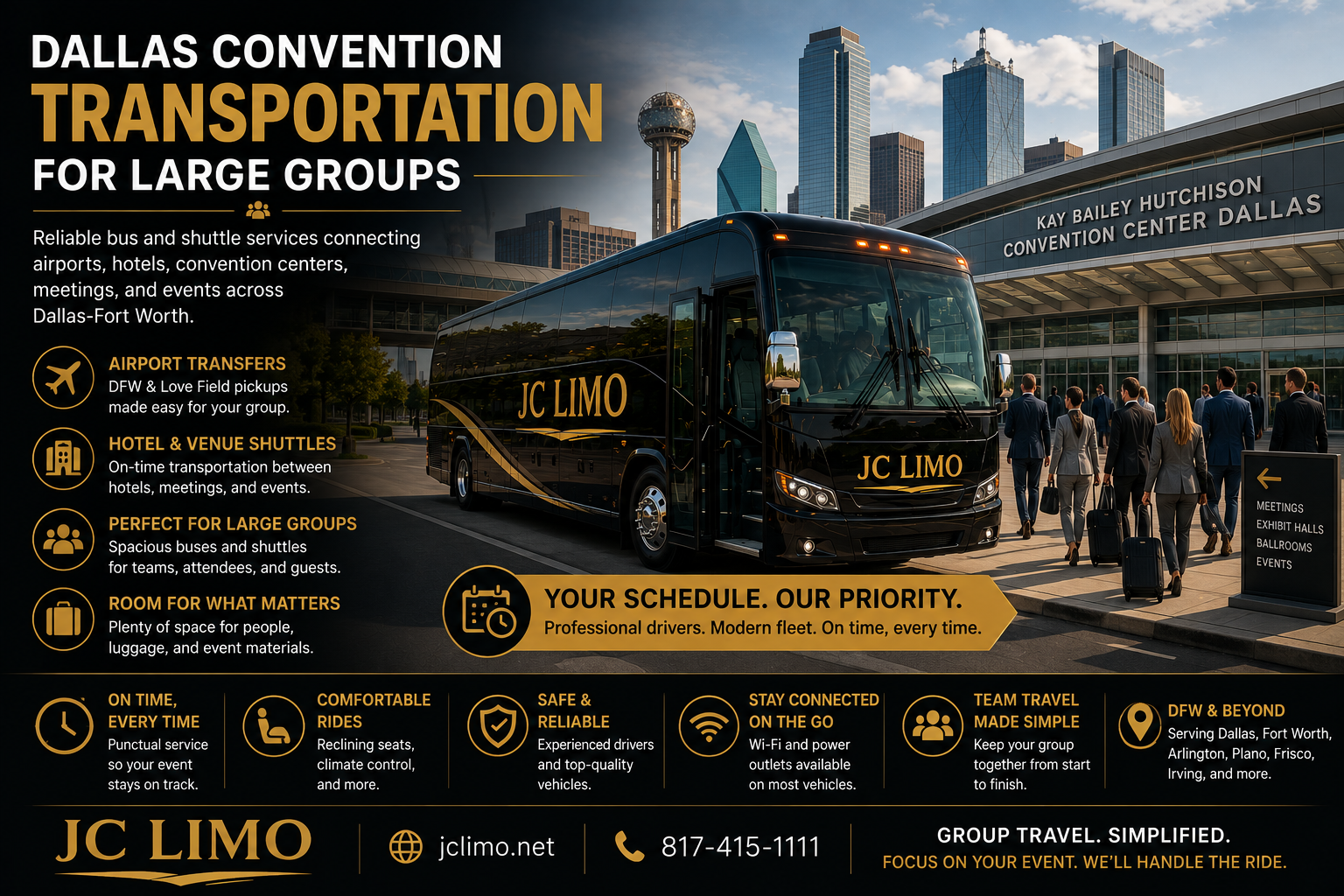
A successful convention trip involves much more than booking flights and registering attendees.
The moment a group arrives in Dallas-Fort Worth, another challenge begins: moving everyone between airports, hotels, convention venues, restaurants, meetings, and evening events without losing valuable time.
For one or two travelers, transportation is relatively easy to arrange. For 20, 40, or 50 people, the situation changes quickly.
Some attendees order rideshares. Others rent cars. A few leave the hotel early. Someone goes to the wrong entrance. Another person gets stuck looking for parking. Before long, a group that traveled to Dallas, Texas together is moving around the city separately.
Private bus and shuttle transportation offers a more organized alternative.
With JC LIMO, companies, associations, exhibitors, professional organizations, and other groups can coordinate transportation around their convention itinerary instead of leaving every attendee to arrange individual rides.
From airport arrival to the final trip back to the hotel, transportation can become part of the event plan rather than a daily problem to solve.
Why Convention Transportation Needs Its Own Plan
Most companies spend considerable time preparing for conventions.
Booth materials are designed.
Meetings are scheduled.
Sales teams prepare presentations.
Hotels and flights are booked.
Client dinners are arranged.
But transportation is sometimes left until much later.
That can create unnecessary complications.
A convention may have a fixed opening time, but your team still needs enough time to leave the hotel, travel through Dallas traffic, arrive at the venue, enter the building, and prepare before attendees arrive.
If employees are traveling separately, everyone may reach the venue at different times.
With centralized group transportation, the company can establish one schedule.
Employees know where to meet and when the bus leaves.
That makes the morning easier to manage and helps the entire team start the day together.
Dallas-Fort Worth Is a Major Convention Destination
Dallas-Fort Worth attracts business events from across the United States and around the world.
The region offers convention facilities, hotels, corporate headquarters, entertainment venues, restaurants, and two major airports.
That makes DFW an excellent location for large professional events.
It also means attendees can travel significant distances during a single trip.
A group may land at Dallas Fort Worth International Airport, stay at a hotel in Dallas, attend a convention during the day, travel to a restaurant for a client dinner, and attend another event elsewhere in North Texas.
The following morning, the entire process begins again.
For visitors unfamiliar with DFW, those distances can be surprising.
Dallas and Fort Worth are part of the same metropolitan region, but that doesn’t mean every destination is only a few minutes away.
Transportation planning needs to account for actual travel times.
Airport-to-Hotel Transportation for Convention Groups
Convention transportation often begins before the convention itself.
Employees, clients, exhibitors, and attendees may arrive through Dallas Fort Worth International Airport or Dallas Love Field.
If several people are arriving around the same time, private airport transportation can help consolidate those trips.
Rather than having each passenger book an individual vehicle, groups can travel together to their hotel.
For larger events, arrivals may be divided into scheduled transportation windows.
For example, a company might have one shuttle for employees arriving around midday and another for attendees arriving later in the afternoon.
The exact strategy depends on flight schedules and group size.
The important point is that airport transportation is planned before everyone lands.
That gives travelers one less thing to figure out after a flight.
Hotel-to-Convention Shuttle Service
One of the most practical uses of private transportation is connecting the group’s hotel with the convention venue.
Instead of employees leaving individually throughout the morning, the company can establish a scheduled departure.
Attendees meet in the hotel lobby or another designated pickup location and board together.
For large groups, multiple departures can be considered when appropriate.
For example, exhibitors who need to arrive early may use an earlier shuttle, while other attendees depart later.
At the end of the day, transportation can return passengers to the hotel or continue to an evening event.
This creates a predictable daily routine.
Once attendees understand the schedule, they don’t have to make new transportation decisions every morning.
Exhibitor Transportation Requires Extra Planning
Exhibitors often operate on a different schedule from general convention attendees.
Teams may need to arrive before the exhibit hall opens.
There may be booth preparation, staff briefings, equipment checks, and other work to complete before visitors arrive.
That makes punctual transportation particularly important.
If the entire exhibition team depends on separate rides, a few delayed employees can create unnecessary pressure.
A private bus or shuttle helps keep the team together.
Everyone receives the same departure time.
The team can even use the ride to review goals, discuss schedules, or prepare for the day.
At the end of a long convention session, employees also know transportation back to the hotel has already been arranged.
Move Clients Without Making Them Plan the Ride
Conventions are often about relationships.
Companies attend to meet prospects, strengthen partnerships, reconnect with customers, and create new business opportunities.
Those conversations don’t always end when the convention floor closes.
There may be client dinners, private presentations, receptions, entertainment, or networking events throughout Dallas-Fort Worth.
If you’re inviting important guests, transportation can become part of the hospitality.
Instead of sending everyone an address and asking them to arrange their own ride, a private shuttle can take the group from the convention venue or hotel directly to the event.
It’s a relatively simple detail, but it creates a more coordinated experience.
Clients can focus on the conversation rather than checking directions or parking information.
Corporate Dinners Are Easier When Everyone Travels Together
Convention schedules frequently continue into the evening.
A team may leave the event and head directly to dinner.
If 30 employees and clients travel separately, the dinner may effectively have 15 or 20 different arrival times.
Some people arrive early.
Others are stuck in traffic.
Someone parks several blocks away.
The reservation begins, but part of the group is missing.
A private bus can make that transition much smoother.
Passengers leave the convention together and travel directly to the restaurant.
The group arrives at roughly the same time, making it easier for the dinner schedule to begin as planned.
Afterward, transportation can return attendees to their hotel or continue to another scheduled destination.
Make Multi-Stop Convention Days Manageable
Convention trips often involve complicated itineraries.
Consider a typical day:
The group leaves the hotel in the morning.
Employees attend the convention.
A smaller team travels to an off-site client meeting.
Everyone reconnects for dinner.
The evening ends at a private networking event.
Finally, the group returns to the hotel.
Trying to coordinate every movement through separate cars can consume a surprising amount of time.
Private transportation allows the itinerary to be planned as a connected sequence.
The group doesn’t need to arrange a new ride every time the location changes.
For busy convention schedules, that consistency can be extremely valuable.
Transportation for Speakers and VIP Guests
Conventions often include speakers, executives, VIP guests, sponsors, and other individuals whose schedules may differ from the general attendee group.
They might need transportation from the airport directly to a hotel, from a hotel to a speaking engagement, or from the convention to a private meeting.
Transportation can be coordinated around these requirements while larger groups use separate buses or shuttles.
The important thing is identifying these different transportation needs early.
Don’t assume every attendee follows the same itinerary.
A good convention transportation plan separates groups according to where they actually need to go.
Reduce the Need for Rental Cars
Visitors often assume they need to rent vehicles when traveling to Texas.
For individual travelers with independent plans, that may make sense.
For employees attending the same convention and following essentially the same schedule, it can create unnecessary duplication.
If 20 employees rent 10 vehicles, the company now has to account for rental arrangements, parking, fuel, tolls, and multiple drivers.
Centralized transportation can reduce the need for so many separate vehicles.
Passengers can travel together between the main destinations while the transportation plan is managed at the group level.
For companies trying to simplify convention logistics, that can be appealing.
Parking Can Steal Time From the Event
Parking isn’t only an expense.
It’s also a time issue.
Imagine 15 vehicles carrying your team to a busy event.
Each driver needs to reach the correct parking area, find a space, walk to the venue, and locate the rest of the group.
Those small delays add up.
With a bus, passengers can follow the planned drop-off arrangement and enter the event together.
They don’t need to remember which garage they used or where the car is parked.
At the end of the event, the group follows the established transportation plan.
This can make arrival and departure significantly easier for attendees.
Keep Your Team Connected
Conventions can be exhausting.
Employees spend the day attending meetings, speaking with customers, walking exhibition floors, and processing huge amounts of information.
Traveling together creates valuable shared time.
On the way to the convention, the team can discuss goals for the day.
Afterward, employees can talk about leads, meetings, competitor activity, and follow-up priorities.
Instead of everyone returning to the hotel alone, the ride becomes an informal team debrief.
For sales and marketing groups, those conversations can be surprisingly useful.
Transportation isn’t only moving employees.
It can also create more time for the team to connect.
Employee Transportation for Large Corporate Events
Some conventions and conferences involve hundreds of employees.
In those situations, transportation becomes a larger operational project.
Companies may need several vehicles, different departure windows, multiple hotels, or transportation for separate departments.
The earlier this is planned, the better.
Begin by identifying how many people are staying at each hotel and when different teams need to arrive.
Then determine whether all attendees can follow the same schedule or whether separate groups are necessary.
A structured transportation plan can help reduce confusion for large corporate events.
Instead of every employee receiving general instructions to “get to the convention,” they receive specific information about their shuttle.
Don’t Forget Equipment and Event Materials
Convention groups don’t always travel light.
Exhibitors may have presentation materials, promotional items, signage, product samples, technology, or other equipment.
Airport transfers may also involve significant passenger luggage.
These requirements should be discussed when choosing transportation.
A vehicle that fits the passenger count may not necessarily fit everything the passengers are carrying.
When planning JC LIMO transportation, provide information about luggage and equipment in advance.
This helps ensure the transportation arrangement is appropriate for the actual trip.
Choosing the Right Bus or Shuttle
The right vehicle depends on several factors.
Passenger count is important, but it isn’t the only consideration.
Think about luggage, equipment, trip length, number of destinations, pickup locations, and schedule.
A smaller group attending a client dinner may need a different transportation solution from a large team traveling between a hotel and convention center.
Likewise, a full-size bus may make sense for larger groups that want to travel together.
The goal is to match transportation to the itinerary rather than forcing the itinerary around the vehicle.
Create a Transportation Schedule Attendees Can Understand
A complicated transportation plan can create as many problems as having no plan at all.
Keep instructions simple.
Tell passengers exactly where to meet and when.
For example:
7:15 AM — Meet in hotel lobby
7:30 AM — Bus departure
8:00 AM — Expected convention arrival
5:15 PM — Meet for evening transportation
5:30 PM — Departure for client dinner
This is much clearer than simply telling employees transportation will be available “in the morning.”
For larger events, share the schedule before attendees arrive in Dallas.
That allows everyone to plan accordingly.
Build Extra Time Into the Schedule
Convention days often operate on tight timelines, but transportation shouldn’t be planned down to the last possible minute.
Traffic can change.
Boarding takes time.
Large venues may have specific access points.
Passengers still need time to enter the building and reach the correct hall or meeting room.
If your team needs to be ready at 9:00 a.m., don’t schedule transportation to arrive at exactly 9:00.
Work backward from when attendees actually need to be in position.
A little extra time in the transportation schedule can protect the rest of the day.
Plan the Return Trip Before the Event Begins
After a long convention day, the last thing attendees want is another transportation problem.
Make the return plan clear in advance.
If the group is returning directly to the hotel, establish a meeting point and departure time.
If some attendees are going to dinner while others return to the hotel, communicate which shuttle serves each group.
For multi-day events, consistency helps.
Using similar pickup locations and schedules each day makes the system easier for passengers to understand.
Transportation for the Final Airport Departure
The convention isn’t finished from a logistics perspective until everyone reaches the airport.
Departure day can be particularly challenging because attendees may have different flight times.
Transportation may need to be organized around departure windows.
Travelers with morning flights leave earlier, while afternoon passengers may have another transfer later.
Allow enough time for the drive, unloading, airport check-in, security, and terminal navigation.
For groups leaving from hotels in Dallas, Fort Worth, or other DFW communities, travel times should be considered carefully.
The final airport transfer deserves the same planning as the arrival.
Why Local Dallas-Fort Worth Knowledge Matters
Convention transportation often crosses multiple areas of North Texas.
A company may stay in Irving, attend meetings in Dallas, host dinner in Fort Worth, and fly through DFW International Airport.
Understanding the geography of the region helps create a more realistic schedule.
Dallas-Fort Worth isn’t one compact downtown area.
Travel times can vary significantly depending on destination and time of day.
Planning transportation around the actual DFW environment helps reduce unnecessary scheduling pressure.
Let JC LIMO Keep Your Convention Moving
A convention should be about business opportunities, networking, learning, customers, and relationships.
Your team shouldn’t spend half the trip trying to coordinate rides.
JC LIMO provides private bus and shuttle transportation for convention and conference groups throughout Dallas, Texas, Fort Worth, and surrounding North Texas communities.
Transportation can support airport arrivals, hotel transfers, convention schedules, trade shows, corporate dinners, private meetings, networking events, and return airport trips.
Whether you’re bringing a small team or coordinating a much larger group, centralized transportation can help create a more organized experience.
Spend More Time at the Event, Not Getting There
Great convention planning happens behind the scenes.
When transportation works properly, attendees don’t have to think much about it.
They know where to meet.
They know when the bus leaves.
They know how they’re getting to dinner.
And they know how they’re returning to the hotel.
That simplicity gives employees more time and energy to focus on why they came to Dallas in the first place.

Related posts
 16Aug, 26
 Group Transportation for Dallas Events Made Easy – Copy – Copy
 16Aug, 26
 How Dallas Businesses Improve Travel With Shuttle Services – Copy
 16Aug, 26