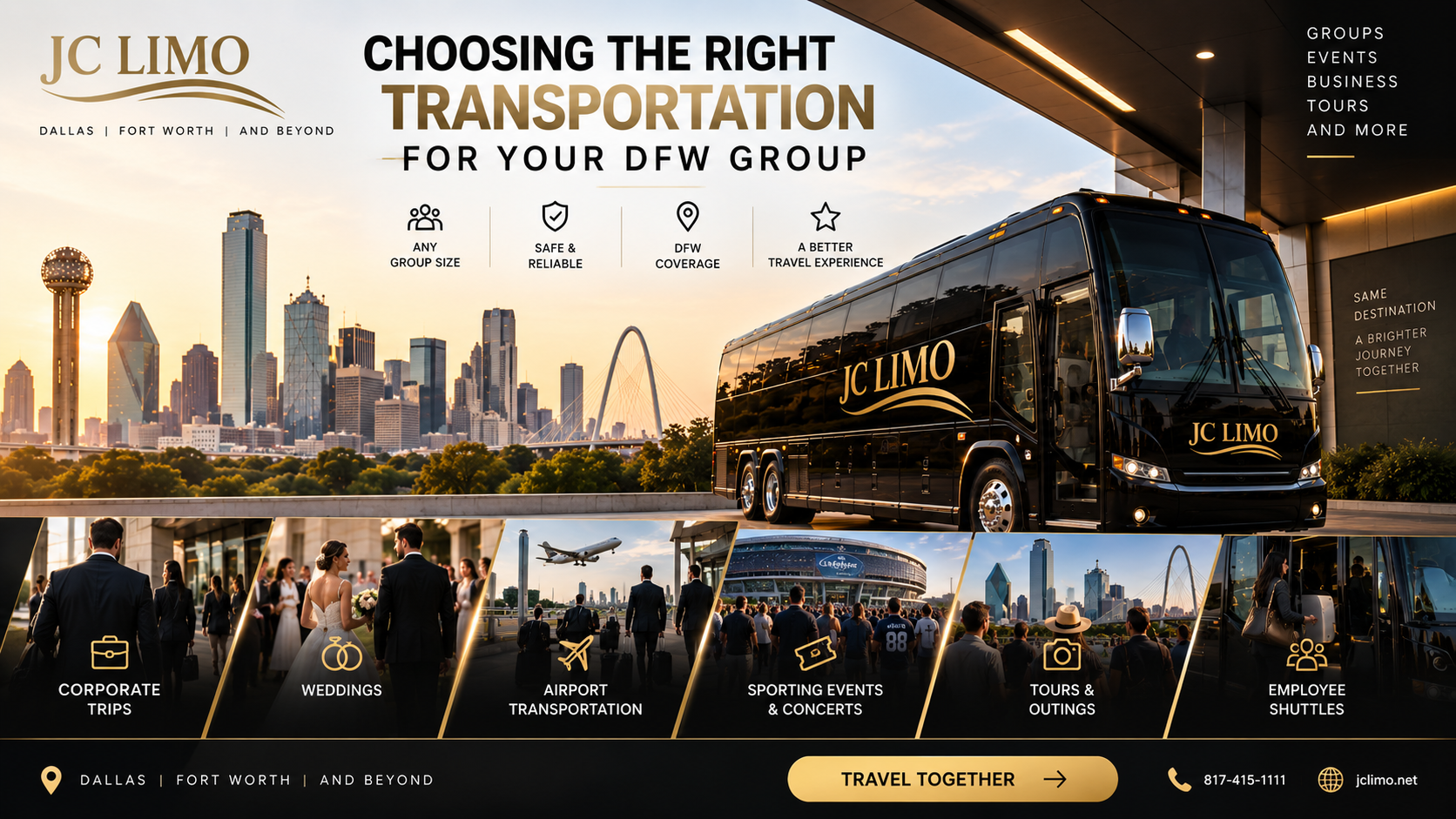
Planning transportation for a group sounds easy until you start asking the important questions.
How many people are traveling? Where are they going? Will they have luggage? Is the trip one-way or round-trip? Are there multiple stops? Does everyone need to travel together? Will transportation be needed for several hours or several days?
For groups traveling throughout Dallas–Fort Worth, Texas, answering these questions before booking transportation can make a significant difference.
A corporate team traveling between meetings has different needs from wedding guests traveling between a hotel and reception venue. A large group heading to an event may require a different vehicle from a smaller team visiting several locations across DFW.
The right transportation is not simply about finding a bus.
It is about matching the bus or shuttle service to the group, itinerary, and purpose of the trip.
With JC LIMO, groups can organize transportation throughout Dallas, Fort Worth, and surrounding North Texas areas based on the way they actually plan to travel.
Start With the Number of Passengers
The first question is the most obvious:
How many people are traveling?
Passenger count helps determine which type of transportation makes sense.
For a small group, dividing passengers between several cars may initially seem manageable. But as the group grows, the number of vehicles, drivers, parking spaces, and arrival times grows too.
That is when professional group transportation becomes increasingly useful.
For example, JC LIMO offers options including a 31-passenger minibus and a 56-passenger motor coach.
A medium-sized group may find that a minibus provides the right balance of capacity and convenience.
A significantly larger group may benefit from keeping more passengers together in a motor coach.
The goal should be to choose a vehicle that comfortably supports the passenger count while fitting the overall itinerary.
Consider More Than the Number of Seats
Passenger count is important, but it should not be the only factor.
Imagine two groups of 30 people.
The first is a corporate team traveling from a Dallas hotel to a nearby conference.
The second is a group arriving at DFW International Airport with suitcases and other luggage.
Both groups have the same number of passengers.
Their transportation requirements are different.
Luggage takes space.
Trip duration matters.
The number of stops matters.
The type of event matters.
Before selecting a Dallas bus transportation option, organizers should think about everything passengers will bring and what they will need during the journey.
Think About the Full Itinerary
One of the biggest transportation planning mistakes is focusing only on the first trip.
Suppose a corporate group needs transportation from its hotel to a meeting in the morning.
That sounds simple.
But what happens after the meeting?
Does the group return to the hotel?
Go to lunch?
Travel to another office?
Attend an evening event?
Head to Fort Worth?
When the full itinerary is considered from the beginning, transportation can be planned around the entire day rather than one journey at a time.
This can make multi-stop travel much easier.
Instead of constantly arranging new rides, a private JC LIMO bus can become part of the schedule.
When a Minibus Makes Sense
A minibus can be a practical transportation option for medium-sized groups.
JC LIMO’s 31-passenger minibus can work for many types of trips throughout Dallas–Fort Worth.
For example, it may be suitable for:
Corporate teams
Private outings
Wedding groups
Conference attendees
Hotel transportation
Local tours
Employee transportation
Airport group transfers
Business dinners
Special events
The advantage is simple: passengers can stay together without coordinating numerous individual vehicles.
For itineraries involving several stops, keeping the group together can also make departure times easier to manage.
When a Larger Motor Coach Makes Sense
Larger groups naturally require greater capacity.
A 56-passenger motor coach can be a better fit when an organization needs to transport a significant number of people together.
This can include large corporate groups, conventions, schools, organizations, wedding guests, tours, conferences, and other major events.
Instead of dividing passengers between multiple smaller vehicles, organizers may be able to consolidate more of the group into one transportation plan.
This simplifies communication.
One pickup point.
One departure time.
One destination.
For organizers responsible for large groups, reducing the number of moving pieces can be extremely valuable.
When Shuttle Transportation Is the Better Choice
Not every transportation need requires passengers to travel together once and return together once.
Sometimes people need to move repeatedly between two locations.
That is where shuttle transportation can become useful.
Imagine a corporate event where attendees are staying at a nearby hotel.
Rather than expecting everyone to arrange transportation individually, scheduled shuttles can connect the hotel and event venue.
The same approach can work for:
Weddings
Conferences
Employee transportation
Large private events
Hotel transportation
Remote parking arrangements
Corporate programs
A shuttle creates a transportation system rather than a single trip.
For events with different arrival or departure times, this can provide additional flexibility.
Corporate Transportation Should Match the Schedule
Business travel often includes fixed times and multiple destinations.
A group might start at a hotel in downtown Dallas, travel to an office in Plano, continue to another meeting, and finish with dinner before returning to the hotel.
Choosing transportation for this type of trip requires thinking about timing and routing.
A private bus can keep the team together throughout the day.
This means employees do not need to repeatedly arrange rides between meetings.
It also gives the organizer a clearer understanding of how the group will move from one destination to the next.
For companies hosting visitors, clients, or executives, planned transportation can contribute to a more professional experience.
Wedding Transportation Requires a Different Approach
Weddings create unique transportation needs.
Guests may be staying at one or several hotels.
The ceremony and reception may take place at different locations.
Some attendees may be visiting Dallas–Fort Worth for the first time.
Transportation should therefore be easy for guests to understand.
A wedding shuttle can provide scheduled pickups from designated locations and transport guests to the venue.
Return transportation can also be planned in advance.
When selecting a vehicle, couples and planners should consider how many guests will use the shuttle rather than simply looking at the total wedding attendance.
Not every guest may require transportation.
Knowing the expected passenger count helps determine the right vehicle and schedule.
Airport Groups Need to Think About Luggage
Airport transportation presents another set of considerations.
A bus carrying 30 passengers to a local dinner has different requirements from a bus carrying 30 passengers with suitcases.
When arranging group airport transportation in Dallas, organizers should consider luggage from the beginning.
They should also think about the group’s arrival schedule.
Are passengers arriving on the same flight?
Are they arriving within a similar time window?
Will everyone travel to the same hotel?
Does the group have another destination immediately after arrival?
The answers can determine how airport transportation should be structured.
Multi-Stop Trips Need Flexible Planning
Dallas–Fort Worth groups often travel beyond one city.
A single itinerary might include Dallas, Fort Worth, Arlington, Irving, Grapevine, Plano, or Frisco.
When several stops are involved, transportation becomes a major part of the schedule.
A private bus can help connect those destinations while keeping passengers together.
This is useful for corporate roadshows, property tours, sightseeing trips, family outings, business visits, and other multi-location journeys.
Instead of each passenger navigating the Metroplex independently, everyone follows the same planned route.
Consider How Long the Group Will Be Traveling
Trip duration also matters.
Transportation for a quick hotel-to-venue transfer is different from transportation for an entire day of activities.
For longer trips, organizers should think about passenger comfort and how much time the group will spend on the road.
A DFW itinerary can involve significant travel time, especially when destinations are spread across different parts of North Texas.
Planning realistic travel windows helps prevent the schedule from feeling rushed.
It is better to understand transportation requirements before finalizing the itinerary than to discover later that the schedule does not leave enough time between destinations.
Event Transportation Should Account for Traffic
Concerts, sporting events, festivals, conventions, and other major activities can attract large crowds.
That can affect traffic and parking around venues.
If 40 people are attending an event together, having them travel in 15 or 20 separate vehicles adds another layer of complexity.
A private group bus can reduce the number of vehicles that need to reach the destination.
It also gives the group a shared transportation plan for the return journey.
When planning event transportation, organizers should build appropriate time into the schedule rather than assuming normal driving conditions.
Do You Need One-Way or Round-Trip Transportation?
It sounds like a basic question, but return transportation is easy to overlook.
A group may have a clear plan for reaching an event without deciding how everyone will leave.
That can lead to last-minute transportation requests at the end of the night.
Planning both directions creates a better experience.
For example:
Hotel → Event → Hotel
Airport → Hotel → Airport
Office → Conference → Dinner → Hotel
Hotel → Wedding → Reception → Hotel
When the entire transportation journey is planned, passengers know what to expect.
Good Transportation Planning Starts Early
Waiting until the last minute can limit transportation options and create unnecessary pressure.
As soon as the basic itinerary is available, organizers should begin thinking about transportation.
Useful information to gather includes:
- Number of passengers
- Pickup location
- Destination
- Number of stops
- Travel dates
- Desired departure times
- Return transportation
- Luggage requirements
- Event start times
- Hotel information
- Special itinerary requirements
The more accurate the information, the easier it becomes to select an appropriate transportation solution.
One Transportation Solution Does Not Fit Every Group
There is no single vehicle or transportation schedule that works for every Dallas–Fort Worth group.
That is why understanding the trip is so important.
A 25-person corporate team may benefit from a minibus.
A larger event may require a motor coach.
A wedding may work best with scheduled shuttles.
A multi-stop corporate itinerary may require transportation throughout the day.
An airport group needs to consider luggage and arrival schedules.
The best transportation solution is the one designed around the actual journey.
Find the Right DFW Transportation With JC LIMO
Group travel becomes much easier when transportation fits the itinerary instead of forcing the itinerary to fit the transportation.
Whether you are organizing a corporate trip, wedding, conference, airport transfer, tour, private outing, employee shuttle, or special event, understanding your group’s needs is the first step.
JC LIMO provides bus and shuttle transportation across Dallas, Fort Worth, and the wider DFW area, helping groups choose transportation based on passenger count, schedule, destinations, and trip requirements.

Related posts
 25Oct, 26
Limo Golf Outing & Country Club Transportation – Copy
 25Oct, 26
Limo Golf Outing & Country Club Transportation – Copy
 25Oct, 26
