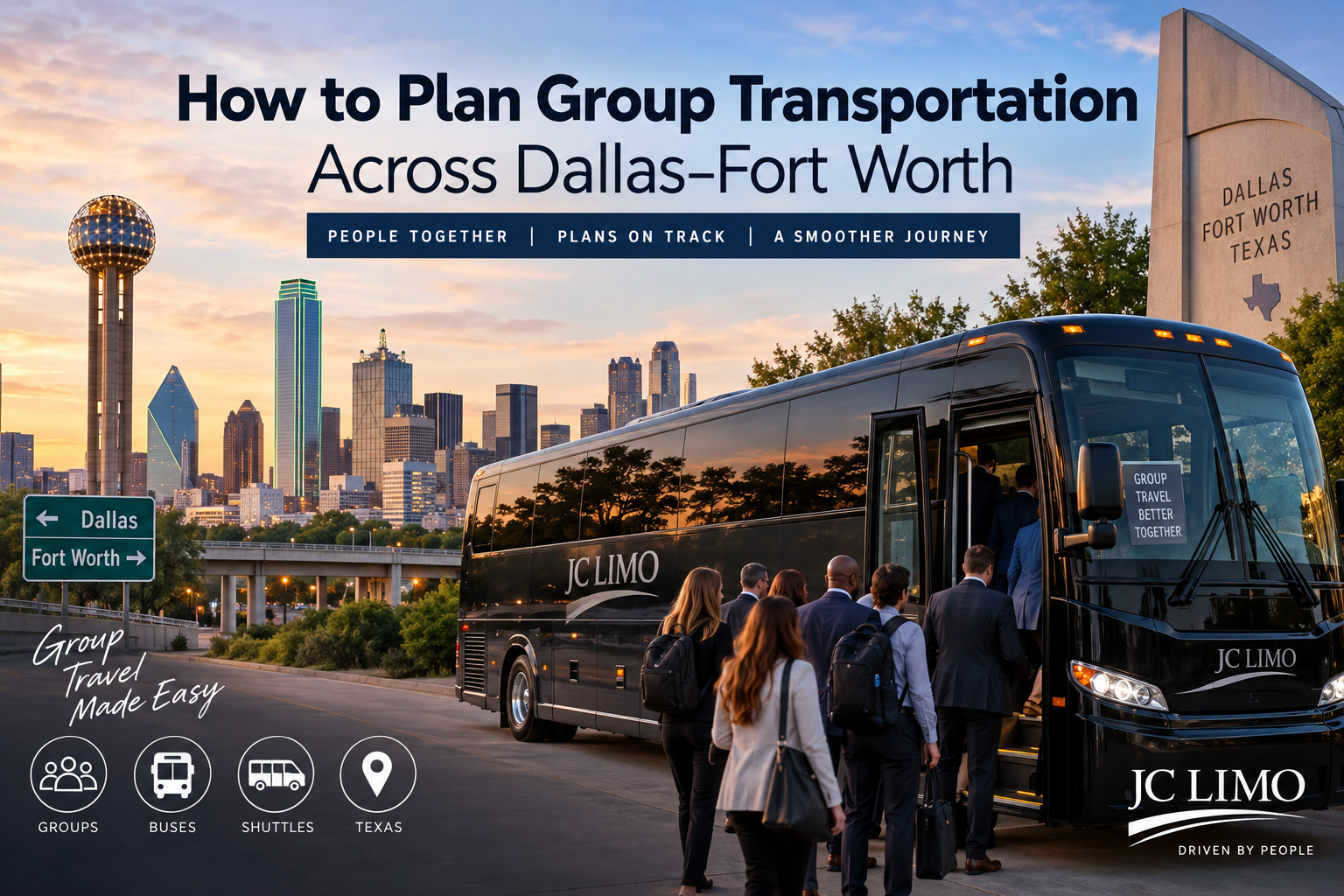
Moving one person around Dallas–Fort Worth is usually simple. Moving 30, 40, or 50 people on the same schedule is a completely different challenge.
One person is running late. Someone else went to the wrong entrance. Three people decided to drive themselves. Another group is waiting at a hotel while everyone assumes somebody else arranged their ride.
Before long, transportation becomes the part of the day everyone is talking about—and not for the right reasons.
That is why successful group travel requires more than simply finding enough vehicles. It requires planning.
Whether you are organizing a company event, private celebration, conference, school activity, church trip, airport transfer, employee program, or another group outing, having a clear transportation plan can make the entire experience easier.
For groups traveling around Dallas, Fort Worth, and the wider North Texas area, professional bus and shuttle transportation provides a practical way to keep people together and schedules under control.
At JC LIMO, group transportation is built around that idea: make the journey organized so passengers can focus on where they are going instead of worrying about how they will get there.
Why Group Transportation Requires More Planning in DFW
Dallas–Fort Worth is enormous.
A group may stay at a hotel near DFW Airport, attend a morning meeting in Irving, have lunch in downtown Dallas, and finish the evening at an event in Arlington or Fort Worth.
On a map, the itinerary may look straightforward.
In reality, every additional location creates another transportation variable.
There is traffic to consider. Pickup locations need to be clear. Parking may be limited. Large venues may have specific loading areas. Groups need enough time to board. And if everyone is traveling separately, one delayed vehicle can affect the entire schedule.
This is why group transportation in Dallas, Texas should be treated as part of the event plan—not something added at the last minute.
A dedicated bus or shuttle creates one transportation system for the group rather than asking every passenger to solve the journey individually.
Start With the Group, Not the Vehicle
One of the easiest mistakes when arranging transportation is starting with the question:
“What bus should we book?”
A better question is:
“What does our group actually need?”
Start with the basics.
How many passengers are traveling?
Where are they starting?
Where are they going?
Will everyone arrive at the pickup location at the same time?
How much luggage or equipment will they have?
Are there multiple stops?
Will transportation be needed for one trip, an entire day, or on a recurring schedule?
The answers help determine what type of group transportation makes sense.
For example, a business transporting employees between a parking area and workplace has very different requirements from a group of wedding guests moving between a hotel, ceremony, and reception.
Both may use a shuttle, but the schedules and logistics are completely different.
Transportation works better when the service is designed around the actual movement of the passengers.
Choose a Bus That Fits the Group
Once you understand the itinerary, you can think about capacity.
JC LIMO provides group transportation options that include 31-passenger minibuses and 56-passenger motor coaches, allowing transportation to be matched more closely to different group sizes.
The goal is not simply to find the biggest vehicle available.
It is to find an option that makes sense for the passenger count, route, luggage requirements, duration, and type of trip.
A smaller group attending a corporate dinner, for example, may not require the same transportation setup as 50 conference attendees traveling from a hotel to a convention venue.
Likewise, a group taking a longer trip across Texas may place more importance on space and comfort than passengers making a short transfer.
Thinking about these details early helps avoid unnecessary complications later.
Why One Bus Can Be Easier Than Multiple Cars
Imagine you have 45 people traveling to the same event.
One option is asking everyone to drive.
That sounds flexible until the messages start:
“Where should I park?”
“Which entrance are we using?”
“I’m stuck in traffic.”
“I can’t find the group.”
“Can someone send me the address again?”
Another option is coordinating multiple rideshare vehicles. That can work for very small groups, but the larger the group becomes, the more difficult it is to keep everyone synchronized.
A dedicated bus transportation service changes the structure.
Instead of managing dozens of individual journeys, the organizer manages one transportation plan.
Passengers have a defined pickup point.
The group leaves together.
The route is planned.
The arrival is coordinated.
And when the event finishes, everyone knows where the transportation is waiting.
That simplicity can be especially valuable when moving groups around Dallas and Fort Worth.
Build Extra Time Into the Dallas–Fort Worth Schedule
A transportation itinerary should never be based only on the driving time shown on a map.
Real group travel takes longer.
People need time to find the pickup location, load luggage, board the vehicle, settle into their seats, and occasionally wait for another passenger.
Then there is traffic.
Dallas–Fort Worth traffic can change quickly depending on the time of day, construction, weather, concerts, games, conventions, and other major events.
That means a 30-minute route should not automatically become a 30-minute transportation window.
Professional planning should consider the entire process from passenger gathering to final arrival.
A small time buffer can make the difference between arriving calmly and watching everyone rush through the doors five minutes late.
Make Pickup Points Obvious
A good group transportation plan is easy to understand.
Passengers should not have to interpret vague instructions like:
“Meet outside the hotel.”
Which side?
The lobby entrance?
The conference entrance?
The parking lot?
The street?
Large hotels, stadiums, office campuses, airports, and event venues can have several entrances.
Instead, provide passengers with one specific pickup location.
For example:
“Meet at the hotel’s main lobby entrance near the valet area.”
That single sentence can prevent ten phone calls.
For larger groups, it can also help to appoint one group coordinator who communicates directly with the transportation provider.
When everyone knows where to go and who to contact, the boarding process becomes much smoother.
Use Shuttles When Passengers Need Repeated Transportation
Not every transportation requirement is a single journey.
Sometimes people need to move repeatedly throughout the day.
That is where shuttle services become particularly useful.
A company may need employees transported between an off-site parking area and an office.
A conference may require continuous transportation between hotels and the venue.
A construction project may need workers moved according to scheduled shifts.
A wedding may need guests transferred between hotels, the ceremony, and the reception.
Instead of treating each journey as a separate trip, a scheduled shuttle creates a transportation loop.
Passengers understand when and where the shuttle operates, while organizers have a structured system for managing movement.
For organizations with recurring transportation needs in Dallas, Fort Worth, Plano, Frisco, Irving, Arlington, and surrounding Texas communities, this can be much easier to manage than arranging individual transportation every day.
Multi-Stop Transportation Needs a Clear Itinerary
Some group trips are simple:
Hotel → Event → Hotel.
Others look more like:
Hotel → Breakfast → Meeting → Lunch → Site Visit → Dinner → Hotel.
Once multiple stops are involved, timing becomes even more important.
Each stop needs a planned arrival time, departure time, loading location, and realistic allowance for passengers to return to the bus.
This is common for corporate roadshows, property tours, business visits, sightseeing groups, private events, and other full-day itineraries.
With JC LIMO transportation, multi-stop travel can be organized around one coordinated itinerary rather than asking passengers to arrange separate rides between every location.
That keeps the day moving and reduces the chances of losing people between stops.
Think About the Passenger Experience
Transportation is functional, but it is also part of the experience.
Consider a company bringing clients into Dallas for an important meeting.
Their impression of the day does not begin when they walk into the conference room.
It begins when they leave the airport or hotel.
The same applies to wedding guests, employees, students, event attendees, and private groups.
A comfortable, organized ride sets the tone.
Passengers can talk, relax, review plans, or simply enjoy the journey without thinking about navigation and parking.
For longer trips across Texas, the value of traveling together becomes even more noticeable.
Instead of arriving tired from separate drives, the group shares the journey.
Group Transportation Can Simplify Event Parking
Parking is often one of the most underestimated parts of event planning.
A venue may have enough room for the event itself but limited parking for dozens of additional cars.
Downtown locations can create another problem because guests may have to search for garages or walk several blocks.
A bus or shuttle service can reduce the number of individual vehicles arriving at the destination.
Guests can park at a designated location, meet at a hotel, or gather at another convenient pickup point before traveling together.
This is particularly useful for conferences, corporate events, weddings, concerts, sports outings, and private celebrations.
Instead of sending every passenger parking instructions, organizers can give them one simple instruction:
Meet the shuttle.
Airport Groups Need Coordination Before Landing
Airport transportation becomes more complicated when a group is arriving on several flights.
Some passengers may land at Dallas/Fort Worth International Airport, while others arrive at Dallas Love Field.
Even passengers on the same flight may take different amounts of time to collect luggage.
The solution is not simply sending a bus and hoping everyone finds it.
A group airport plan should consider arrival times, terminals, baggage collection, meeting points, and how long the vehicle should wait before departure.
When several flights are involved, organizers may also choose to group passengers into transportation windows.
For example, rather than arranging transportation every time one person lands, travelers arriving within a similar period can meet before taking the shuttle together.
It is a small planning decision that can make a complicated arrival day much easier.
Corporate Groups Benefit From Consistency
Business transportation has another requirement: professionalism.
Employees, executives, partners, and clients may be traveling according to tight schedules.
Meetings cannot always be moved because transportation was late or somebody could not find parking.
A structured transportation program provides more predictability.
That can include airport transfers, employee shuttles, conference transportation, corporate events, roadshows, office transfers, and recurring routes.
JC LIMO also operates with 24/7 dispatch, which is particularly useful when transportation schedules extend beyond normal office hours.
For travel managers and event organizers, having one transportation provider coordinating the journey can also reduce the number of moving parts they need to manage.
Local Knowledge Matters in North Texas
GPS is useful.
Local experience is better.
Transportation across the Dallas–Fort Worth Metroplex involves more than following the shortest route.
The fastest route on a quiet Sunday afternoon may be very different during weekday rush hour.
An event at a stadium can completely change traffic patterns in Arlington.
A convention can create congestion around downtown hotels.
Airport traffic may require extra planning.
Construction can turn a familiar route into a slow one.
That is why local knowledge matters when planning Dallas and Fort Worth transportation.
The goal is not simply to know where the destination is.
It is to understand how the group can realistically get there on time.
Communication Makes Group Travel Easier
The best transportation plans are often the simplest ones.
Before travel day, passengers should receive the essential information:
- Pickup location
- Pickup time
- Destination
- Return schedule
- Group coordinator contact information
- Any luggage or boarding instructions
There is no need to send everyone a complicated transportation document.
People mainly want to know two things:
Where do I need to be?
When do I need to be there?
Answer those clearly, and much of the confusion disappears.
When Should You Book Group Transportation?
Earlier is usually better, especially when traveling during busy periods.
Large events, conventions, wedding weekends, holidays, school activities, sports events, and major Dallas–Fort Worth programs can increase demand for buses and shuttles.
Booking earlier also gives organizers more time to finalize routes and communicate transportation information to passengers.
If your itinerary is still changing, that does not mean you need to wait until every detail is perfect.
Start with what you know:
Your approximate group size, date, main pickup area, destination, and expected schedule.
The transportation plan can then become more detailed as the event approaches.
Transportation Should Make the Day Easier
The best group transportation is almost invisible.
Nobody spends the day talking about parking.
Nobody is calling the organizer asking where to go.
Nobody misses the first part of the event because their ride arrived late.
People simply meet, board, travel, and arrive.
That is the goal.
Whether you are moving a small team, dozens of event guests, employees on a recurring schedule, or a large group traveling across North Texas, professional transportation gives the journey structure.
With JC LIMO, groups can arrange buses, shuttles, charter transportation, airport transfers, multi-stop travel, and other transportation services throughout Dallas, Fort Worth, and surrounding Texas communities.
Because when dozens of people need to be in the same place at the same time, transportation should not be left to chance.

Related posts
 13Oct, 26
Dallas Group Transportation With Luggage and Equipment
 13Oct, 26
Dallas Group Transportation With Multiple Drop-Offs
 13Oct, 26
- October 13, 2026
- 0
- 10
