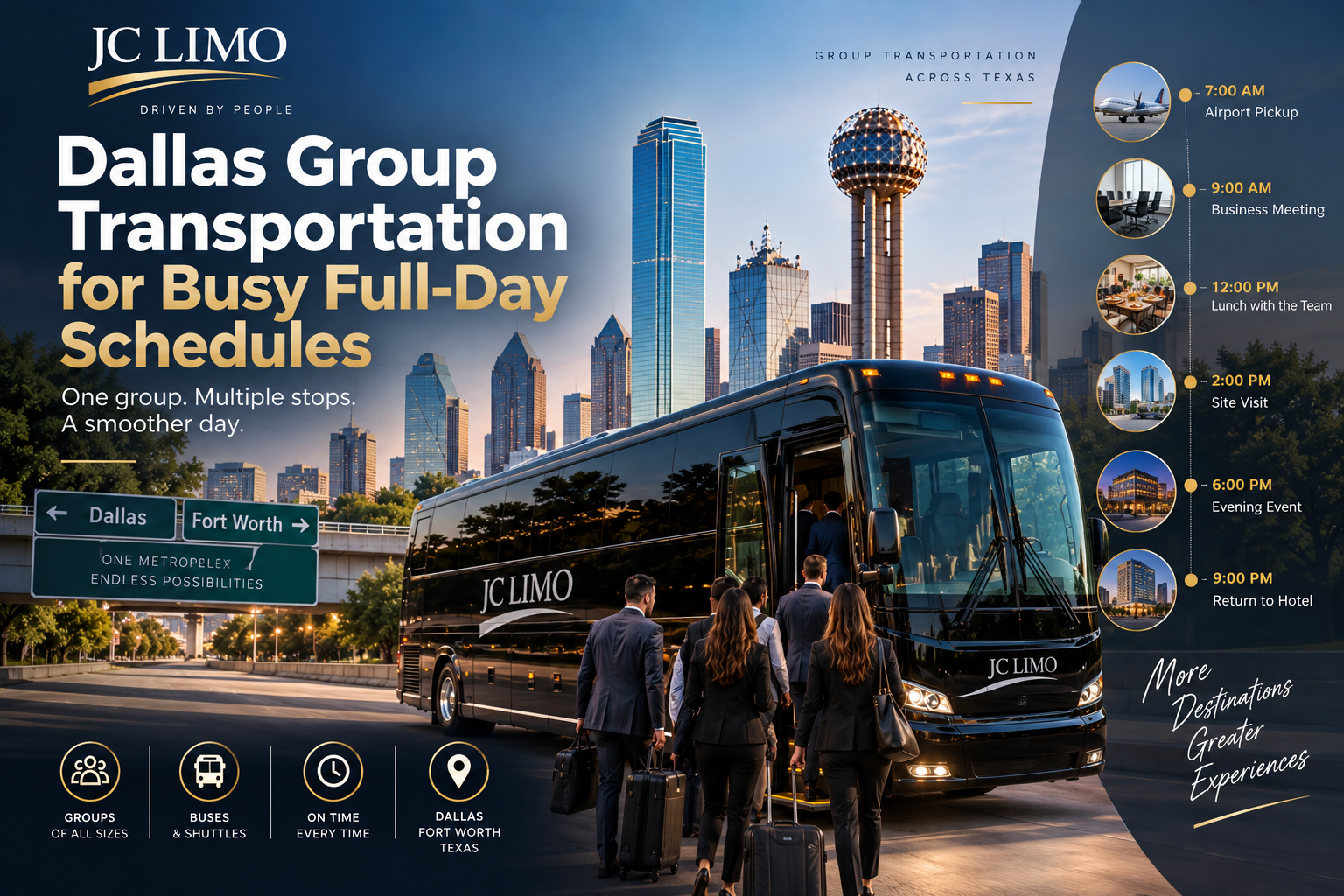
A busy day in Dallas can involve much more than getting from one place to another.
Your group might start with an early airport pickup, travel to a hotel, attend a morning meeting, head across town for lunch, visit another location in the afternoon, and finish the day at a dinner or special event.
On paper, the schedule looks organized.
In reality, transportation can quickly become the part that throws everything off.
One late departure affects the next meeting. A passenger takes a rideshare to the wrong location. Someone cannot find parking. Another person stays behind because they did not know the group had already left.
When several destinations are involved, transportation needs to become part of the schedule itself.
For businesses, event planners, families, organizations, schools, and other groups traveling around Dallas, Fort Worth, and North Texas, professional bus and shuttle transportation can help turn a complicated itinerary into one connected journey.
That is exactly where JC LIMO comes in.
Instead of coordinating dozens of separate trips throughout the day, groups can travel with one transportation plan built around their schedule.
A Full Day of Travel Is Different From a Single Transfer
There is a major difference between booking transportation from Point A to Point B and planning transportation for an entire day.
A simple transfer might involve:
Hotel → Venue.
A full-day itinerary could look like:
Hotel → Meeting → Lunch → Site Visit → Event → Dinner → Hotel.
Every additional stop creates another opportunity for delays.
The challenge is not simply driving between destinations. The challenge is keeping the entire group moving according to the same timeline.
That is why full-day group transportation in Dallas should be planned as one complete journey.
When transportation is considered early, organizers can build realistic departure times, pickup locations, boarding periods, and travel buffers into the schedule.
Dallas–Fort Worth Can Turn a Short Schedule Into a Long Day
Dallas–Fort Worth covers a large geographic area.
A group can easily travel between Dallas, Fort Worth, Arlington, Irving, Plano, Frisco, Grapevine, and other North Texas communities during the same day.
Distances that appear manageable on a map may take longer during peak traffic periods.
This becomes especially important when groups have appointments at specific times.
Imagine a corporate group finishing a meeting in downtown Dallas at 3:00 PM and needing to attend another event across the Metroplex shortly afterward.
The organizer cannot simply look at the estimated drive time.
Passengers need to leave the meeting.
They need to walk to the vehicle.
Everyone needs to board.
The bus needs to leave the pickup area.
Then actual traffic conditions come into play.
Good transportation planning considers all of those steps.
Start With the Entire Day, Not Individual Trips
One of the best ways to plan full-day transportation is to look at the complete itinerary before booking individual rides.
Write down every destination in order.
For example:
7:30 AM — Hotel pickup
8:15 AM — Corporate office
11:30 AM — Depart for lunch
1:00 PM — Client meeting
3:30 PM — Site visit
6:00 PM — Dinner
8:30 PM — Return to hotel
Once the schedule is visible, it becomes easier to identify where transportation is needed and where extra time should be added.
This approach is particularly helpful for groups because it creates one transportation timeline rather than several disconnected journeys.
With JC LIMO, the itinerary can be structured around the group’s movements throughout Dallas–Fort Worth.
Corporate Roadshows Need Transportation That Follows the Agenda
Corporate roadshows are a good example of why transportation planning matters.
Executives, investors, sales teams, clients, or business partners may have several meetings scheduled across Dallas in a single day.
These meetings often have fixed start times.
Arriving 20 minutes late may affect more than convenience. It can disrupt the entire business agenda.
If everyone travels independently, organizers have less control over arrival times.
One person may get stuck looking for parking.
Another may choose a different route.
Someone else may enter the wrong building.
A dedicated JC LIMO bus or shuttle allows the group to move between appointments together.
When one meeting finishes, passengers return to the same vehicle and continue to the next destination.
There is no need to arrange a new ride after every meeting.
Conferences Often Involve More Transportation Than Expected
Conference transportation does not always begin and end at the convention center.
Attendees may need transportation between airports, hotels, conference venues, restaurants, networking events, entertainment locations, and private meetings.
A three-day conference can therefore involve dozens of individual transportation movements.
For organizers, this becomes a logistical challenge.
A scheduled shuttle service can create a predictable transportation system.
For example, morning shuttles can move attendees from hotels to the conference.
Afternoon transportation can connect the conference to another activity.
Evening shuttles can return attendees to their hotels.
The passengers do not need to solve transportation every few hours.
They simply follow the established schedule.
One Bus Keeps the Conversation Going
There is another advantage to group travel that is easy to overlook.
The time spent traveling does not necessarily have to feel wasted.
For corporate groups, colleagues can discuss the previous meeting or prepare for the next one.
Conference attendees can network.
Families can talk.
Event guests can enjoy the excitement together.
When everyone travels separately, those moments disappear.
Passengers are focused on directions, driving, parking, or waiting for rides.
On a group bus, the journey becomes shared time.
For a full-day itinerary, those periods between destinations can become an important part of the overall experience.
Shuttle Transportation Works Well for Flexible Schedules
Not every group follows one fixed route.
Some events have passengers moving between two or three locations throughout the day.
In those situations, shuttles can be particularly useful.
Instead of moving everyone at exactly the same time, a shuttle can operate according to scheduled departure windows.
This could work for:
Conferences.
Large corporate events.
Hotel guests.
Remote parking.
Employee transportation.
Trade shows.
Multi-venue celebrations.
Large private functions.
The key is creating a clear schedule so passengers understand when the shuttle operates.
For example:
Depart Hotel — 8:00 AM
Depart Hotel — 8:45 AM
Return Shuttle — 4:30 PM
Return Shuttle — 5:30 PM
This gives passengers some flexibility while keeping transportation organized.
Lunch Stops Need Planning Too
Lunch often seems like the easiest part of an itinerary.
It can actually create significant delays.
A group of 40 people does not leave a restaurant as quickly as four people.
Some passengers finish earlier.
Others continue talking.
Someone visits the restroom.
Another person needs to collect something they left at the table.
If the next meeting starts at 2:00 PM, the organizer needs to consider more than the restaurant-to-meeting driving time.
The departure process itself needs time.
That is why full-day Dallas group transportation should include realistic boarding windows.
Trying to make every transition too tight usually creates unnecessary stress.
Large Venues May Have Specific Loading Areas
Dallas–Fort Worth has many large venues, hotels, convention facilities, stadiums, business campuses, entertainment districts, and event spaces.
Large vehicles may not always use the same entrance as individual passenger cars.
This matters when planning a bus transportation itinerary.
Passengers should know exactly where they will be picked up after an event.
“Meet outside” is rarely enough.
A better instruction might be:
“Meet at the designated group transportation area at 9:15 PM.”
Clear instructions prevent passengers from spreading across several entrances while the driver waits somewhere else.
For large groups, a designated group leader can also help make sure everyone returns to the correct pickup location.
Airport Arrivals Can Be the First Part of a Longer Schedule
For many groups visiting Texas, the day begins at the airport.
Dallas/Fort Worth International Airport is a major entry point for business travelers, tourists, event attendees, and groups visiting North Texas.
Some passengers may also arrive through Dallas Love Field.
The airport transfer might only be the first step.
A group could travel directly from the airport to a meeting, hotel, restaurant, conference, or event.
That means airport transportation should be connected to the rest of the itinerary.
Flight arrival times, luggage collection, passenger meeting points, and the next appointment all need to be considered.
Building enough time between the scheduled flight arrival and the next activity can prevent the entire day from starting behind schedule.
Business Groups Need a Consistent Transportation Experience
When companies host employees, partners, or clients, transportation becomes part of the professional experience.
Imagine inviting a group of important clients to Dallas.
They arrive at the airport and arrange their own rides.
Later, they need another rideshare to reach dinner.
The next morning, everyone drives separately to a meeting.
Afterward, they arrange another set of vehicles for an event.
Technically, the transportation works.
But it creates a fragmented experience.
Professional group transportation creates continuity.
The group knows what vehicle they are using.
They know the pickup location.
They know the schedule.
They do not need to open an app and arrange another ride every few hours.
For companies hosting visitors in Dallas, Texas, that consistency can make the trip feel much more organized.
Think About Luggage and Equipment
Passenger count is important, but it is not the only factor when selecting transportation.
What is everyone bringing?
Airport groups may have suitcases.
Corporate teams may carry presentation materials.
Production crews may have equipment.
Sports groups may have bags.
Event teams may need supplies.
These details should be considered before selecting a bus.
JC LIMO provides transportation options including 31-passenger minibuses and 56-passenger motor coaches, allowing different types of groups to choose transportation according to their travel requirements.
Providing accurate information about the group before the trip makes planning easier.
A Few Minutes Between Stops Can Protect the Whole Schedule
One of the smartest things an organizer can do is avoid scheduling every part of the day back-to-back.
If one activity ends at 1:00 PM, scheduling the next one based on the absolute minimum driving time creates unnecessary risk.
Instead, build a buffer.
That buffer can absorb:
Traffic.
Slow boarding.
A meeting running late.
Venue congestion.
Unexpected route changes.
Passenger delays.
The goal is not to make the day unnecessarily long.
It is to prevent one small delay from affecting every activity that follows.
For busy Dallas–Fort Worth transportation, a little flexibility can protect the entire itinerary.
Keep Passengers Informed Without Overloading Them
Passengers do not need every logistical detail.
They need the information that affects them.
A simple itinerary could say:
7:45 AM — Meet in hotel lobby
8:00 AM — Bus departs
11:45 AM — Meet at main office entrance
12:00 PM — Depart for lunch
5:15 PM — Meet at designated event pickup area
That is much easier to follow than a long transportation document.
For groups with several stops, sending the day’s schedule by text, email, or group message can also help everyone stay aligned.
Designate One Transportation Coordinator
When 50 passengers are traveling, 50 people should not be communicating independently with the transportation provider.
Choose one primary coordinator.
That person should understand the itinerary and be available during the journey.
If the meeting ends early, the coordinator communicates the update.
If passengers need additional boarding time, the coordinator handles it.
If the group needs clarification about the next pickup point, there is one source of information.
This simple step can make complicated transportation much easier to manage.
Full-Day Transportation Can Reduce Decision Fatigue
Busy travel days require dozens of small decisions.
Where are we going?
How do we get there?
Which entrance?
Where do we park?
Who is driving?
When should we leave?
Which rideshare vehicle is ours?
Where do we meet afterward?
Over an entire day, those questions become tiring.
A planned JC LIMO transportation itinerary removes many of those decisions.
Passengers know the vehicle is part of the schedule.
When one activity finishes, they return to the bus or shuttle and continue.
That simplicity can be especially valuable for visitors who are unfamiliar with Dallas–Fort Worth.
24/7 Dispatch Supports Early and Late Schedules
Full-day itineraries do not always fit neatly between 9 AM and 5 PM.
Airport departures may require early pickups.
Corporate groups may begin before normal business hours.
Concerts, dinners, and private events can finish late at night.
JC LIMO offers 24/7 dispatch, supporting transportation requirements that extend beyond a standard daytime schedule.
For groups with early starts or late finishes, transportation planning should cover the entire journey—including the trip back.
Make Transportation Part of the Experience
Transportation is often treated as the space between important moments.
But on a busy group trip, it becomes part of those moments.
It is where colleagues discuss a successful meeting.
It is where friends laugh on the way to an event.
It is where visitors see Dallas for the first time.
It is where everyone gets a chance to sit down before the next activity begins.
A comfortable, coordinated journey can help the entire day feel more relaxed.
And when the schedule is busy, that matters.
Keep Your Dallas–Fort Worth Schedule Moving With JC LIMO
A full itinerary should feel exciting—not exhausting.
When your group has several destinations across Dallas, Fort Worth, or surrounding Texas communities, transportation can either connect the day or complicate it.
Planning ahead makes the difference.
With professional buses, shuttles, group transportation, corporate transportation, airport transfers, and multi-stop travel, JC LIMO helps groups move through Dallas–Fort Worth with one coordinated transportation plan.

Related posts
 13Oct, 26
Dallas Group Transportation With Luggage and Equipment
 13Oct, 26
Dallas Group Transportation With Multiple Drop-Offs
 13Oct, 26
- October 13, 2026
- 0
- 10
