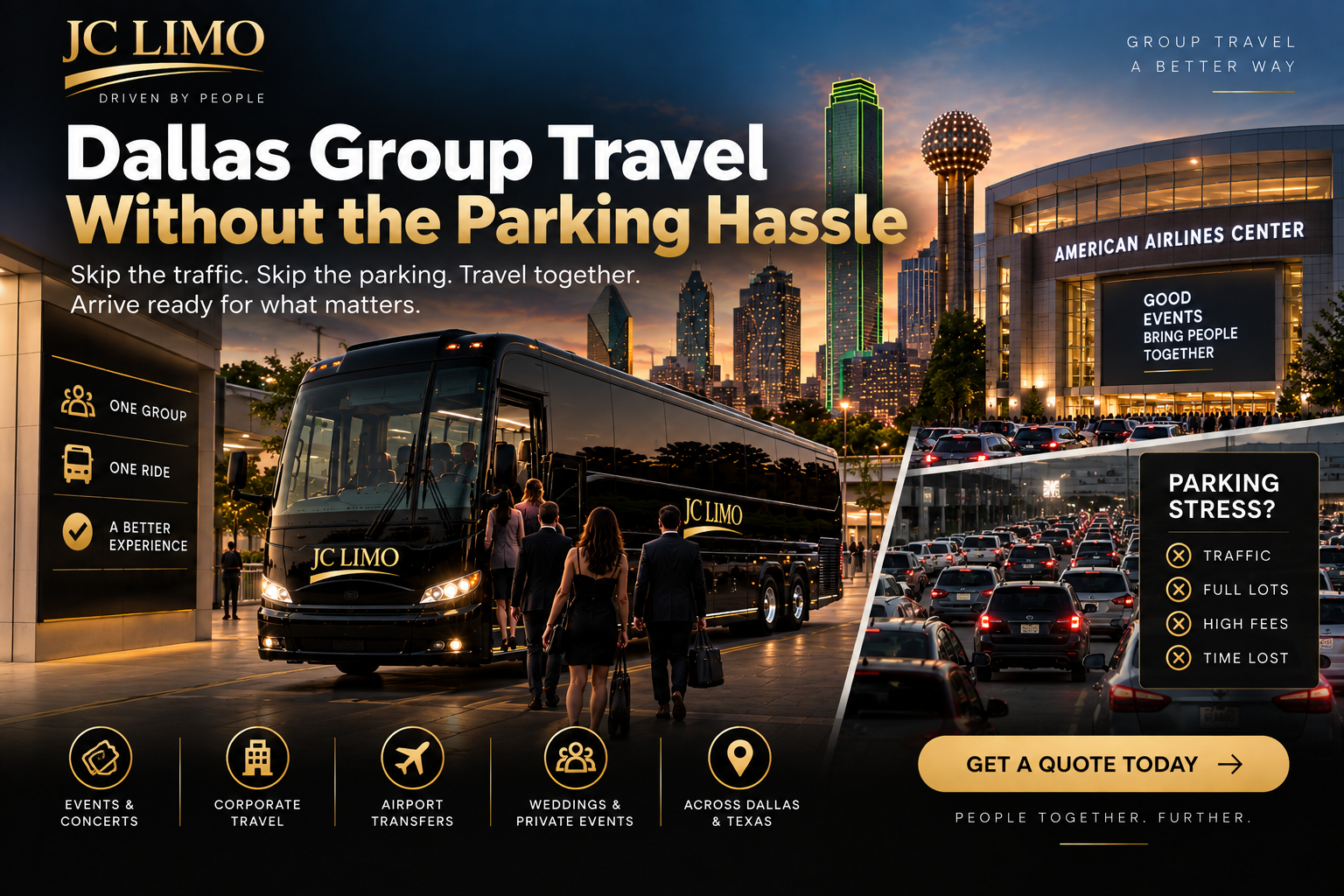
There is a point in almost every group trip when someone asks the same question:
“Where are we going to park?”
For one vehicle, parking might be a small detail.
For a group arriving in 10, 15, or 20 separate cars, it can become a major part of the transportation plan.
Drivers need directions. Parking fees can add up. Some people find spaces quickly while others circle the area. Passengers may enter through different parts of the venue, and when the event finishes, the entire process happens again in reverse.
Across Dallas–Fort Worth, parking can be especially important when groups are heading to busy entertainment districts, conferences, corporate meetings, sporting events, concerts, hotels, private events, and other popular destinations.
That is one reason organized bus and shuttle transportation can make group travel much easier.
Instead of coordinating a collection of separate cars, JC LIMO can help groups move according to one transportation plan.
The group meets.
The bus departs.
Passengers arrive together.
And nobody in the group has to spend the beginning of the experience searching for a parking space.
Parking Is Part of the Trip
People often think of transportation as the drive from Point A to Point B.
But driving is only one part of the journey.
When passengers use separate vehicles, the complete process looks more like this:
Leave the starting location.
Navigate to the destination.
Deal with traffic.
Find the correct entrance.
Locate parking.
Walk from the parking area.
Meet the rest of the group.
After the event, everyone repeats those steps in reverse.
For an individual traveler, that may be manageable.
For a large group, every step can multiply.
Private group transportation in Dallas–Fort Worth can simplify that process by giving passengers one shared travel plan.
Multiple Cars Mean Multiple Arrival Times
Imagine a 40-person corporate group traveling to an event.
If everyone drives separately, the group could need 15 or more vehicles depending on how passengers divide themselves.
Those vehicles will not necessarily arrive together.
One driver leaves early.
Another gets stuck in traffic.
Someone misses an exit.
Another person stops for fuel.
One driver finds parking immediately.
Someone else spends another 15 minutes looking for a space.
The invitation may say the event begins at 7:00 PM, but the group can arrive over a much wider window.
A private JC LIMO bus changes the structure.
Instead of coordinating many vehicles, the organizer coordinates one group departure.
When the bus arrives, the passengers arrive together.
Dallas Events Can Attract Heavy Traffic
Dallas–Fort Worth hosts concerts, sporting events, conferences, exhibitions, festivals, corporate gatherings, and other major events throughout the year.
Large events naturally bring more people into the same area.
That can mean more vehicles.
More traffic.
Busier parking areas.
Longer entrance lines.
And more people trying to leave at the same time after the event.
Groups attending these events should think about transportation before the day arrives.
Waiting until everyone is already on the road can create unnecessary confusion.
An organized event shuttle or charter bus gives the group a transportation plan before traffic becomes part of the experience.
Parking Can Separate a Group Before the Event Starts
One of the biggest problems with separate cars is not simply finding parking.
It is that parking can separate the group.
One vehicle parks on one side of the venue.
Another uses a different garage.
A third group enters from another street.
Suddenly, passengers who planned to attend the event together are sending messages:
“Where are you?”
“Which entrance?”
“What level are you parked on?”
“Are you inside already?”
“Should we wait?”
When the group travels by bus, passengers can stay together for much more of the journey.
That can be particularly valuable for out-of-town visitors who may not know the venue or surrounding area.
Group Transportation Can Simplify Corporate Events
Corporate transportation is often about more than convenience.
Timing and presentation matter too.
A company may be transporting employees or guests from a hotel to a conference, client dinner, awards event, meeting, or private function.
Asking 30 visitors to drive independently creates variables the organizer cannot easily control.
A coordinated corporate bus or shuttle provides one meeting time and one departure.
Guests can leave the hotel together.
Arrive together.
And return according to the planned schedule.
For visiting employees or clients, it also removes the need to navigate unfamiliar Dallas streets.
Conferences Create Parking Pressure at Peak Times
Conferences can bring hundreds or thousands of attendees to the same location.
Many arrive during similar morning windows.
Then large numbers leave at similar times in the afternoon.
If a company has a group staying at the same hotel, it may not make sense for everyone to travel separately.
A scheduled hotel-to-conference shuttle can create a simpler routine.
For example:
7:30 AM — Meet in hotel lobby
7:45 AM — Shuttle departure
Conference transportation provided
5:30 PM — Return shuttle
Passengers know exactly what to do.
Nobody needs to research parking before breakfast.
Concert Transportation Should Include the Trip Home
A concert is supposed to be the memorable part of the evening.
Not the parking garage.
For groups attending a concert in Dallas–Fort Worth, the transportation plan should cover both arrival and departure.
The return trip is especially important.
After a major event, many people leave at once.
If the group used separate cars, everyone needs to find their vehicle and navigate away independently.
With planned concert transportation, passengers can receive a designated post-event meeting point before entering the venue.
When the concert finishes, they know where to go.
That makes the final part of the evening much easier to understand.
Sporting Events Have Similar Challenges
Sports transportation presents many of the same issues.
Fans often arrive during a concentrated period before the game.
Parking areas fill.
Traffic increases.
After the event, large numbers of vehicles leave at approximately the same time.
For a group of coworkers, friends, visitors, or clients, traveling together can make the day feel more like a shared event from the beginning.
The group can meet at a hotel, office, or another designated location.
Board the bus.
Travel to the event.
Then return together afterward.
The journey becomes part of the group experience rather than a collection of separate commutes.
Private Celebrations Benefit From One Transportation Plan
Birthdays, anniversaries, family gatherings, bachelor and bachelorette celebrations, quinceañeras, and other private events may involve multiple destinations.
Perhaps the group begins at a hotel.
Then travels to dinner.
Then an entertainment venue.
Then returns to the hotel.
If everyone drives, parking becomes a question at every stop.
With a private bus, the transportation plan can connect the itinerary.
The group does not need to repeatedly divide into cars and reorganize.
Passengers simply return to the bus when it is time to continue.
Weddings Can Reduce Parking Questions for Guests
Wedding transportation is another area where parking matters.
A ceremony or reception venue may have limited parking, unfamiliar access, or simply be somewhere guests have never visited.
Out-of-town guests may be especially unsure about where to go.
A wedding shuttle from a designated hotel can make the instructions much simpler.
Instead of giving every guest detailed driving and parking directions, organizers can provide a transportation schedule.
For example:
Hotel pickup: 4:00 PM
Shuttle departure: 4:15 PM
Return transportation available after reception
That gives guests one clear plan.
Remote Parking Can Work Better With a Shuttle
Sometimes the best parking strategy is not to have every passenger park at the final destination.
A business, event, or organization may use a remote parking area and shuttle passengers to the actual venue.
This can be useful when parking near the destination is limited or when a large number of people need to move between two fixed points.
A recurring shuttle service can operate according to scheduled windows.
Passengers park at the designated location, board the shuttle, and continue to the destination.
The same system can bring them back later.
For larger operations, this can create a much more organized passenger flow.
Employee Shuttles Can Connect Parking and Workplaces
Parking challenges are not limited to special events.
Some workplaces may have employees parking away from the main facility.
A scheduled employee shuttle can connect a designated parking location with the workplace.
For employees, the system should be predictable.
They need to know:
Where to park.
Where the shuttle boards.
When it departs.
How frequently it operates.
When return transportation is available.
Consistency is particularly important when the shuttle supports daily or recurring work schedules.
The Cost of Parking Is Not the Only Consideration
People sometimes compare group transportation with driving by looking only at the cost of parking.
But parking creates other considerations too.
Fuel.
Multiple vehicles.
Driving responsibility.
Arrival coordination.
Walking distance.
Time spent finding spaces.
Navigation.
Group communication.
Departure coordination.
The best transportation decision depends on the trip, group, and destination.
For some journeys, separate vehicles may make sense.
For others, consolidating passengers into a bus or shuttle can significantly simplify the experience.
Out-of-Town Visitors Benefit Even More
A local driver may already know which highway to use or where a venue’s parking garage is located.
A visitor may not.
That makes parking and navigation a larger part of the trip for out-of-town groups.
Someone visiting Dallas for a conference should not need to become an expert on local parking.
A wedding guest flying into Texas should not have to spend the weekend learning routes between a hotel and venue.
A corporate visitor should be able to focus on the meeting.
Private group transportation removes many of those decisions from individual passengers.
A Bus Creates One Meeting Point
One of the simplest benefits of group transportation is having a single starting point.
Instead of telling passengers:
“Meet us at the venue.”
You can tell them:
“Meet at the hotel entrance at 5:30 PM.”
That is a much more controlled situation.
The organizer can see who is present.
Passengers know where they need to be.
The group boards together.
If someone is missing, the issue becomes clear before transportation leaves rather than after everyone is spread across several parking garages.
Plan the Pickup Location Before Departure
The return meeting point should be established before passengers leave the bus.
Do not wait until the event finishes.
A large venue may have several exits.
Passengers can easily walk in different directions.
Before arrival, communicate the pickup instructions.
For example:
Return pickup: Designated group transportation area
Meet: 10:15 PM
Bus departure: 10:30 PM
If the venue has specific transportation procedures, the group should follow those requirements.
Clear instructions reduce the number of “Where is the bus?” messages later.
Build Time for Boarding
A bus may reduce parking complications, but the schedule still needs to be realistic.
Thirty or 50 passengers do not board instantly.
Allow time for people to gather.
If the group is leaving a hotel, passengers may need to come downstairs.
If the pickup is after an event, they need time to exit the venue and reach the meeting point.
A good transportation plan distinguishes between meeting time and departure time.
For example:
Meet at 6:15 PM.
Depart at 6:30 PM.
That 15-minute difference can prevent delays.
Match the Bus to the Group
JC LIMO offers transportation options including 31-passenger minibuses and 56-passenger motor coaches.
The appropriate option depends on the trip.
Consider:
Passenger count.
Pickup location.
Destination.
Luggage.
Number of stops.
Journey length.
Event schedule.
Return transportation.
A group traveling from a hotel to a local dinner may have different requirements from an airport group carrying luggage or a full-day trip across Texas.
Transportation planning should consider the complete itinerary.
One Bus Can Make Communication Easier
When passengers are spread across many vehicles, transportation updates become more difficult.
Imagine an event entrance changes.
Now the organizer needs to make sure every driver receives the message.
Or dinner starts 30 minutes later.
Everyone needs the new schedule.
With one bus or a coordinated shuttle system, communication becomes more centralized.
The transportation coordinator can share the update with the group and adjust the plan when appropriate.
That can be especially useful during complicated multi-stop itineraries.
Multi-Stop Trips Create Multiple Parking Problems
A single destination creates one parking challenge.
A multi-stop itinerary creates several.
Consider a corporate day:
Hotel.
Meeting.
Lunch.
Site visit.
Dinner.
Hotel.
With separate cars, drivers may need to park four different times.
They also need to navigate between each location.
A dedicated JC LIMO bus can connect those stops under one transportation plan.
When the meeting finishes, passengers return to the bus.
After lunch, they do it again.
The group keeps moving without rebuilding the transportation plan at every destination.
Parking Is Also About the Passenger Experience
Transportation is part of how people experience an event.
Imagine two versions of the same corporate dinner.
In the first, guests spend 20 minutes searching for parking and then walk several blocks before arriving.
In the second, the group travels together and arrives according to a planned transportation schedule.
The dinner itself has not changed.
But the experience around it has.
For companies, event planners, wedding hosts, and group organizers, those details can matter.
Dallas–Fort Worth Group Travel Should Feel Organized
Dallas–Fort Worth is a large and active metropolitan area.
Groups move between airports, hotels, business districts, entertainment venues, restaurants, conference centers, workplaces, and destinations throughout North Texas every day.
Trying to coordinate every passenger through separate vehicles can add unnecessary complexity.
Group transportation gives organizers another option.
One pickup point.
One schedule.
One bus or coordinated shuttle plan.
One return strategy.
That structure can make a major difference when traffic and parking are already demanding attention.
Spend More Time at the Destination, Not Looking for Parking
A group trip should be about where you are going and who you are traveling with.
Not which parking garage still has spaces.
Not where the other cars went.
Not which entrance someone used.
Not who is driving back.
With professional bus and shuttle transportation, groups can reduce many of those individual transportation decisions.
JC LIMO provides group transportation throughout Dallas, Fort Worth, the DFW Metroplex, North Texas, and destinations across Texas for corporate groups, events, conferences, weddings, private celebrations, employees, airport travelers, and more.

Related posts
 13Oct, 26
Dallas Group Transportation With Luggage and Equipment
 13Oct, 26
Dallas Group Transportation With Multiple Drop-Offs
 13Oct, 26
- October 13, 2026
- 0
- 10
