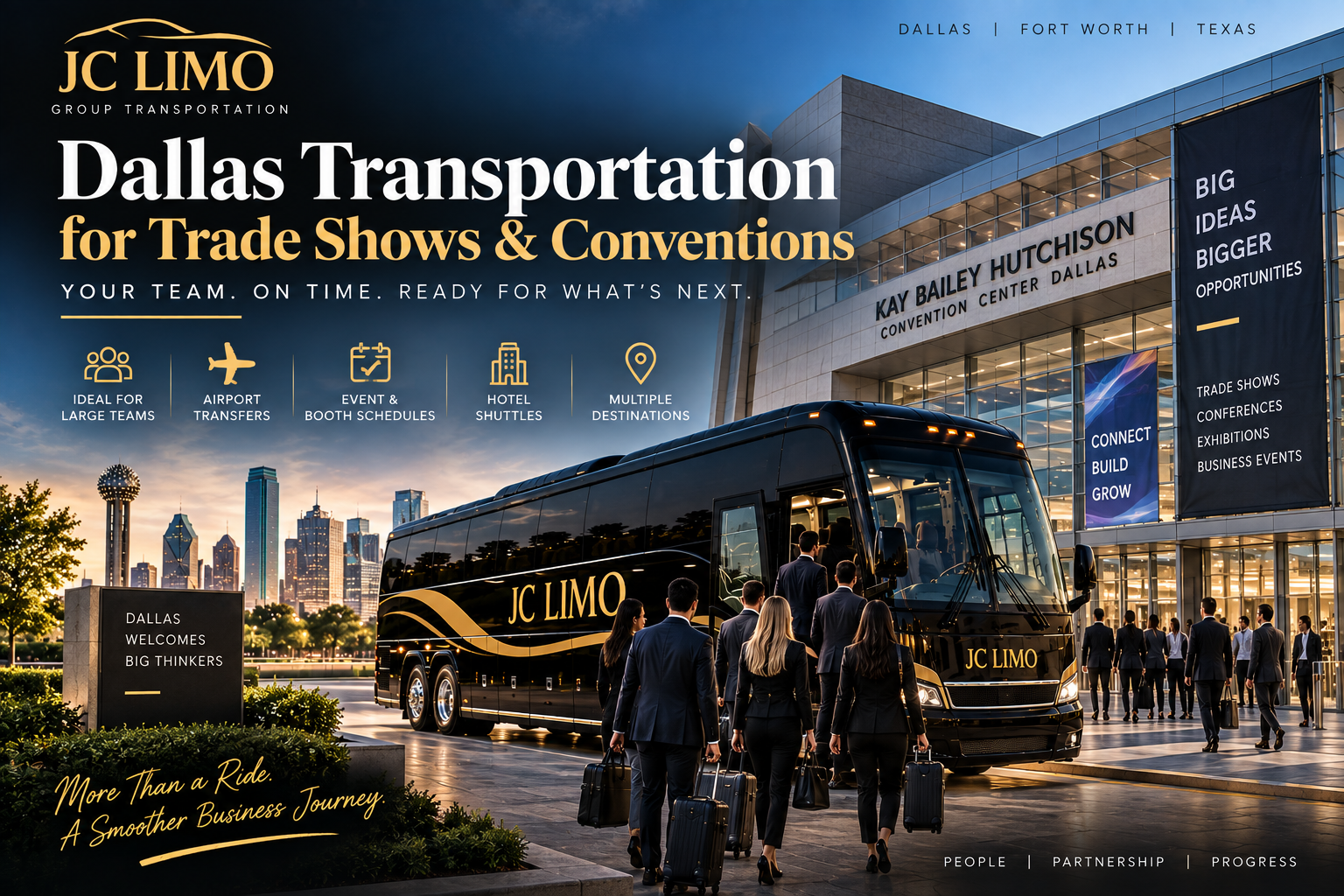
A successful trade show trip involves much more than booking a booth and showing up at the convention center.
Employees need to arrive on time. Clients may be staying at different hotels. Exhibitors could have early setup schedules. Teams may have dinners and meetings after the show. Some attendees are flying into Dallas, while others are traveling from different parts of Texas.
When dozens of people are involved, transportation becomes part of the event strategy.
A missed pickup can mean a late meeting. An unorganized hotel departure can delay an entire team. Asking every employee to arrange transportation independently creates unnecessary variables during an already busy event.
That is why private bus and shuttle transportation can be especially valuable for trade shows, conventions, exhibitions, and corporate events in Dallas–Fort Worth.
With JC LIMO, companies and organizations can build transportation around the event schedule, helping employees, guests, and business groups move between airports, hotels, convention venues, meetings, restaurants, and other destinations.
The goal is simple: keep the business moving while transportation works quietly in the background.
Transportation Is Part of the Trade Show Plan
Companies often spend weeks or months preparing for a major exhibition.
There are booth designs to approve, marketing materials to print, sales presentations to prepare, meetings to schedule, and travel arrangements to coordinate.
Transportation sometimes receives much less attention.
Yet once the team arrives in Dallas, it affects almost every part of the schedule.
How will everyone get from the airport to the hotel?
How will the team reach the venue in the morning?
What happens if exhibitors need to arrive before general attendees?
How are clients getting to the evening dinner?
How will everyone return to the hotel after networking events?
Answering these questions before the trip creates a much smoother experience.
Start With the Full Convention Schedule
Before arranging a bus or shuttle, look at the entire event schedule rather than only the opening and closing times.
Trade show teams often need to arrive much earlier than attendees.
An exhibition may open at 9:00 AM, but booth staff could need to be on-site at 7:30 AM.
The transportation plan should reflect when passengers actually need to arrive.
The same applies at the end of the day.
The exhibition floor may close at 5:00 PM, but staff could need additional time to organize the booth, meet a client, or prepare for the next day.
A realistic transportation schedule should be based on the team’s responsibilities, not simply the public event hours.
Hotels Can Become Transportation Hubs
For multi-day conventions, the hotel often becomes the most practical central pickup point.
Employees know where to meet each morning.
A JC LIMO shuttle can collect the team and transport everyone to the event venue according to the schedule.
At the end of the day, the bus can provide return transportation or continue to another planned destination.
A typical schedule might look like:
Hotel → Convention Center → Client Dinner → Hotel
Another day could include:
Hotel → Exhibition Venue → Corporate Office → Networking Event → Hotel
Using the hotel as the transportation hub gives passengers a familiar starting and ending point throughout the trip.
Keep Your Team Together
Trade shows are busy enough without trying to track employees across several vehicles.
If 30 staff members arrange transportation independently, they may arrive at different times.
Some could be delayed by traffic.
Others may have trouble finding the correct entrance.
Someone could accidentally travel to the attendee entrance when exhibitors are supposed to enter somewhere else.
A private bus keeps the team together.
Employees board at the agreed location, travel as one group, and arrive according to one schedule.
For managers, this makes the morning easier to coordinate.
For employees, it removes one task from an already demanding day.
Exhibitors Often Need Early Transportation
Exhibition teams frequently work outside normal event hours.
Booths need to be prepared.
Displays need to be checked.
Sales materials need to be organized.
Technology may need testing.
Team briefings could happen before attendees enter.
That means transportation may need to begin early in the morning.
Instead of asking each employee to arrange an individual ride before sunrise, companies can schedule group transportation based on exhibitor access times.
Passengers know when the shuttle leaves and can plan their morning accordingly.
This is especially useful for teams visiting Dallas from outside Texas who may not be familiar with the area.
Convention Transportation Is Not Just Hotel to Venue
A trade show trip often includes much more than the event itself.
There may be:
- Airport transfers
- Hotel transportation
- Client meetings
- Corporate dinners
- Networking events
- Product demonstrations
- Off-site meetings
- Team activities
- Restaurant reservations
- Evening entertainment
Transportation can connect these activities into one itinerary.
Instead of arranging a new ride every time the team changes location, the company can create a planned schedule for the day.
This becomes particularly useful when the group needs to move between several parts of Dallas–Fort Worth.
Airport Transportation Sets the Tone
For out-of-town teams, the business trip begins at the airport.
Dallas Fort Worth International Airport serves travelers from across the United States and around the world, making it a common starting point for convention groups.
If 40 employees are arriving around the same time, sending everyone separately to the hotel can immediately split the group.
A private bus allows passengers to consolidate transportation.
The same principle can apply when clients, partners, or international guests are arriving for the event.
Instead of asking visitors to navigate Dallas independently, companies can incorporate airport transportation into the larger itinerary.
For business hospitality, that can create a more organized experience from the moment guests arrive.
Don’t Forget About Luggage and Event Materials
Trade show groups often carry more than personal luggage.
Employees may have suitcases, presentation materials, samples, marketing items, signs, or other equipment.
While some exhibition materials may be shipped separately, organizers should still think about what passengers will bring onto the bus.
Tell the transportation provider about luggage and equipment when planning the vehicle.
A bus should have enough space for both passengers and their belongings.
The right vehicle depends on the actual requirements of the trip, not simply the number of people traveling.
Client Transportation Can Strengthen Hospitality
Trade shows are often about relationships.
Companies invite prospects, clients, partners, and other guests to dinners, presentations, and private events.
Transportation can become part of that hospitality.
Imagine inviting a group of important clients to dinner after a full day at a convention.
One option is to send everyone the restaurant address and ask them to meet there.
Another is to have a private JC LIMO bus or shuttle ready to take the group from the venue or hotel directly to dinner.
The second option creates a more connected experience.
Clients do not have to worry about directions or parking.
The host company can keep the group together and move directly into the evening program.
Networking Events Need a Return Plan
Evening networking events may not end at the same time as the trade show.
Some continue late into the evening.
Employees may also be tired after spending the entire day standing, presenting, and speaking with attendees.
Having return transportation already arranged gives the team a clear plan.
Passengers know where to meet and how they are getting back to the hotel.
For larger corporate groups, this can be much easier than asking everyone to arrange transportation individually at the end of a long day.
Multi-Day Events Benefit From Consistency
The first morning of a conference often involves questions.
Where does the bus meet us?
What time do we leave?
Which entrance are we using?
By the second or third day, a consistent transportation routine makes everything easier.
Passengers know the meeting point.
They understand the boarding time.
They know approximately how long the trip takes.
For organizers, this means fewer daily instructions.
A predictable shuttle schedule becomes part of the event routine.
This is one reason private group transportation can work particularly well for conventions lasting several days.
Dallas Traffic Needs to Be Part of the Schedule
A trade show schedule should not assume ideal driving conditions.
Dallas–Fort Worth is a large metropolitan area, and travel times can change depending on traffic, road conditions, events, and time of day.
Morning transportation may overlap with commuter traffic.
Evening trips may coincide with rush hour or major entertainment events.
If the team absolutely needs to be at the venue at 8:00 AM, planning to arrive at exactly 8:00 leaves no room for unexpected delays.
Build reasonable additional time into the schedule.
Arriving early gives employees time to settle in and prepare.
Arriving late can affect the entire day.
Multiple Hotels Require More Planning
Large conferences may have attendees staying across several hotels.
Companies may also have employees divided between different properties because of availability.
In these situations, organizers need to decide whether to use multiple buses, several pickup locations, or a central meeting point.
There is no universal answer.
It depends on the number of passengers, distance between hotels, event schedule, and vehicle capacity.
The important thing is to avoid creating a route that spends too much time collecting passengers before anyone reaches the convention.
Sometimes centralized pickups are more efficient.
In other situations, separate shuttles may make more sense.
Trade Show Transportation for Large Groups
The larger the team, the more useful coordinated transportation can become.
Moving five people is relatively simple.
Moving 50 requires more structure.
Passenger lists may help organizers know who should be on each bus.
For particularly large groups using several vehicles, employees should know which bus they are assigned to.
Clear communication prevents everyone from gathering around one vehicle while another bus leaves half empty.
Simple planning can make a major difference when hundreds of attendees are arriving at the same venue.
Smaller Teams Can Benefit Too
Private transportation is not only useful for huge convention groups.
Smaller teams may also benefit when their schedules are complex.
For example, a company with 15 or 20 employees may have multiple meetings across Dallas throughout the day.
Keeping the team together can still be easier than using several cars or repeatedly arranging separate transportation.
The decision should be based on the itinerary, not simply the group size.
If coordinated transportation saves time and simplifies the schedule, it may be valuable even for a smaller team.
Make the Bus Part of the Corporate Schedule
A bus should not feel separate from the rest of the event plan.
It should be built directly into the itinerary.
Instead of writing:
“Conference begins at 9:00 AM”
Write:
“7:30 AM – Meet in hotel lobby
7:45 AM – Bus departs
8:30 AM – Arrive at convention venue
9:00 AM – Conference begins”
This makes expectations much clearer.
Employees know when their day actually starts.
The same approach can be used for client dinners, networking events, airport transfers, and return trips.
Why Companies Choose Group Transportation
Corporate events involve enough moving parts already.
Flights change.
Meetings run long.
Clients adjust schedules.
Presentations need last-minute updates.
Transportation should reduce complexity rather than add to it.
Private bus and shuttle transportation gives organizers a clearer structure.
Instead of managing many individual journeys, they can organize passengers around a shared schedule.
That can help teams stay together, arrive prepared, and focus on the reason they are in Dallas in the first place.
Travel to Dallas Trade Shows With JC LIMO
Trade shows and conventions create valuable opportunities for companies to meet customers, build partnerships, showcase products, and grow their businesses.
The transportation plan should support those goals.
JC LIMO provides group transportation for businesses, exhibitors, convention attendees, clients, and other groups traveling throughout Dallas, Fort Worth, and North Texas.
Transportation can be planned around airport arrivals, hotels, exhibition venues, corporate meetings, dinners, networking events, and multi-day schedules.
Whether your company needs one bus for a team or multiple shuttles for a larger event, the transportation plan can be built around the passengers and itinerary.
Your team already has enough to think about.
They should not have to spend the morning asking:
“Who’s driving?”
“Where do we park?”
“Which entrance is it?”
“Who hasn’t arrived yet?”
With coordinated group transportation, everyone knows the answer to the most important question:

Related posts
 13Oct, 26
Dallas Group Transportation With Luggage and Equipment
 13Oct, 26
Dallas Group Transportation With Multiple Drop-Offs
 13Oct, 26
- October 13, 2026
- 0
- 10
