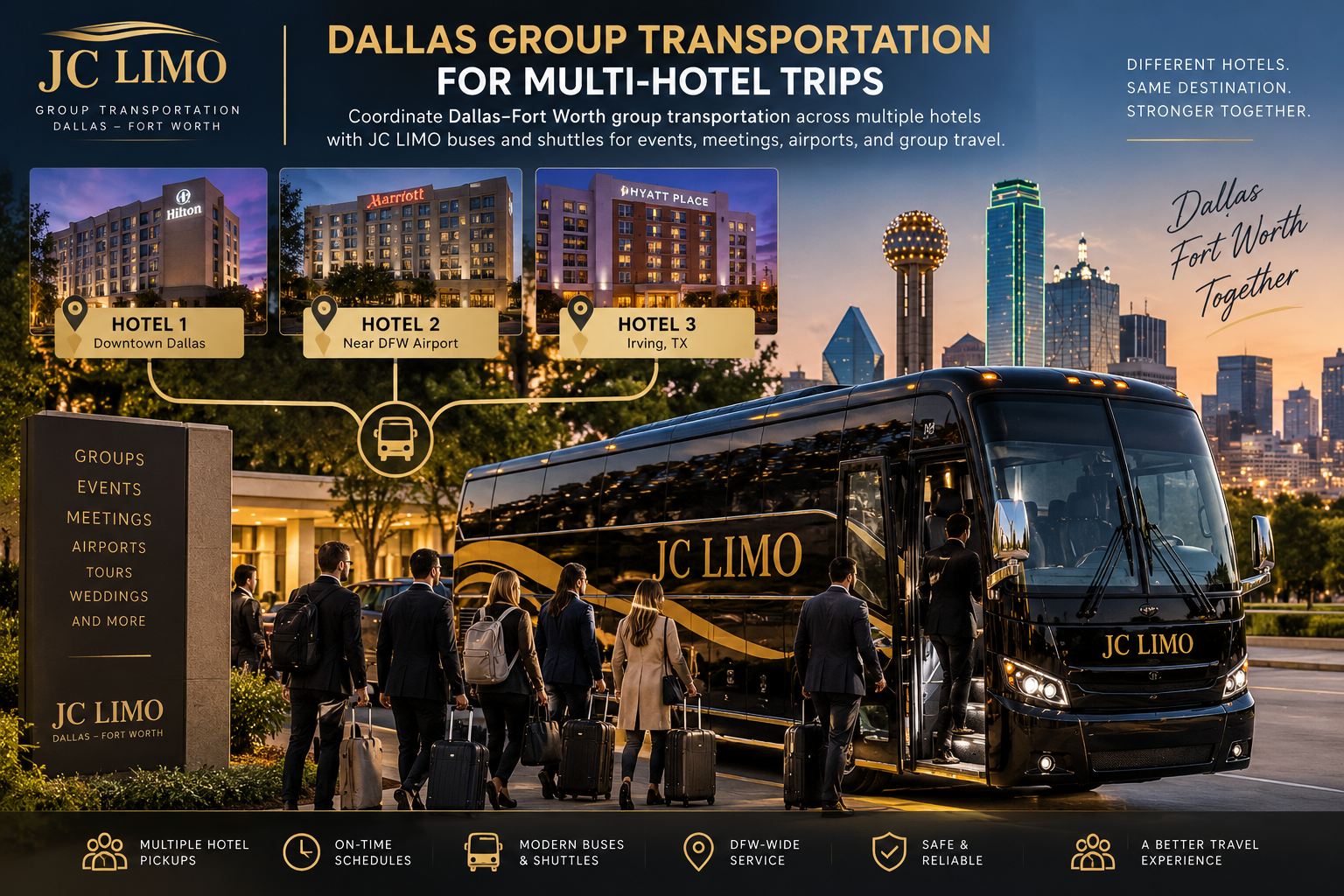
When everyone in a group stays at the same hotel, transportation is relatively straightforward. Pick one meeting point, establish a departure time, load the bus, and go.
But many group trips to Dallas–Fort Worth do not work that way.
Conference attendees may be divided between several hotels. Wedding guests might choose accommodations at different price points. Corporate travelers may stay near separate offices. A large tour group may need more rooms than one property can provide. Some travelers might stay near DFW International Airport while others prefer downtown Dallas.
Suddenly, one pickup becomes three.
One return trip becomes multiple drop-offs.
And every additional hotel adds another layer to the transportation plan.
For organizers, the challenge is keeping the schedule efficient without making one part of the group wait unnecessarily.
Professional Dallas group transportation can simplify these situations by connecting multiple hotels to one coordinated travel plan. With a dedicated JC LIMO bus or shuttle, groups can move between accommodations, meetings, venues, restaurants, airports, and other destinations throughout Dallas, Fort Worth, and North Texas.
Why Groups End Up Staying at Multiple Hotels
Splitting a group between hotels is not always a planning mistake. In many cases, it is the most practical option.
A large conference can fill nearby hotels quickly.
Wedding guests may choose properties based on budget or personal preference.
Corporate visitors may arrive on different dates and book accommodations near different business locations.
Sports groups, school groups, tour groups, and large families can also require more rooms than a single hotel can provide.
Sometimes the group intentionally chooses multiple hotels.
Executives may stay at one property while employees stay at another. Event staff might need accommodation close to the venue while guests stay in a more central location.
The important question is not whether everyone stays together.
It is how everyone will travel together when they need to.
Start With a Hotel Map
Before building the transportation schedule, identify every hotel being used by the group.
Then look at where each property sits in relation to the main destinations.
Suppose a group has guests staying at three hotels:
Hotel A is in downtown Dallas.
Hotel B is near Dallas Love Field.
Hotel C is closer to Irving.
If the group needs to reach the same event in Arlington, sending a bus to the hotels in a random order may waste time.
The route should be designed around geography, departure requirements, and the final destination.
This is one reason transportation planning should begin before the trip.
A well-organized route can make several hotel pickups feel like one smooth departure rather than three separate transportation problems.
Give Every Hotel Its Own Pickup Time
One of the easiest mistakes to make is telling everyone that “the bus leaves at 8:00.”
From where?
If passengers are staying at different hotels, each location needs its own instructions.
A better transportation schedule might say:
7:15 AM — Hotel A pickup
7:30 AM — Hotel B pickup
7:50 AM — Hotel C pickup
8:30 AM — Scheduled arrival
Now every passenger understands exactly when the JC LIMO shuttle is expected at their location.
It is also helpful to tell passengers when they should be ready rather than only providing the departure time.
If a bus arrives at 7:15 AM, guests should not begin leaving their rooms at 7:15.
They should already be at the designated pickup area.
A few minutes saved at each hotel can make a meaningful difference once multiple stops are involved.
Choose Exact Meeting Points at Large Hotels
“Meet in front of the hotel” sounds clear until the hotel has several entrances.
Large properties may include a main lobby entrance, conference entrance, parking garage, valet area, side entrance, and designated commercial vehicle loading zone.
For passengers who have never visited Dallas before, those options can create confusion.
Transportation instructions should identify the exact meeting location whenever possible.
For example:
“Meet at the main lobby entrance near the valet area.”
Or:
“Meet at the designated bus loading zone on the east side of the hotel.”
The more specific the instruction, the less likely passengers are to be standing at different parts of the property.
This becomes particularly important when a Dallas bus has several additional pickups scheduled afterward.
Avoid Making the First Group Wait Too Long
Multiple-hotel transportation requires balance.
If passengers from the first hotel board at 7:00 AM but the final hotel pickup is not completed until 8:00 AM, the first passengers may spend a significant amount of time sitting on the bus before the actual trip begins.
Sometimes that is unavoidable.
But thoughtful route planning can reduce unnecessary waiting.
The order of pickups should consider:
hotel locations, traffic patterns, final destination, group size at each property, boarding time, and scheduled arrival.
For some large groups, it may even make sense to use more than one shuttle.
Instead of one vehicle making several distant pickups, two buses can collect passengers from different areas and meet at the destination.
The best setup depends on the specific itinerary.
Conference Transportation Across Several Hotels
Conferences are one of the most common situations where multi-hotel transportation becomes useful.
A company might bring dozens of employees to a major event in Dallas, but not everyone is booked at the same property.
Some employees may stay near the conference venue.
Others may be several miles away because nearby rooms were unavailable.
Without organized transportation, every attendee has to solve the same morning problem independently.
Some rent cars.
Others order rideshares.
Several people travel together.
Everyone arrives at different times.
A dedicated conference shuttle in Dallas creates a more consistent plan.
The bus can follow a scheduled hotel route before bringing attendees to the conference or meeting venue.
At the end of the day, the process can operate in reverse.
Passengers board at the agreed pickup location and return to their respective hotels according to the planned route.
Wedding Guests Often Need Hotel Shuttle Service
Weddings create another common multi-hotel transportation challenge.
Out-of-town guests may stay at several hotels near the ceremony or reception.
Some guests may be unfamiliar with Dallas–Fort Worth.
Others may not have rental cars.
And after a long reception, asking everyone to arrange their own transportation back to different hotels can make the end of the evening unnecessarily complicated.
A wedding shuttle can connect selected hotels with the ceremony and reception venues.
For example, guests might be collected from two hotels before the ceremony.
After the reception, scheduled shuttle departures can return them to those same properties.
This gives guests a clear transportation option and gives the wedding organizers one coordinated plan to communicate in advance.
Corporate Groups Can Have Multiple Accommodation Hubs
Corporate travel does not always mean everyone stays together.
Executives might choose a hotel near downtown Dallas.
Employees attending a training program could stay closer to a corporate office.
International visitors might be booked near the airport for an early departure.
Clients may be staying somewhere else entirely.
If all of those people need to attend the same dinner, meeting, facility tour, or company event, transportation becomes the connecting point.
A JC LIMO corporate shuttle can be scheduled around the different accommodation hubs.
This allows the company to provide guests with a consistent travel experience without requiring everyone to relocate to the same hotel.
Airport Hotels Create Their Own Transportation Needs
Dallas–Fort Worth receives travelers through major airports, and some groups choose airport-area hotels for convenience.
That can be practical for arrivals and departures.
However, airport hotels may not be close to the group’s main activities.
A group staying near DFW International Airport might have meetings in Dallas, events in Arlington, or dinner plans in Fort Worth.
This means the hotel is only the starting point.
A dedicated bus or shuttle can connect the airport-area accommodation to the rest of the itinerary.
For groups with early flights, transportation can also be planned around the final hotel pickup and airport transfer.
This is particularly helpful when dozens of passengers are traveling with luggage.
Don’t Forget Luggage During Hotel Transfers
Multi-hotel trips sometimes include more than daily pickups.
Passengers may actually be changing hotels.
Perhaps the first part of the trip takes place in Dallas and the second part in Fort Worth.
Maybe a conference ends and the group moves to a hotel closer to the airport before flying home.
In these cases, the transportation plan needs to account for luggage.
A vehicle that comfortably carries a large number of passengers for a short local transfer may have different requirements when every traveler brings a suitcase.
Organizers should consider the number of passengers and the amount of luggage when selecting a group bus in Dallas.
This helps ensure the vehicle is appropriate for the actual trip rather than passenger count alone.
Multiple Hotels Can Work for Fort Worth Trips Too
The same planning principles apply when the itinerary extends into Fort Worth, Texas.
Imagine a group staying at hotels in Dallas and Irving but attending an evening event in Fort Worth.
Instead of asking every passenger to independently make the trip west, the transportation schedule can connect the hotels before continuing toward Fort Worth.
The return journey can follow a planned drop-off order.
This is especially useful when the group is visiting popular Fort Worth destinations, attending a private function, or spending an evening at the Fort Worth Stockyards.
Passengers do not need to think about the route back to their individual hotels.
They simply board the scheduled group transportation.
Make Return Transportation Just as Clear
Morning pickups usually receive plenty of attention.
Return transportation sometimes does not.
After a long event, passengers need clear instructions about where and when the bus will depart.
If several hotels are involved, they should also understand the drop-off sequence.
For example:
10:00 PM — Bus departs event
10:30 PM — Hotel C
10:45 PM — Hotel B
11:00 PM — Hotel A
Providing this information in advance helps passengers understand what to expect.
It can also help guests decide whether the scheduled group transportation fits their personal plans for the evening.
One Communication Channel Helps
When passengers are spread across several hotels, communication becomes especially important.
Organizers should avoid sending different versions of the schedule to different people unless necessary.
Create one central itinerary that clearly lists all transportation details.
Include:
- Hotel name
- Pickup location
- Ready time
- Departure time
- Destination
- Return pickup point
- Return departure time
- Hotel drop-off sequence
Everyone can then see the complete transportation plan.
For large groups, it may also help to assign a group leader at each hotel.
That person can help confirm that passengers are ready before the bus arrives.
Consider Separate Shuttles for Very Large Groups
One bus is not always the best answer.
If a group is extremely large or hotels are located far apart, multiple shuttles may create a more efficient transportation program.
For example, one bus could serve downtown Dallas hotels while another serves hotels closer to DFW Airport.
Both groups could then arrive at the same event independently.
This approach can reduce travel time and prevent passengers from spending too long making additional hotel stops.
It also provides flexibility when different groups have slightly different schedules.
Professional transportation planning is about finding the structure that fits the trip—not forcing every itinerary into the same model.
Build Extra Time Into Morning Departures
Morning hotel pickups can take longer than expected.
Passengers may be finishing breakfast.
Someone may need to return to their room.
An elevator may be busy.
A large group may take several minutes to board.
Luggage can add more time.
When several hotels are involved, small delays can accumulate.
If every stop takes five minutes longer than planned, three hotels could put the schedule 15 minutes behind.
Building a reasonable buffer into the transportation schedule helps protect important arrival times.
That is particularly important for conferences, meetings, airport departures, weddings, and other events that cannot simply start later.
Make Multi-Day Transportation Consistent
For trips lasting several days, consistency can make everything easier.
If passengers use the same hotel pickup area every morning, they quickly learn where to go.
If departure times follow a clear schedule, fewer reminders are needed.
The group begins to understand the transportation routine.
This is valuable for corporate conferences, multi-day tours, sports groups, school trips, and large events.
Rather than reinventing transportation every day, organizers can establish a reliable system from the beginning.
Keep the Group Connected Even When Hotels Are Separate
Staying in multiple hotels does not mean the group needs to experience the trip separately.
With the right transportation plan, accommodation can remain flexible while the actual itinerary stays coordinated.
Guests can choose different hotels.
Employees can stay near different offices.
Families can select accommodations that fit their budgets.
Conference attendees can use whatever rooms are available.
When it is time for the group to come together, scheduled transportation connects everyone.
That is the real value of professional Dallas–Fort Worth group transportation.
Coordinate Multi-Hotel Transportation With JC LIMO
Managing several hotels adds complexity to a group trip, but it does not have to create confusion.
A clear pickup schedule, realistic route, designated meeting points, appropriate vehicle, and organized return plan can keep everyone moving together.
JC LIMO provides bus and shuttle transportation for groups throughout Dallas, Fort Worth, Texas, and the surrounding DFW Metroplex, helping connect hotels with airports, conferences, meetings, weddings, restaurants, events, tours, and other destinations.
Whether your group is divided between two hotels or several properties across North Texas, transportation should bring the itinerary together.
Plan each pickup.
Give passengers clear instructions.
Allow realistic travel time.
Choose transportation that fits both the group and its luggage.

Related posts
 13Oct, 26
Dallas Group Transportation With Luggage and Equipment
 13Oct, 26
Dallas Group Transportation With Multiple Drop-Offs
 13Oct, 26
- October 13, 2026
- 0
- 10
