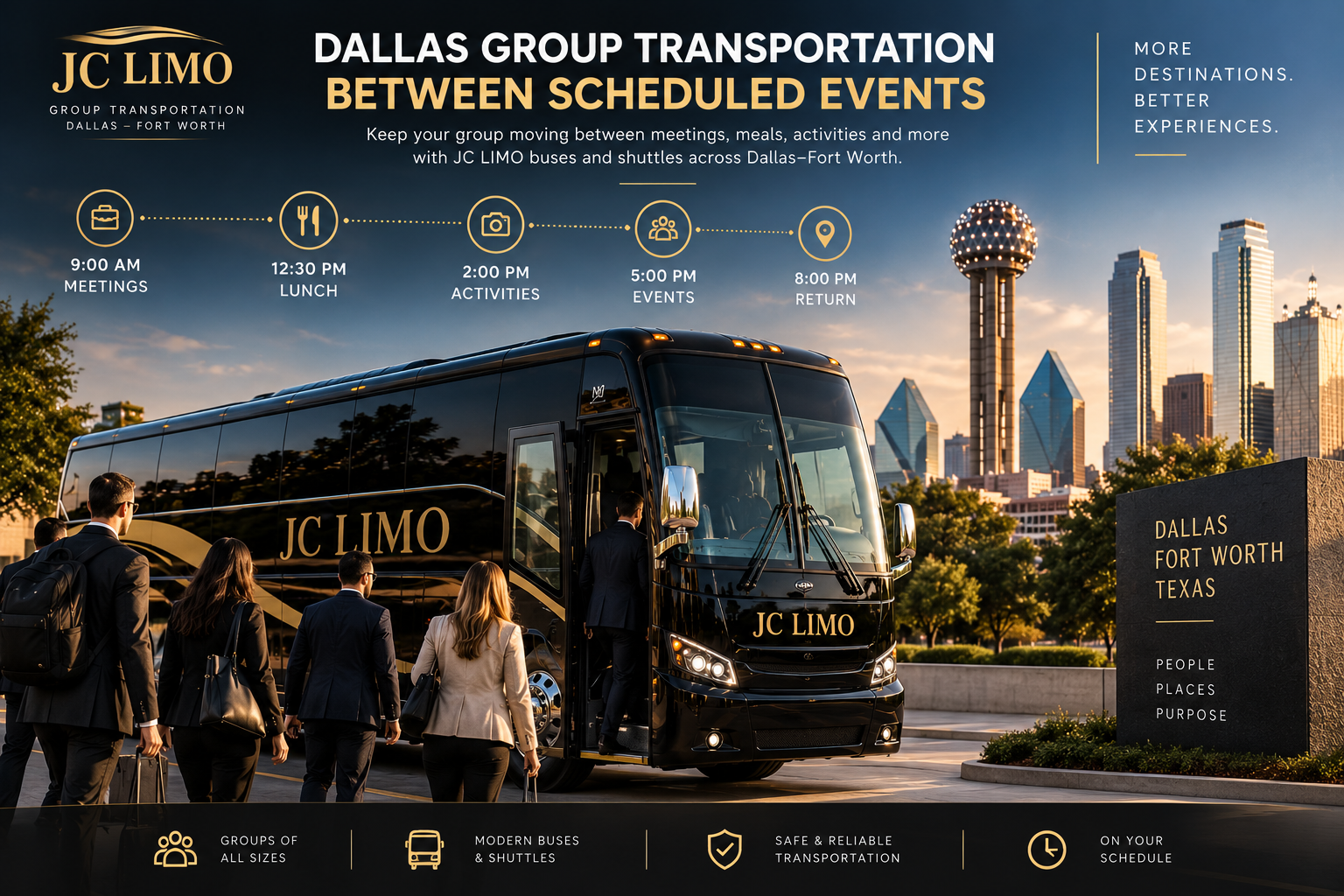
Group trips rarely follow a perfectly continuous schedule.
A morning meeting might finish at 11:00 AM, but lunch is not booked until 12:30 PM. A conference session could end in the afternoon while the company’s dinner reservation is several hours later. Wedding guests may have time between the ceremony and reception. A tour group might finish one activity before the next destination is ready to receive them.
These gaps can look harmless when an itinerary is being created.
Once dozens of people are involved, however, the question becomes more complicated:
What does everyone do between scheduled events?
Returning to the hotel may take too much time. Letting everyone leave separately can make it difficult to regroup. Waiting outside the next venue for an hour is not much of an experience either.
Good Dallas group transportation is not only about getting passengers to major destinations. It can also help organizers manage the spaces between them.
With a dedicated JC LIMO bus or shuttle, groups traveling throughout Dallas, Fort Worth, and North Texas can create a transportation plan that keeps the day moving even when activities do not line up perfectly.
The Hidden Challenge in Group Itineraries
Most planners naturally focus on the major parts of a trip.
The conference.
The wedding.
The corporate meeting.
The sporting event.
The tour.
The dinner.
Transportation is then organized around getting passengers to those major activities.
But a real itinerary has more than destinations.
It has transition periods.
Consider a corporate group visiting Dallas for a day of meetings.
The morning presentation finishes at 10:45 AM.
Lunch is scheduled for noon.
The afternoon meeting starts at 2:00 PM.
Dinner is at 6:30 PM.
There are several periods during that day when the group is technically between activities.
For an individual traveler, this may not matter. They can find a coffee shop, take a walk, or adjust their plans independently.
For a group of 40 people, spontaneous decisions are more difficult.
That is why the time between scheduled activities should be considered during transportation planning.
Don’t Automatically Return to the Hotel
When there is a gap in the itinerary, returning to the hotel may seem like the obvious solution.
Sometimes it is.
Other times, it adds unnecessary transportation.
Imagine a group finishes an activity in downtown Dallas at 3:30 PM and has dinner nearby at 5:30 PM.
If the hotel is 25 minutes away, returning there could mean:
25 minutes back to the hotel,
time for everyone to unload,
a short break,
time to regroup,
and another 25-minute drive back toward dinner.
The group may spend most of the two-hour break traveling.
A better solution might be to remain in the same general area and plan an appropriate stop before dinner.
A coordinated Dallas bus or shuttle makes this easier because the transportation remains available as part of the itinerary rather than requiring everyone to arrange another ride.
Use Geography to Fill Schedule Gaps
When deciding what to do between activities, look at the route.
Where does the first event finish?
Where is the next event?
What destinations are located between them?
A well-designed itinerary can use transportation routes strategically.
For example, if a group is traveling from Dallas toward Fort Worth for an evening activity, an afternoon stop can potentially be planned somewhere along the broader route rather than sending everyone back in the opposite direction.
This approach can reduce unnecessary travel and give passengers a better experience.
For tour groups, this may mean adding a sightseeing stop.
For corporate groups, it could mean scheduling coffee, lunch, or informal networking near the next meeting.
For families, it might mean finding a comfortable place to spend an hour before the next scheduled activity.
The key is treating transportation in Dallas–Fort Worth as part of itinerary design.
Keep the Group Together During Longer Breaks
Long breaks create another challenge: regrouping.
Suppose a group has three hours between activities.
If everyone is released to make their own plans, they may spread throughout Dallas.
When it is time to leave again, the organizer has to bring everyone back together.
One person is still eating.
Another went shopping.
Someone else misunderstood the meeting location.
Several passengers are waiting somewhere else.
Suddenly, the next departure is delayed.
This does not mean groups cannot have free time.
It means free time should have a clear transportation structure.
The organizer might choose one central drop-off and pickup location.
Passengers can explore the immediate area, but everyone knows exactly where the JC LIMO shuttle will meet them afterward.
This provides flexibility without losing the group entirely.
Conferences Often Have Awkward Gaps
Conference schedules frequently create periods where attendees have several hours before the next company activity.
Official sessions may finish at 4:00 PM while a client dinner begins at 7:00 PM.
Employees could return to the hotel, but depending on the location, that may consume much of the available time.
Instead, companies can think strategically about the gap.
Perhaps the group travels to the dinner area early and has some free time nearby.
Maybe an informal team activity is scheduled.
Another option could be a relaxed networking stop.
The specific activity depends on the group, but the transportation principle remains the same.
A dedicated conference shuttle in Dallas allows the company to create a continuous travel plan instead of repeatedly sending attendees in different directions.
Corporate Groups Can Use Travel Time Productively
Not every gap needs to be filled with another activity.
Sometimes the best option is simply to give passengers time to reset.
For business travelers, time on the bus can be useful.
Employees can answer emails.
Teams can discuss the previous meeting.
Executives can prepare for the next presentation.
Visitors can simply relax.
This is one reason dedicated corporate transportation can work well for busy Dallas itineraries.
Travel time is no longer time spent concentrating on navigation, parking, or coordinating rideshares.
Passengers can use the journey however they choose.
When several appointments are scheduled throughout the day, those small breaks can become valuable.
Wedding Schedules Often Include Time Between Venues
Weddings are another situation where scheduled gaps are common.
The ceremony may finish well before the reception begins.
Guests might be unfamiliar with Dallas or Fort Worth and have no idea where to go during the break.
If everyone drives separately, they may scatter throughout the area and return at different times.
A wedding shuttle gives planners more options.
Depending on the itinerary, transportation could bring guests to a hotel, restaurant, planned gathering point, or another appropriate destination before continuing to the reception.
Most importantly, everyone receives the same instructions.
Guests know when transportation leaves, where it is going, and when they need to be ready for the next part of the celebration.
That reduces uncertainty for out-of-town visitors.
Make Meal Stops Part of the Transportation Plan
Food is one of the easiest ways to use a longer break, but large groups need planning.
A restaurant that can easily serve four people may not be prepared for 40 passengers arriving unexpectedly.
If a meal is being used to bridge two activities, reservations should be made in advance whenever appropriate.
Transportation timing should also be coordinated with the reservation.
For example:
11:00 AM — Morning activity ends
11:15 AM — Board JC LIMO bus
11:45 AM — Arrive for group lunch
1:00 PM — Depart restaurant
1:30 PM — Arrive at afternoon destination
Now the meal serves a purpose within the overall itinerary instead of becoming an improvised stop.
Fort Worth Can Become Part of a Split-Day Itinerary
Some groups divide their day between Dallas and Fort Worth, Texas.
They may have business activities in Dallas during the morning and leisure plans in Fort Worth later.
Rather than returning to a Dallas hotel between the two, the group can transition gradually toward Fort Worth.
This can create a more efficient schedule.
A lunch stop, sightseeing opportunity, or planned break may fit naturally into the journey.
By the time the evening activity begins, the group is already in the correct part of the Metroplex.
This approach can be particularly useful when visiting destinations such as the Fort Worth Stockyards or attending evening events in Fort Worth.
A dedicated bus between Dallas and Fort Worth gives planners more control over that transition.
Give Passengers Free Time Without Losing the Schedule
Free time can be an important part of group travel.
Not every minute needs to be organized.
Tour participants may want to shop.
Conference attendees may need personal time.
Families may simply want an opportunity to walk around.
The solution is to define the boundaries clearly.
Tell passengers:
where they are being dropped off,
where they need to return,
what time they should be back,
and what time the bus actually departs.
For example:
Drop-off: 2:00 PM
Free time: 2:00–3:45 PM
Meet at bus: 3:45 PM
Departure: 4:00 PM
That 15-minute boarding window helps prevent the scheduled departure from becoming the meeting time.
For large groups, this distinction matters.
Don’t Schedule Every Minute Too Tightly
There is another side to managing gaps: sometimes gaps are useful.
Trying to remove every minute of unused time can make a group itinerary exhausting.
If every activity begins immediately after the previous one, even a small delay can affect the entire schedule.
Passengers may also feel as though they are constantly rushing from one place to another.
Building reasonable buffers between activities can make the day more comfortable.
A 30-minute gap may provide time for passengers to board without rushing.
An hour between meetings may give a corporate group time to travel comfortably and prepare.
The goal is not to eliminate empty time.
It is to manage it intentionally.
Think About the Needs of the Group
The right way to use a schedule gap depends on who is traveling.
A group of corporate executives may appreciate quiet time between meetings.
A school group may need a structured activity.
Wedding guests may prefer returning to the hotel.
Tourists might want sightseeing time.
Older passengers may appreciate an opportunity to rest.
Groups with children may need food or bathroom stops more frequently.
Transportation planning should reflect those needs.
The same Dallas itinerary will not work equally well for every type of group.
That is why the schedule should be built around the passengers rather than simply around destinations.
Use One Bus Instead of Starting Over After Every Activity
One of the biggest advantages of a dedicated group bus is that transportation can remain consistent throughout the day.
Without it, each activity can feel like a separate trip.
Arrive.
Finish.
Order rideshares.
Travel.
Finish again.
Order more rideshares.
Repeat.
With scheduled group transportation, each activity becomes part of one continuous itinerary.
Passengers know the vehicle.
They know the boarding process.
They know where to meet.
And they know transportation has already been planned for the next stage.
That continuity is particularly helpful on complicated days.
Plan for Unexpected Extra Time
Sometimes the schedule changes in the opposite direction.
An activity ends earlier than expected.
A meeting is canceled.
A tour takes 45 minutes instead of 90.
Now the group has unexpected free time.
Having some flexibility in the itinerary can help.
Organizers may identify optional stops in advance that can be used if the schedule allows.
Alternatively, the group can simply enjoy a longer break.
The important point is that the transportation plan should not depend on every activity ending at the exact predicted minute.
Real-world schedules change.
A practical itinerary leaves room for that.
Account for Traffic Before Adding Another Stop
An empty hour does not always mean there is time for another destination.
Travel time matters.
If adding a stop requires 20 minutes to get there and another 20 minutes to reach the next activity, a one-hour gap leaves very little actual time at the destination.
This is where realistic Dallas transportation planning becomes important.
Before adding another activity, consider the complete movement:
boarding,
travel,
unloading,
activity time,
regrouping,
boarding again,
and travel to the next destination.
Sometimes the best decision is to keep the schedule simple.
Multi-Day Trips Benefit From Different Pacing
If a group is in Dallas–Fort Worth for several days, every day does not need to have the same intensity.
One day may be filled with meetings.
Another might have more free time.
A third could focus on Fort Worth.
Transportation can be adapted to each day’s needs.
This variety can make longer group trips more enjoyable while still keeping the logistics organized.
A JC LIMO shuttle or bus can support airport transfers, daily hotel departures, business meetings, group meals, attractions, events, and evening returns as different needs arise throughout the trip.
Transportation Connects More Than Destinations
It is easy to think about transportation as a simple line:
Point A to Point B.
Group travel is rarely that simple.
There are hotels, meals, breaks, delays, early finishes, free time, meetings, events, and changing plans in between.
Good transportation connects all of those moments.
When the plan works, passengers do not spend the day wondering how they are getting to the next destination.
They already know.
That gives the group more freedom to focus on the trip itself.
Keep the Entire Day Connected With JC LIMO
A great Dallas–Fort Worth itinerary is not only about choosing the right destinations.
It is also about managing the time between them.
Whether your group is attending corporate meetings, conferences, weddings, tours, dinners, sporting events, or private activities, those in-between hours deserve the same planning as the main event.
JC LIMO provides professional bus and shuttle transportation for groups throughout Dallas, Fort Worth, Texas, and surrounding North Texas communities, helping connect every stage of the itinerary.
Instead of arranging a new ride after every stop, groups can build transportation into the entire day.
Plan realistic travel times.
Use central pickup locations.
Give passengers clear free-time instructions.
Choose stops that make geographic sense.
Allow enough flexibility for schedules to change.
And make sure everyone knows where the bus will be when it is time to continue.

Related posts
 13Oct, 26
Dallas Group Transportation With Luggage and Equipment
 13Oct, 26
Dallas Group Transportation With Multiple Drop-Offs
 13Oct, 26
- October 13, 2026
- 0
- 10
