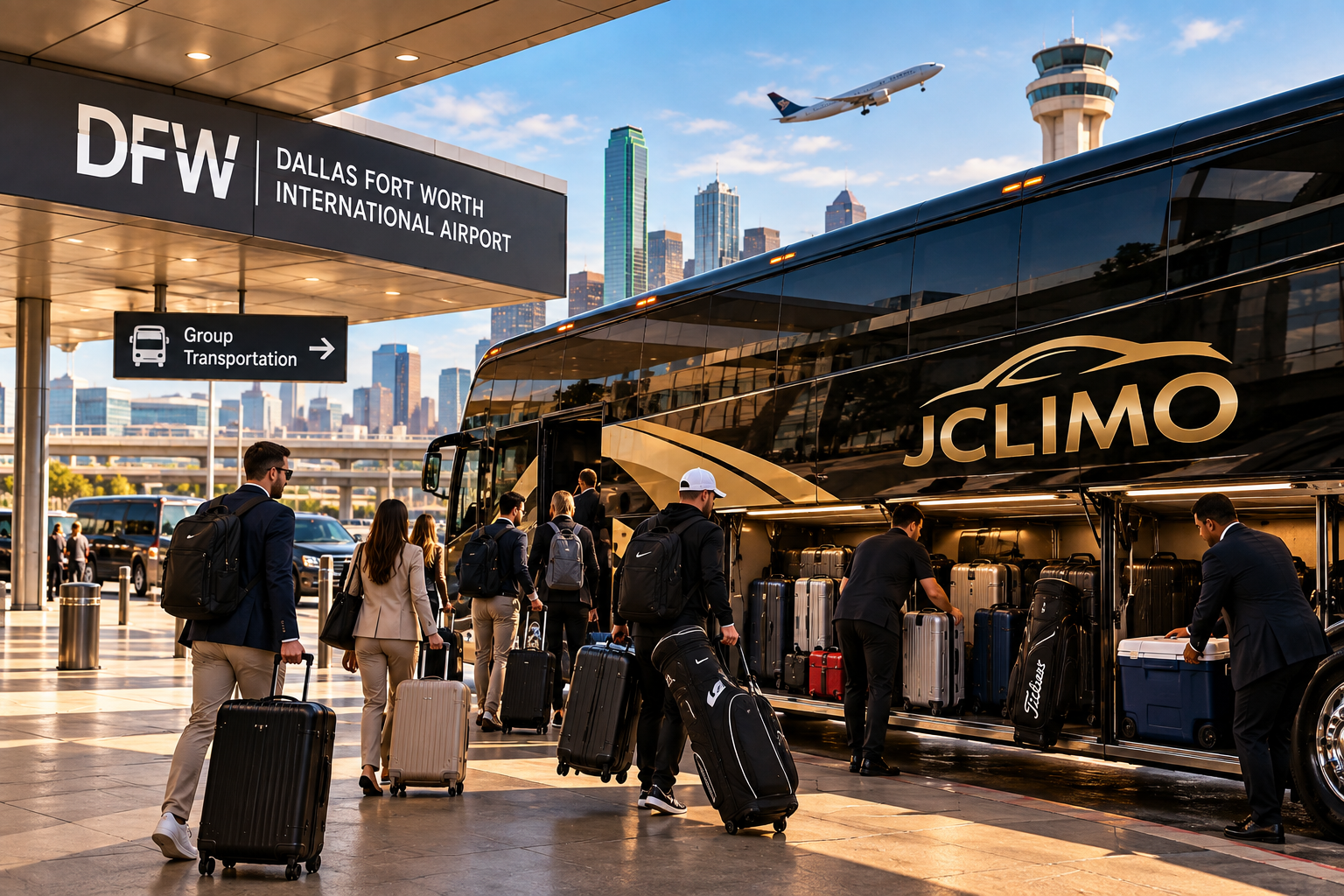
Moving a group from one place to another is one thing.
Moving the group along with suitcases, equipment, presentation materials, event supplies, and personal bags requires a different level of planning.
A corporate team arriving at DFW Airport may have luggage for several days. A sports group could travel with equipment in addition to personal bags. Event staff may need to move supplies between a hotel and venue. A family group might arrive in Texas with suitcases, carry-ons, and everything needed for a weekend away.
The number of passengers is only part of the transportation equation.
What everyone is bringing matters too.
JC LIMO provides bus and shuttle transportation for groups traveling throughout Dallas, Fort Worth, and surrounding Texas areas. When passengers have luggage or equipment, thinking about those belongings before transportation is arranged can help create a more practical travel plan.
Passenger Count Doesn’t Tell the Whole Story
When organizers begin looking for group transportation, one of the first questions is naturally how many people are traveling.
But imagine two groups with exactly the same number of passengers.
The first is traveling from a Dallas hotel to dinner.
Everyone has only a phone and a small personal bag.
The second has just landed at DFW International Airport for a five-day trip.
Every passenger has a suitcase, carry-on, laptop bag, and other personal belongings.
The passenger count is identical.
The transportation requirements are not.
This is why organizers should consider both people and belongings when planning a bus or shuttle.
A realistic picture of what the group is carrying helps make the transportation arrangement better suited to the actual trip.
Airport Groups Usually Have More Than Passengers
Airport transportation is one of the clearest examples.
A group arriving at DFW Airport may have a significant amount of luggage.
Even a relatively small group can generate a surprising number of bags when passengers are staying in Texas for several days.
There may be:
Checked suitcases
Carry-on bags
Backpacks
Laptop cases
Garment bags
Presentation materials
Special equipment
Personal items
If the group is traveling for a conference or corporate event, there could also be banners, displays, samples, promotional materials, or other business items.
That is why airport group transportation should not be planned using passenger numbers alone.
Think About Luggage Before the Group Lands
The best time to think about luggage is not when everyone is standing outside the airport.
It is during transportation planning.
Organizers can ask passengers or team leaders for a rough idea of what everyone will bring.
Does each traveler have one suitcase?
Are people traveling with oversized items?
Is the group carrying event equipment?
Are there presentation materials?
Will luggage remain with passengers throughout the day?
These questions can influence how the trip is organized.
For example, a group may land in Dallas in the morning but have a meeting before hotel check-in.
That means all of the luggage is part of the transportation plan for the first part of the day.
Hotel Check-In Can Affect the Route
Luggage also changes how arrival day works.
Suppose a group lands at DFW Airport at 10:00 a.m., but hotel rooms will not be available until later.
The first event begins in the afternoon.
The organizer needs to decide what happens between the airport and the event.
Can luggage be dropped at the hotel?
Does the group need to travel with it?
Will there be another stop first?
Where will the bus go after passengers leave their belongings?
Transportation planning should connect all of these steps.
A simple airport-to-hotel transfer may become:
DFW Airport → Hotel luggage drop → Lunch → Meeting → Hotel
Thinking through that sequence before arrival can make the first day much easier to organize.
Departure Day Creates a Similar Challenge
The same issue appears at the end of a trip.
Hotel check-out may be at 11:00 a.m., but the group’s flight could leave several hours later.
There may also be one final meeting, lunch, conference session, or activity before the airport.
Now the group has passengers plus all of their luggage.
The final day’s transportation plan needs to account for both.
Instead of thinking only about the airport departure, organizers should consider the complete route from hotel check-out until passengers reach DFW Airport.
That could include several stops.
When luggage is part of the plan from the beginning, those stops can be organized more realistically.
Corporate Groups May Carry More Than Suitcases
Business travel can involve much more than personal luggage.
A corporate group attending a trade show, conference, product demonstration, or client presentation may travel with materials needed for the event.
These could include display items, printed materials, samples, presentation cases, signs, branded items, or other business supplies.
If the company has several employees traveling together, the amount of equipment can add up quickly.
This is particularly important when transportation involves multiple locations.
The group might travel from the airport to a hotel, from the hotel to an event venue, and later to another business location.
Knowing which materials need to move with the group at each stage helps create a more practical transportation plan.
Trade Show Transportation Has Different Needs
Trade shows and exhibitions can create particularly equipment-heavy trips.
Employees may be carrying booth materials, marketing items, product samples, displays, or other supplies in addition to their own luggage.
The transportation plan should therefore consider what needs to arrive at the venue and when.
Some materials may need to travel with the group.
Others may have separate delivery arrangements.
Either way, the organizer should know what is being transported before the day begins.
This reduces the chance of arriving at a venue and realizing that the group’s transportation arrangement does not fit the belongings passengers brought with them.
Sports Groups Have Their Own Equipment Requirements
Sports transportation is another situation where passenger count is only one part of the picture.
Teams may travel with:
Uniform bags
Personal luggage
Sports equipment
Coolers
Training supplies
Medical kits
Coaching materials
Other team gear
The exact equipment depends on the sport and the trip.
A local game may require much less than a multi-day tournament.
A team traveling from outside Dallas could arrive with both personal luggage and sporting equipment.
Organizers should consider all of it when arranging bus transportation.
Keeping players, coaches, staff, and necessary gear on a coordinated travel plan can make moving between hotels, games, practices, and other destinations easier to manage.
Equipment Can Change During the Trip
Another detail organizers sometimes overlook is that the amount of luggage or equipment may change throughout the itinerary.
On arrival day, everyone has suitcases.
After hotel check-in, those suitcases may remain at the hotel.
The group then travels with much less.
On departure day, all the luggage returns.
Event materials may follow a similar pattern.
A corporate group might travel lightly to dinner but carry several cases to a conference the following morning.
Transportation requirements should therefore be considered for each major part of the trip rather than assuming every ride is identical.
Event Staff and Production Groups
Events often involve people who need to move supplies as well as themselves.
Staff members may carry registration materials, decorations, printed items, technology, signage, or other event-related equipment.
A group could need transportation between a hotel, preparation location, venue, and another event space.
For these trips, the organizer should communicate what passengers will bring.
Some equipment may require specialized handling or separate transportation, while other items can travel with the group depending on the arrangement.
The important thing is not to assume.
Providing accurate information during transportation planning helps avoid surprises on event day.
Family Groups Can Have a Lot of Luggage Too
Equipment-heavy transportation is not limited to businesses and sports teams.
Family groups can generate plenty of luggage.
A large family visiting Dallas for a reunion, wedding, graduation, or vacation may arrive with suitcases, carry-ons, personal bags, and items for children.
If several generations are traveling together, passengers may also have different mobility and packing needs.
Instead of dividing everyone and their belongings between several cars, group transportation can create one coordinated travel arrangement.
This can be particularly useful when everyone is arriving or departing around the same time.
Keep Belongings Organized Between Stops
Multi-stop trips require extra attention to belongings.
Imagine a group traveling:
Airport → Hotel → Lunch → Event Venue
Some bags may be dropped at the hotel.
Others may need to remain with passengers.
Event materials might continue to the venue.
Without a plan, it can become unclear which items are going where.
Before departure, organizers can identify:
What stays with passengers
What is dropped at the hotel
What needs to reach the event
Who is responsible for important equipment
Whether anything needs special handling
A few minutes of organization can prevent confusion later in the day.
Don’t Treat Every Bag the Same
Not all luggage is standard.
Some groups may travel with unusual or oversized items.
These could include specialized sports equipment, large presentation cases, instruments, event displays, or other items that require more consideration.
When arranging transportation, organizers should mention anything outside normal personal luggage.
That gives the transportation provider a clearer understanding of the trip.
It is much better to discuss unusual equipment before the day of travel than to discover a space or handling issue at pickup.
Plan for the Return Trip From the Beginning
People naturally think about luggage when arriving.
It should also be considered for the return.
At the end of a Dallas trip, passengers may have more belongings than when they arrived.
There could be conference materials, purchases, gifts, documents, or additional equipment collected during the trip.
If the group is traveling from a hotel to DFW Airport, organizers should make sure the final transportation plan reflects the luggage passengers will actually have on departure day.
The same applies to longer Texas trips.
If a group is traveling from Dallas or Fort Worth to another city, the bus or shuttle arrangement should consider everything passengers need to bring.
Boarding Takes Longer With Luggage
Luggage does not only affect space.
It can also affect timing.
A group carrying several bags per passenger generally needs more time to board than a group traveling empty-handed from a hotel to dinner.
People need to gather their belongings.
Items need to be accounted for.
Passengers may need to identify which bags belong to them.
At airports and hotels, this process can take longer than expected.
That is why group itineraries involving luggage should allow reasonable boarding time.
Scheduling a departure at the exact minute another activity ends can create unnecessary pressure.
Use a Simple Luggage Check Before Leaving
For group organizers, a simple check before departure can be helpful.
You do not need an elaborate tracking system.
Before leaving a hotel or airport, make sure passengers have checked that their major belongings are accounted for.
For teams and corporate groups, designated leaders can also confirm that shared equipment or materials are present.
This becomes especially important when the trip includes multiple stops.
It is much easier to identify a missing item before the bus leaves than after the group reaches the next side of Dallas–Fort Worth.
Group Transportation Can Reduce Vehicle Splitting
Luggage can make individual transportation even more complicated.
A group may discover that not every car has enough room for passengers and bags.
Now luggage is separated from its owner.
One suitcase travels in another vehicle.
Event supplies are divided between several cars.
Passengers arrive at different times.
The organizer has to keep track of both people and belongings.
Using an appropriate group bus or shuttle can reduce the need to split the group across multiple independent rides.
Everyone follows the same transportation plan, and the organizer has fewer moving parts to manage.
Longer Texas Trips Require Extra Preparation
Groups traveling beyond Dallas–Fort Worth may spend more time on the road.
For those journeys, packing and equipment become even more important.
Passengers may bring additional luggage for overnight stays.
Sports teams could have more gear.
Corporate groups may carry materials needed at the destination.
Before a longer Texas trip, organizers should confirm what passengers are bringing and whether any planned stops affect how belongings need to be organized.
The goal is to make the transportation arrangement fit the journey rather than trying to adapt everything at the last minute.
Choose Transportation Based on the Whole Trip
A useful transportation plan looks at more than the first pickup.
Consider the full itinerary.
How many passengers are traveling?
How much luggage do they have?
Are there oversized items?
Is there business or sports equipment?
Will luggage be dropped at a hotel?
Does the group have several stops?
Will the same belongings return on departure day?
Is the trip staying within Dallas–Fort Worth or continuing elsewhere in Texas?
The answers help create a clearer picture of what the group actually needs.
Communication Makes Luggage Planning Easier
Organizers do not need to know the exact dimensions of every suitcase.
But useful information should be communicated early.
Instead of saying:
“We have a group traveling from the airport.”
It is more helpful to explain:
“We have a group arriving at DFW Airport for a four-day trip, and most passengers will have checked luggage and carry-ons.”
If there is special equipment, mention it.
If the group has unusually large items, mention them.
If there are several stops before the hotel, mention that too.
Accurate information helps transportation planning reflect the real trip.
Bus and Shuttle Transportation Across Dallas–Fort Worth
Groups travel through North Texas for many different reasons.
Some come for business.
Others attend sporting events, weddings, conferences, reunions, tours, or private events.
The belongings they bring vary just as much as the reasons for traveling.
JC LIMO provides group transportation throughout Dallas, Fort Worth, and surrounding Texas communities, connecting airports, hotels, venues, businesses, restaurants, and other destinations.
When luggage and equipment are part of the journey, planning them alongside passenger transportation can help create a more organized experience.
Travel With the Group—and What the Group Brings
A successful group transportation plan should account for more than the people sitting in the seats.
Suitcases matter.
Carry-ons matter.
Sports gear matters.
Conference materials matter.
Event supplies matter.
And the route those belongings need to follow matters too.
JC LIMO provides buses and shuttles for groups traveling across Dallas–Fort Worth and North Texas.
Whether your passengers are arriving at DFW Airport with luggage, heading to a conference with business materials, traveling to a tournament with equipment, or beginning a longer Texas trip, the right transportation plan starts with understanding what the group is bringing.

Related posts
 13Oct, 26
Dallas Group Transportation With Luggage and Equipment
 13Oct, 26
Dallas Group Transportation With Multiple Drop-Offs
 13Oct, 26
- October 13, 2026
- 0
- 10
