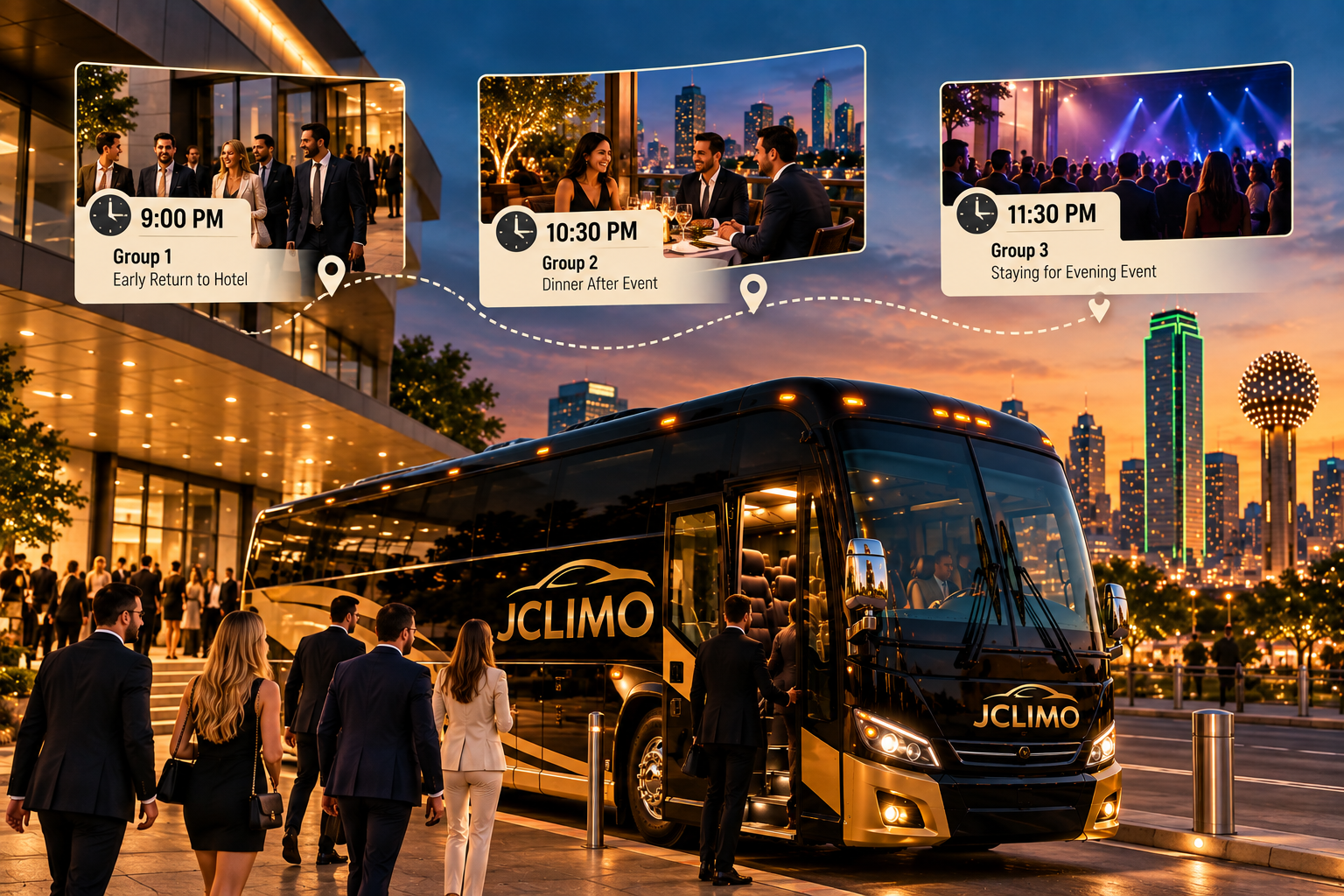
Group transportation is easy to picture when everyone follows the same schedule.
The bus picks everyone up together.
The group travels to the event.
The event ends.
Everyone gets back on the bus and returns to the hotel.
But real group trips are not always that simple.
A conference may finish at 5:00 p.m., while some employees stay for networking. A corporate event might have guests who leave after dinner while another group remains for an evening program. Wedding guests may want different return times. Sports teams, event staff, families, and private groups can all find themselves in situations where passengers arrive together but do not necessarily leave together.
That creates an important transportation question:
What happens when the group is ready to leave at different times?
JC LIMO provides bus and shuttle transportation throughout Dallas, Fort Worth, and surrounding Texas communities. For trips where passengers may finish activities at different times, planning the return transportation in advance can help keep the entire experience organized.
The Return Trip Deserves Its Own Plan
Transportation planning often focuses heavily on arrival.
What time should the bus leave the hotel?
When does everyone need to be at the venue?
Where is the group being dropped off?
Those are important questions.
But the return journey can be more complicated.
At the beginning of an event, everyone usually has the same deadline.
At the end, people may have different plans.
Some passengers want to leave immediately.
Others stay to talk.
A smaller group may have another activity afterward.
Event staff could need additional time to finish their responsibilities.
The return trip should therefore be planned as carefully as the initial transportation.
Why Groups Split Up at the End of the Day
There are many reasons passengers who arrived together may not be ready to leave together.
A business conference is a good example.
Some employees finish after the final session.
Others attend a networking reception.
Executives might have a client dinner.
A small team could remain for an additional meeting.
The same thing happens at private events.
At a wedding, some guests may prefer an earlier hotel return while others stay until the end of the reception.
At a sporting event, participants may leave at a different time from spectators or staff.
The important point is to identify these differences before the group is standing outside the venue trying to make a last-minute transportation decision.
One Departure Time Doesn’t Always Fit Everyone
The simplest transportation plan is one departure.
The bus arrives.
Everyone boards.
The group leaves.
When the schedule allows it, that works well.
But forcing every passenger into the same departure time may not always match the event.
If some guests are ready to leave at 9:00 p.m. and others plan to stay until 11:30 p.m., a single departure creates a compromise.
Either the early group waits for several hours, or the later group needs to find separate transportation.
Depending on the group size and itinerary, organizers may want to consider scheduled transportation windows instead.
The exact structure will depend on the event, number of passengers, destination, and overall transportation arrangement.
Corporate Events Often Have Different End Times
Business programs can become particularly complicated in the evening.
Imagine a company bringing employees to Dallas for a conference.
Everyone travels together in the morning.
During the day, the group follows the same schedule.
Then the conference ends.
Some employees return to the hotel.
Another group attends a reception.
Managers go to a private dinner.
Several team members stay at the conference venue for additional networking.
Suddenly, the group has divided into four different schedules.
If this possibility is known in advance, transportation can be planned around it.
Instead of making decisions at the end of a long day, organizers can communicate the available transportation schedule before the event begins.
Conference Transportation After the Final Session
Conferences are one of the clearest examples of staggered departures.
The official program may end at a specific time, but attendees do not necessarily leave immediately.
Some people continue conversations with colleagues.
Others visit exhibitors.
A company may host a private reception.
Employees could have dinner plans afterward.
For a group staying at the same Dallas hotel, organizers can decide whether one return shuttle is sufficient or whether the schedule requires additional planning.
Passengers should know what transportation is available before the final session ends.
This allows them to decide whether they need to be ready for a particular departure.
Networking Events Can Extend the Evening
Networking is difficult to schedule precisely.
A reception might officially end at 8:00 p.m., but some conversations continue.
For business travelers, those conversations may be one of the most valuable parts of the trip.
Transportation should not become an unexpected source of pressure.
If the group knows that the bus leaves at a specific time, passengers can plan accordingly.
If more than one transportation window is part of the arrangement, that should also be communicated clearly.
The goal is not to make the schedule complicated.
It is to prevent uncertainty when people are ready to leave.
Wedding Guests May Want Early and Late Returns
Weddings create another common situation.
Guests arrive at the ceremony or reception together, but not everyone wants to leave at the same time.
Families with children may prefer an earlier return.
Older relatives may not want to stay until the end of the evening.
Friends of the couple may plan to remain until the reception finishes.
If everyone is staying at the same hotel, transportation can potentially be planned around those different needs.
The key is setting expectations.
Guests should know whether there is one return time or more than one.
They should also know where to meet the shuttle and how early they should arrive at the pickup point.
Event Staff May Leave Later Than Guests
Not everyone at an event is simply attending.
Corporate teams, event organizers, production staff, exhibitors, and other workers may need to remain after guests leave.
They might collect materials, finish conversations, organize equipment, or complete event responsibilities.
If staff members are also relying on group transportation, their later departure should be included in the plan.
Otherwise, the main group may leave while the people working at the event are left trying to arrange another ride.
Understanding who needs transportation—and when—is just as important as knowing the total passenger count.
Sports Groups Can Split After Games
Sports transportation can also involve different end times.
Players and coaches may have post-game responsibilities.
Staff may need to handle equipment.
Families or supporters could leave immediately.
Some team members may return to the hotel while others attend a scheduled meal.
If the group is traveling from outside Dallas, these differences can be especially important because passengers may not have their own vehicles.
A clear bus or shuttle plan helps everyone understand what happens after the game.
Give Passengers the Return Schedule Before Arrival
One of the easiest ways to reduce confusion is to communicate the return plan before the group reaches the destination.
Do not wait until the event is almost finished.
Passengers should know:
Where the bus will meet them
What time they should be at the pickup point
When transportation departs
Whether there are multiple planned departures
Where each departure is going
Who to contact if they have a question
This information can be included in the itinerary, event email, group chat, or other communication.
The format matters less than making sure passengers receive it.
Use Clear Names for Different Departures
If an event involves more than one transportation window, avoid vague descriptions.
“Early bus” and “late bus” may work conversationally, but specific times are clearer.
For example:
Hotel Return 1: Meet at 8:45 p.m. – Depart at 9:00 p.m.
Hotel Return 2: Meet at 10:45 p.m. – Depart at 11:00 p.m.
Passengers can immediately understand which transportation option fits their plans.
This is particularly useful for weddings, conferences, corporate dinners, and other events where attendees may choose how long they stay.
Make the Pickup Location Easy to Find
Departure timing is only useful if passengers know where to meet.
Large event venues can have several entrances.
Hotels may have multiple pickup areas.
Convention centers can cover significant areas.
Stadiums and entertainment venues may have designated transportation zones.
“Meet outside” is often not specific enough.
Organizers should identify a clear pickup point before the event.
If possible, passengers should receive that information before they separate inside the venue.
Allow Time Between Meeting and Departure
If transportation departs at 10:00 p.m., passengers should not be told to meet at exactly 10:00.
They need time to leave the event, walk to the pickup point, and board.
A meeting time before departure creates a useful buffer.
For example:
Meet: 9:45 p.m.
Depart: 10:00 p.m.
This simple distinction can help keep the transportation schedule more organized.
It also makes expectations clearer for the group.
Hotels May Be the Common Return Point
For out-of-town groups, the hotel is often the easiest common destination at the end of the day.
Passengers may have spent the day in different meetings or activities, but eventually many need to return to the same property.
This makes hotel transportation an important part of conference, wedding, sports, and corporate planning.
If a group is staying at multiple hotels, the return plan may require several drop-off locations.
That should be considered when determining departure timing.
Multiple Hotels Make the Return More Complex
Suppose wedding guests are staying at three hotels.
At the end of the reception, the bus needs to return passengers to each property.
The order of those stops matters.
So does the number of passengers going to each location.
The same situation can occur with conference groups.
Some employees stay near DFW Airport.
Others are in downtown Dallas.
A single return route may not always make sense.
Organizers should think about where passengers actually need to go rather than assuming everyone has the same final destination.
Dallas–Fort Worth Distances Matter Late at Night Too
A group may attend an event in Dallas but stay in Fort Worth.
Another could have dinner in Arlington after a conference in Dallas.
Passengers might be returning to hotels near DFW Airport, Irving, Plano, Frisco, Grapevine, or another part of North Texas.
The distance does not disappear because the main event has ended.
Return transportation needs to account for the actual geography of the trip.
A late-night drive across the Metroplex is still part of the itinerary and should be planned accordingly.
Think About Who Is Taking Each Bus
If multiple transportation windows are planned, organizers should have a rough idea of passenger distribution.
If almost everyone plans to leave early and only a small number stay late, that information matters.
The goal is not necessarily to create an exact passenger manifest for every situation.
It is to understand the likely transportation needs.
For corporate groups, employees may be able to select their preferred return time in advance.
Wedding planners can estimate how many guests may use earlier transportation.
Event organizers can identify staff members who will remain later.
These details make planning more realistic.
Last-Minute Changes Still Happen
Even with a clear plan, people change their minds.
Someone planning to stay late may decide to leave earlier.
Another passenger becomes involved in a conversation and misses the first planned departure.
An event runs longer than expected.
A meeting ends early.
Group transportation planning cannot eliminate every change.
What it can do is create a structure.
When passengers understand the planned transportation windows, last-minute decisions are easier to manage than when no return plan exists at all.
Avoid Having Everyone Arrange Rides at the End
The end of an event is often the worst time to begin organizing transportation.
Passengers are tired.
People are leaving in different directions.
The venue may be busy.
Rideshare pickup areas can become crowded.
Some guests may not know Dallas well.
Others may be carrying luggage, equipment, or event materials.
Planning bus or shuttle transportation before the event means the group already knows what happens when the activity ends.
That removes one more decision from the end of the day.
Late Transportation Should Be Part of the Itinerary
If an event is expected to end late, that should be visible in the travel plan.
Passengers should not have to wonder whether transportation is still available.
For groups visiting Dallas from outside Texas, this becomes particularly important.
They may not have rental vehicles or local transportation knowledge.
A clear return schedule gives them confidence about how they are getting back to the hotel or next destination.
The Final Departure Should Be Clearly Defined
When several transportation windows exist, there should be no confusion about the last one.
Passengers need to know when the final scheduled departure occurs.
That gives everyone a clear boundary for the evening.
For example:
“Final hotel shuttle departs at 11:30 p.m.”
That is much clearer than saying transportation will be available “later.”
Specific communication helps people make their own decisions about when to leave.
Different Groups May Continue to Different Destinations
Sometimes the group does not simply split between early and late departures.
Different passengers may actually be going to different places.
One group returns to the hotel.
Another goes to dinner.
A third travels to an evening activity.
Executives may continue to a private meeting.
In that case, transportation planning should focus on the next destination rather than only the departure time.
The organizer needs to understand both:
When are people leaving?
and
Where are they going?
Those two questions create the real transportation plan.
Keep the Passenger Experience Simple
Transportation logistics can become complicated behind the scenes.
The passenger experience should remain simple.
People should know:
Where to meet.
When to meet.
Which bus or shuttle they are taking.
Where it is going.
That is enough.
Organizers can handle the larger route planning without requiring every passenger to understand the full transportation structure.
Group Transportation Should Work With the Event
The event schedule should not have to be completely redesigned around transportation.
Transportation should support what the group is actually doing.
If guests naturally finish at different times, that should be considered during planning.
If employees split into different evening activities, the transportation plan should acknowledge it.
If everyone genuinely leaves together, a single departure may be all that is needed.
The right arrangement depends on the group—not on a one-size-fits-all schedule.
Plan Dallas Group Returns With JC LIMO
Getting a group to an event is only the first half of the transportation plan.
You also need to know how everyone is getting back.
JC LIMO provides bus and shuttle transportation for groups traveling throughout Dallas, Fort Worth, and surrounding Texas communities.
From conferences and corporate events to weddings, sports trips, meetings, private gatherings, hotel transfers, and other group activities, return transportation can be planned around the way your group actually travels.
Some passengers may leave early.
Others may stay later.
Different groups may continue to different destinations.
The important thing is having a plan before the event ends.

