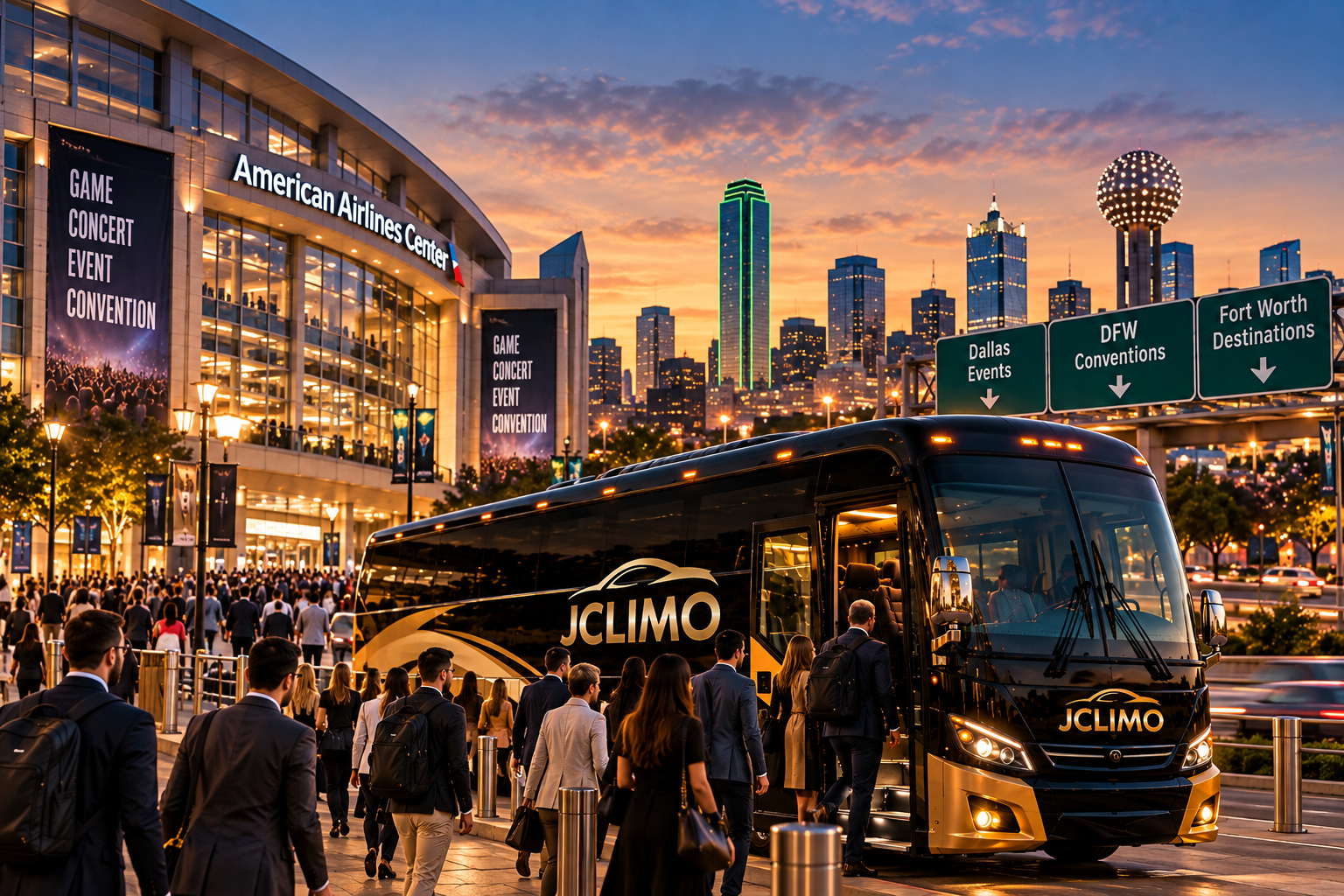
Dallas–Fort Worth is always moving.
But some days are much busier than others.
A major conference fills hotels and convention spaces. A sporting event brings thousands of people into one area. A concert creates heavy traffic around a venue. Several large events may happen across Dallas, Arlington, and Fort Worth on the same weekend.
For individual travelers, a busy event day may simply mean leaving earlier.
For groups, it can affect the entire transportation plan.
Pickup locations become more important. Travel windows may need additional time. Parking areas can be crowded. Hotel entrances become busy. Venue access may change as more vehicles arrive. Passengers need clear instructions about where to meet before and after an event.
JC LIMO provides bus and shuttle transportation for groups traveling throughout Dallas, Fort Worth, and surrounding Texas communities.
When your group is traveling on a busy day, planning transportation before the crowds arrive can help create a more organized experience.
What Makes a Dallas Travel Day “Busy”?
A busy travel day does not necessarily mean the entire Dallas–Fort Worth area is crowded.
Often, activity is concentrated around specific locations.
A convention may affect roads and hotels around a business district.
A major game can increase traffic around a stadium.
A concert may create congestion near an entertainment venue.
A festival can affect streets and parking in one part of the city.
At the same time, normal commuter traffic continues across North Texas.
For group organizers, the important question is not simply:
“Will Dallas be busy?”
It is:
“What could affect the route our group needs to travel?”
That creates a much more useful starting point for transportation planning.
Start With the Event Schedule
The first step is understanding exactly when the group needs to arrive.
If an event begins at 7:00 p.m., that does not mean transportation should be planned to reach the area at 6:55 p.m.
Passengers may need time to leave the bus, walk to an entrance, pass through event procedures, locate seats, check in, or meet other attendees.
Large groups often need more time for these steps than individual travelers.
Start with the required arrival time and work backward.
Consider:
How long passengers need after arrival.
How long unloading may take.
Estimated travel time.
Possible event traffic.
Boarding time at the hotel or pickup location.
This creates a more realistic departure time.
Distance Alone Doesn’t Tell You When to Leave
A destination may appear relatively close to the hotel on a map.
That does not mean the trip will always take the same amount of time.
Traffic conditions across Dallas–Fort Worth can change depending on the day, time, road conditions, and local events.
A route that moves easily in the afternoon could look very different before a major evening event.
For groups, relying on the shortest possible travel time creates unnecessary pressure.
Transportation planning should include enough flexibility for the real conditions surrounding the trip.
Conventions Can Create Transportation Demand Across the City
Large conventions affect more than the convention venue itself.
Attendees may stay across multiple hotels.
Companies may host dinners and private receptions after official sessions.
Teams could schedule client meetings at other locations.
Employees may need transportation between hotels, conference facilities, restaurants, offices, and evening events.
That means a conference transportation plan should consider the full day.
A group could follow a schedule such as:
Hotel → Conference
Conference → Client Dinner
Client Dinner → Private Event
Private Event → Hotel
On a busy convention day, arranging those connections before the trip begins can make the schedule much easier to understand.
Hotel Pickup Areas Can Get Busy
Hotels are natural meeting points for group transportation.
But during large events, the front of a hotel can become crowded.
Several groups may be leaving around the same time.
Taxis, rideshare vehicles, buses, hotel shuttles, private cars, and guests can all be using the same area.
Passengers should therefore know exactly where their JC LIMO bus or shuttle pickup is expected to take place.
Clear communication can prevent guests from waiting at the wrong entrance or looking for transportation after the scheduled departure time.
Sporting Events Require More Than a Game-Time Plan
A group attending a sporting event needs to think beyond kickoff, tipoff, or the opening pitch.
When will the surrounding area become busy?
Where will the group be dropped off?
How long will passengers need to reach the venue entrance?
Where will everyone meet afterward?
Will thousands of other people be leaving at the same time?
The post-event transportation plan can be just as important as the arrival.
When a large crowd exits together, passengers should already know their meeting point.
Trying to decide where the bus is located after leaving the venue can create unnecessary confusion.
Concert Transportation Has Similar Challenges
Concerts create many of the same transportation considerations.
Groups may travel from hotels, restaurants, private gatherings, or other parts of Dallas–Fort Worth to the venue.
Before the concert, passengers are generally focused on arriving on time.
Afterward, the entire crowd may begin leaving at once.
A clearly communicated pickup location is essential.
Passengers should know where they are expected to meet and whether they need to walk to a designated transportation area.
For out-of-town groups, these instructions become even more valuable because visitors may not recognize surrounding streets or landmarks.
Conferences, Games, and Concerts Can Overlap
Dallas–Fort Worth is large enough to host several major activities at the same time.
A conference may be taking place in Dallas while a sporting event is happening in Arlington and another large event draws crowds elsewhere in the Metroplex.
Your group may not be attending all of those events, but surrounding activity can still influence transportation.
This is why organizers should consider the broader day rather than focusing exclusively on their own venue.
The route between a hotel and destination may pass through areas affected by other traffic.
Corporate Events Often Have Fixed Arrival Times
Business events may have less flexibility than private activities.
If a presentation begins at 9:00 a.m., employees cannot simply arrive whenever traffic allows.
Client meetings, training sessions, conferences, product launches, and company programs all depend on timing.
Group bus transportation allows the company to establish one departure schedule.
Instead of asking every employee to navigate busy Dallas traffic independently, passengers can meet at a designated location and travel together.
That gives the organizer fewer separate arrivals to track.
Group Transportation Can Reduce Parking Coordination
Parking becomes another challenge on busy event days.
When a group travels in individual cars, each driver needs to understand where to park.
Some may use different lots.
Passengers could enter the venue from different directions.
After the event, everyone has to find their vehicle before continuing to the next destination.
A bus or shuttle changes that process.
Passengers can travel according to one transportation plan without every person needing to coordinate an individual car.
For large groups, this can significantly simplify the logistics surrounding an event.
Multiple Cars Can Mean Multiple Delays
Imagine 25 employees traveling from a hotel to a major event using several different vehicles.
One car leaves early.
Another gets stuck behind traffic.
Someone misses an exit.
A rideshare driver goes to the wrong hotel entrance.
Several passengers struggle to locate parking.
Even if most people arrive on time, the organizer may still be waiting for the last few.
With group transportation, more passengers move together.
The group may still encounter traffic, but they encounter it as one group rather than as several separate journeys.
Build Boarding Time Into the Schedule
On a busy day, the transportation schedule should not begin with the moment the bus moves.
Boarding is part of the trip.
Passengers need to leave their rooms or previous activity, reach the pickup location, identify the correct transportation, and board.
If luggage, event materials, or equipment is involved, additional time may be necessary.
For example:
Passenger meeting time: 4:30 p.m.
Planned departure: 4:45 p.m.
That gives the group a clear window rather than expecting everyone to appear at the exact second transportation is supposed to leave.
Give Passengers One Clear Meeting Point
A busy environment makes vague instructions worse.
“Meet near the venue” is not enough.
“Meet somewhere outside the hotel” can also create problems.
Group organizers should communicate a specific meeting location.
Passengers should know:
Where to meet.
What time to arrive.
When the bus is expected to depart.
What destination comes next.
Where to meet after the event.
The more crowded the day, the more valuable those simple details become.
Out-of-Town Groups Need Extra Clarity
Visitors from outside Texas may not understand the geography of Dallas–Fort Worth.
They may not know how far their hotel is from the event.
They may also be unfamiliar with the venue area.
On busy days, asking visitors to independently arrange transportation can add unnecessary complexity.
A bus or shuttle gives the group a shared plan.
Visitors know when to be ready and where transportation will take them.
They do not need to personally determine routes, parking areas, or how different parts of the Metroplex connect.
Weddings Can Be Affected by Busy Weekends Too
Large public events are not the only activities that need transportation planning.
A wedding may happen on the same weekend as a major conference, sporting event, festival, or concert.
That can affect hotel availability and local traffic even if the wedding venue is unrelated to the public event.
Wedding planners and couples should consider what else may be happening in the area when setting shuttle schedules.
Guests may be traveling between hotels, ceremonies, receptions, and other wedding activities.
Providing realistic transportation windows can help keep the wedding itinerary moving.
Private Events Need the Same Planning
Birthday celebrations, family reunions, graduations, company dinners, church activities, and other private events can all take place during busy periods.
The fact that the event itself is private does not mean the roads around it will be quiet.
If the group is moving through Dallas on a major event weekend, the transportation plan should reflect that.
This is especially important when several activities are scheduled close together.
Don’t Schedule Every Activity Too Tightly
Busy days are not ideal for itineraries with no margin between stops.
If lunch ends at 2:00 p.m. and the next event begins across the Metroplex at 2:30 p.m., the schedule may already be difficult before traffic is considered.
Groups need time to leave one activity, board the bus, travel, unload, and reach the next destination.
Adding realistic gaps between activities can make the entire day feel less rushed.
A little extra time in the schedule can be more valuable than trying to fit in one additional stop.
The Return Trip Can Be Harder Than Arrival
Before an event, passengers generally arrive over a wider period.
Afterward, thousands of people may leave at once.
That makes the return journey an important part of transportation planning.
Before passengers enter the venue, they should know:
Where the return pickup will be.
When they need to be there.
What time the bus plans to leave.
Whether the group is returning to a hotel or continuing somewhere else.
Providing these instructions in advance avoids trying to organize everyone after the crowd begins moving.
Consider What Happens After the Main Event
Some group itineraries continue after a game, conference, or concert.
Passengers may travel to dinner.
A corporate group might attend a reception.
Wedding guests could continue to another venue.
Visitors may return to a hotel.
The transportation plan should not end at the event.
Think about the complete route.
For example:
Hotel → Conference → Dinner → Hotel
Or:
Restaurant → Sporting Event → Hotel
Or:
Hotel → Wedding → Reception → Hotel
On busy days, connecting these movements in advance becomes particularly useful.
Different Departure Times Need Clear Planning
Not every passenger will always leave at the same time.
Some conference attendees may stay for networking.
Wedding guests might prefer an earlier return.
Event staff could need to remain after everyone else.
If the group has different departure requirements, identify them before the event.
Transportation should reflect how passengers actually plan to travel rather than assuming everyone follows the exact same schedule.
Keep Important Transportation Information Easy to Find
A transportation plan is only useful when passengers can access it.
For group trips, organizers can share a short schedule through email, a group chat, event materials, or another communication channel.
Keep the information simple.
For example:
Hotel Meet: 5:15 p.m.
Bus Departure: 5:30 p.m.
Event Arrival: Planned before event start
Return Meeting Point: Designated pickup area
Return Departure: 10:30 p.m.
Passengers do not need every route detail.
They need the information required to be in the right place at the right time.
Don’t Wait Until Event Day to Think About Transportation
Busy event days reward early planning.
Waiting until the group is already in Dallas to determine how everyone will reach a major venue can create unnecessary decisions.
Transportation should be considered when the broader trip is being organized.
Once the hotel, venue, dates, passenger count, and approximate schedule are known, organizers can begin thinking about how the group will move.
That also provides an opportunity to identify potential issues before they affect the itinerary.
Dallas and Fort Worth Require Regional Thinking
Groups visiting North Texas sometimes think only in terms of “Dallas transportation.”
But the itinerary may actually involve several parts of the DFW Metroplex.
The hotel could be in Irving.
The event might be in Arlington.
Dinner could be in Dallas.
The following day’s activity might be in Fort Worth.
Each journey has its own timing considerations.
On busy days, looking at the entire region helps organizers create a more realistic plan.
A Bus Can Keep the Group Experience Together
Busy event days can feel chaotic when passengers are scattered across different vehicles.
Group transportation creates one point of consistency.
Everyone meets at the same place.
They travel together.
They receive the same transportation instructions.
They arrive according to the same plan.
After the event, they know where to regroup.
That structure can be valuable for corporate teams, wedding guests, sports groups, families, conference attendees, schools, organizations, and other groups traveling throughout Dallas–Fort Worth.
Plan for the Crowd, Not Just the Distance
A transportation plan should reflect the day the group is actually traveling.
A route on a quiet afternoon is different from the same route before a major event.
The destination may not change.
The distance may not change.
But the environment around the trip can.
That is why busy event transportation should consider timing, passenger coordination, pickup locations, venue access, and the return journey—not just mileage.
Plan Busy Dallas Travel With JC LIMO
A crowded Dallas–Fort Worth event day does not have to turn group transportation into a last-minute problem.
JC LIMO provides buses and shuttles for groups traveling to conferences, corporate events, sporting events, concerts, weddings, private gatherings, hotels, airports, and destinations throughout North Texas.
Whether your group is traveling across Dallas, Fort Worth, Arlington, or the wider DFW area, planning transportation around the day’s schedule can help keep everyone connected.
Know where the group is meeting.
Allow realistic travel time.
Plan the return trip.
And make transportation part of the event plan from the beginning.

Related posts
 13Oct, 26
Dallas Group Transportation With Luggage and Equipment
 13Oct, 26
Dallas Group Transportation With Multiple Drop-Offs
 13Oct, 26
- October 13, 2026
- 0
- 10
