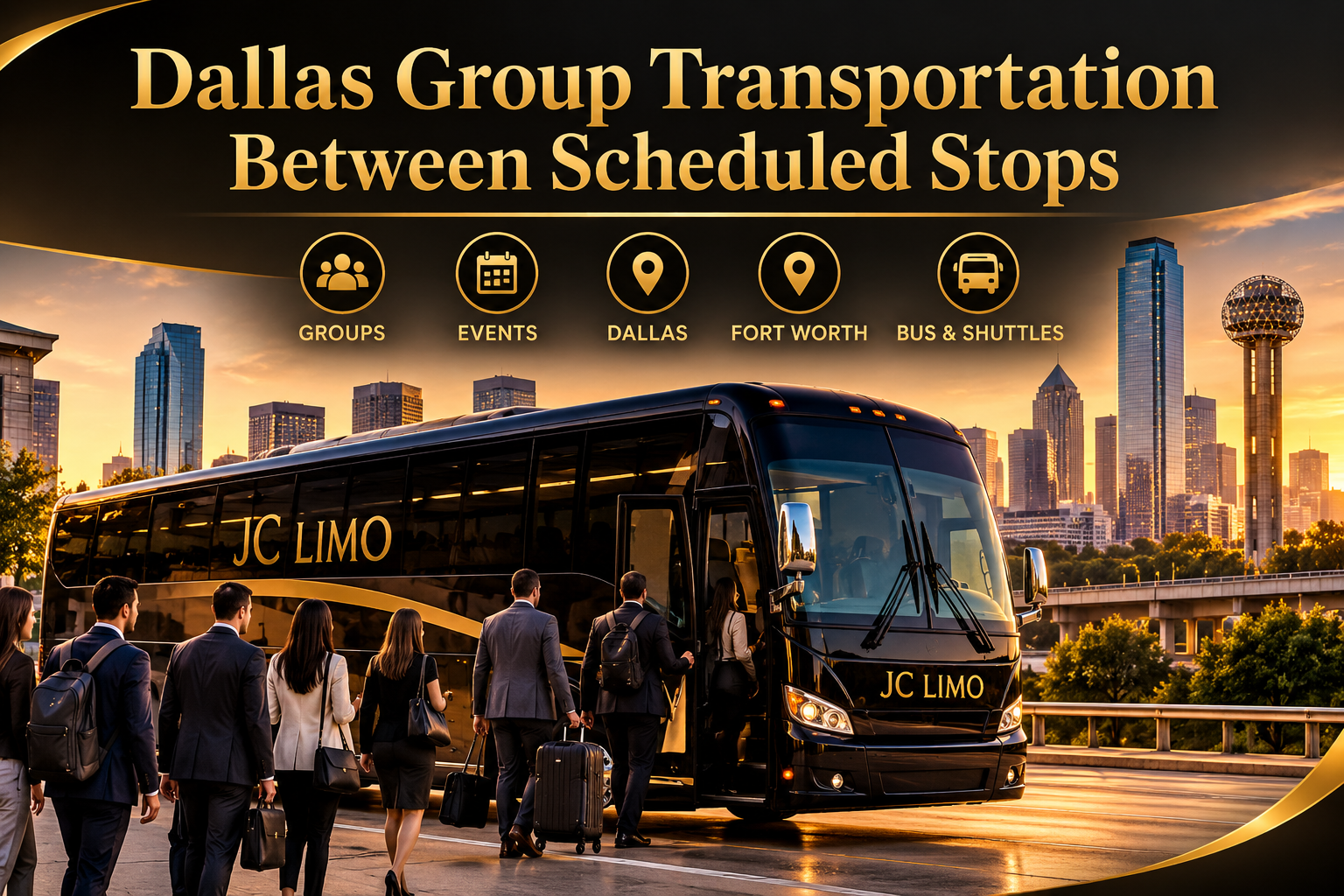
Planning group transportation usually starts with the big moments.
What time does the conference begin? When does the wedding ceremony start? What time is the team expected at the venue? When should everyone arrive at the airport?
Those times matter, but experienced group planners know that another part of the schedule can be just as challenging: everything that happens between those major activities.
Maybe hotel checkout is at 11:00 a.m., but the next event does not begin until 2:00 p.m. Perhaps a corporate meeting finishes earlier than expected, while dinner reservations are still two hours away. A group may need to leave one Dallas venue, make a quick stop, collect additional passengers, and continue to Fort Worth later in the afternoon.
These gaps can create transportation problems when they are not planned in advance.
In a large region like Dallas–Fort Worth, Texas, the solution is not simply having a vehicle available. Groups need a transportation plan that accounts for timing, distances, stops, waiting periods, traffic, and the way the entire day fits together.
That is where organized bus and shuttle transportation can make a significant difference.
The Hardest Part of Group Travel Is Often Between Events
A group itinerary can look perfectly organized on paper.
Breakfast at 8:00 a.m.
Meeting at 10:00 a.m.
Lunch at 1:00 p.m.
Site visit at 3:00 p.m.
Dinner at 7:00 p.m.
The schedule appears simple until you start asking transportation questions.
When should the group leave breakfast?
Where will the bus wait during the meeting?
Does everyone leave the meeting together?
What happens if lunch ends early?
Is there enough travel time between Dallas and the next destination?
Will the group return to the hotel before dinner?
Are passengers carrying bags, equipment, presentation materials, or personal belongings?
These details determine whether a transportation schedule actually works.
For individuals, an unexpected 45-minute gap is usually manageable. Someone can wait in a coffee shop, walk around, or request another ride later.
For groups, it becomes more complicated.
When 20, 30, 40, or more people are traveling together, every unplanned period can create opportunities for passengers to become separated, arrive late, or misunderstand where they are supposed to meet.
A dedicated JC LIMO transportation plan helps keep the day connected from one scheduled activity to the next.
Dallas–Fort Worth Requires Realistic Travel Planning
Dallas and Fort Worth are part of the same Metroplex, but that does not mean every destination is close.
A group might stay near DFW International Airport while attending meetings in Dallas. Another could have an afternoon activity in Arlington followed by dinner in Fort Worth. Corporate groups may travel between Plano, Irving, Frisco, Dallas, and other North Texas business areas during a single itinerary.
Distances add up quickly.
Traffic conditions can also change how much time should be allocated between stops.
That is why group transportation across Dallas, Fort Worth, and surrounding Texas communities should be considered part of the itinerary itself rather than something added after the schedule is finished.
A realistic schedule needs room for boarding, loading belongings, navigating traffic, reaching designated loading areas, and getting the entire group off the vehicle.
Five minutes on a spreadsheet is rarely just five minutes in real group travel.
Why Separate Rides Can Create Problems During Schedule Gaps
Rideshare services and individual vehicles may work well for small parties, but they become more difficult to coordinate as the number of travelers grows.
Imagine a group leaving a morning activity in Dallas.
Some people request rides immediately. Others stop to make a phone call. A few passengers decide to get coffee before leaving. One rideshare driver arrives at the wrong entrance. Another vehicle gets caught in traffic.
Within minutes, one group has become five or six smaller groups moving independently.
Now imagine the next destination has a scheduled arrival time.
Someone has to determine who has arrived, who is still traveling, and whether everyone knows exactly where to go.
With dedicated bus transportation or group shuttles, passengers can board at an agreed location and continue according to one coordinated schedule.
Instead of tracking multiple vehicles, the organizer has one transportation plan.
That becomes especially valuable on days containing several activities.
Hotel Checkout Can Create an Unexpected Transportation Gap
Hotel checkout is one of the most common examples of an awkward scheduling period.
Suppose a group is visiting Dallas for a multi-day conference.
Checkout is at 11:00 a.m., but the group’s final activity begins at 1:30 p.m.
What happens during those two and a half hours?
If everyone handles transportation independently, passengers may leave at different times, carry luggage around, or arrive at the next location much earlier than necessary.
A planned bus or shuttle schedule gives the organizer more control over that transition.
The group can have a defined departure time, keep belongings organized according to the transportation arrangement, and move to the next scheduled location together.
The same approach can help with the opposite situation: arriving in Dallas before hotel check-in.
When flight schedules and hotel schedules do not match, transportation planning can help turn an awkward waiting period into a structured part of the itinerary.
Corporate Groups Often Have More Gaps Than They Expect
Business transportation is rarely limited to one trip from a hotel to a meeting.
A corporate itinerary might involve:
hotel → headquarters → lunch → client meeting → hotel → dinner.
Another group might visit several facilities across Dallas–Fort Worth during the same day.
The difficulty is that meetings do not always end exactly when expected.
A presentation scheduled to finish at 11:30 a.m. might end at 11:10. A site tour might take 30 minutes longer than planned. A client meeting might be moved to another building.
When transportation has been arranged around the overall itinerary, those transitions are easier to manage than when new rides need to be coordinated after every activity.
For companies hosting employees, clients, executives, conference attendees, or visiting partners, organized transportation can also create a more professional experience.
Guests do not have to repeatedly figure out where they are going next.
They can simply follow the established schedule.
Bus Transportation Keeps the Group Connected
There is a major logistical advantage to keeping a group together.
Communication becomes easier.
If the schedule changes, everyone can receive the same update. If the next destination changes, the group can move according to the revised plan rather than trying to contact passengers spread across different vehicles.
This is one reason bus transportation in Dallas and Fort Worth works well for complex itineraries.
A bus is not simply transportation from point A to point B. It can become the connecting element between every part of the group’s day.
The organizer knows where the group is.
Passengers know where they should board.
The next venue can receive a more predictable arrival.
That structure matters when timing is important.
Shuttle Transportation Can Support Repeating Movements
Not every itinerary requires the entire group to move at once.
Some events work better with shuttle transportation operating between two or more locations.
For example, a conference might have attendees moving between a hotel and an event venue throughout the day.
A corporate program could require transportation between an office and an off-site meeting location.
A private event might need guests transported from designated parking or hotel locations to the main venue.
Instead of treating every movement as a separate transportation request, planners can create a shuttle structure around the actual flow of passengers.
This can be particularly useful when different parts of the group have slightly different schedules.
The key is planning the route and timing before the event begins.
Think About Where the Group Will Actually Wait
Waiting time is part of transportation planning, even though it is often overlooked.
If the bus arrives before passengers are ready, is there somewhere appropriate for the vehicle to wait?
If the group arrives early at the next location, can passengers enter?
Does the venue have a designated bus loading area?
Can a large vehicle remain near the property?
Will passengers need to walk from the loading area to the entrance?
These questions become important in busy parts of Dallas and Fort Worth where vehicle access, parking, and loading zones can vary from one property to another.
A strong transportation itinerary considers both driving time and transition time.
That distinction can prevent unnecessary rushing.
Build Buffer Time Into Every Major Transition
One of the easiest ways to improve group transportation is to stop planning every movement down to the exact minute.
Groups take time to move.
People need to gather their belongings.
Someone may need to return to a hotel room.
Passengers need to board.
Traffic lights, construction, congestion, and venue access can all add time.
Building a reasonable buffer into important transitions gives the schedule room to absorb small delays without affecting everything that follows.
For example, if a group absolutely must arrive at a Dallas venue by 6:00 p.m., planning transportation around an arrival at exactly 6:00 leaves no room for unexpected conditions.
The transportation schedule should work backward from the required arrival time while considering the route, boarding process, and local conditions.
That is much more practical than simply checking the estimated driving time on a map.
Multiple Stops Need to Be Planned as One Journey
Some groups need more than a simple round trip.
You may need to collect attendees from multiple hotels.
You might have passengers joining the group later.
There could be a lunch stop between two business locations.
The itinerary may involve Dallas in the morning, Arlington in the afternoon, and Fort Worth in the evening.
In situations like these, each stop should not be treated as an isolated trip.
They are parts of one transportation program.
JC LIMO can coordinate group transportation around multi-stop itineraries throughout the Dallas–Fort Worth area, allowing the route and schedule to be considered together.
This approach helps planners understand how one stop affects the next.
If the first departure moves 15 minutes later, for example, the impact on later activities can be considered immediately.
Group Transportation Is Also About the Passenger Experience
Good logistics should feel simple to the passenger.
Most guests do not want to think about routes, parking, pickup locations, traffic, or travel times throughout the day.
They want to know:
Where do I meet the bus?
What time are we leaving?
Where are we going?
When will we arrive?
Clear answers create a smoother experience.
That is particularly important for visitors who are unfamiliar with Dallas–Fort Worth.
Someone visiting North Texas for the first time may not realize how spread out the Metroplex is or how long it can take to move between different cities.
Organized JC LIMO bus and shuttle transportation gives those passengers a simpler way to follow the itinerary without navigating an unfamiliar region independently.
A Better Way to Plan a Full Day in Dallas–Fort Worth
When building your next group itinerary, start thinking about transportation before the schedule is finalized.
Write down every location the group needs to visit.
Then look at what happens between those locations.
How long will boarding take?
Does the group need to return to the hotel?
Will luggage be involved?
Are there multiple pickups?
Could one activity finish early or late?
Does the next venue have a strict arrival window?
Is the itinerary crossing between Dallas, Fort Worth, Arlington, Plano, Frisco, Irving, or another part of the Metroplex?
Those questions reveal transportation needs that might otherwise appear only on the day of the trip.
The earlier they are identified, the easier it becomes to build a practical schedule.
Keep Every Part of the Day Connected With JC LIMO
Successful group travel is not only about reaching the final destination.
It is about keeping the entire day moving.
From the first hotel pickup to the final drop-off, every transition affects what comes next.
That is why transportation deserves the same level of planning as meetings, reservations, event schedules, and activities.
For groups traveling throughout Dallas, Fort Worth, and North Texas, JC LIMO provides bus and shuttle transportation designed around real itineraries—not just individual rides.
Whether your schedule includes multiple activities, hotel transitions, business meetings, events, meals, sightseeing, or several destinations across the Metroplex, a coordinated transportation plan helps keep everyone moving together.
Instead of asking passengers to figure out each trip independently, give the group one clear plan.
One schedule.
One coordinated route.
And transportation that connects every part of the day.

Related posts
 13Oct, 26
Dallas Group Transportation With Luggage and Equipment
 13Oct, 26
Dallas Group Transportation With Multiple Drop-Offs
 13Oct, 26
- October 13, 2026
- 0
- 10
