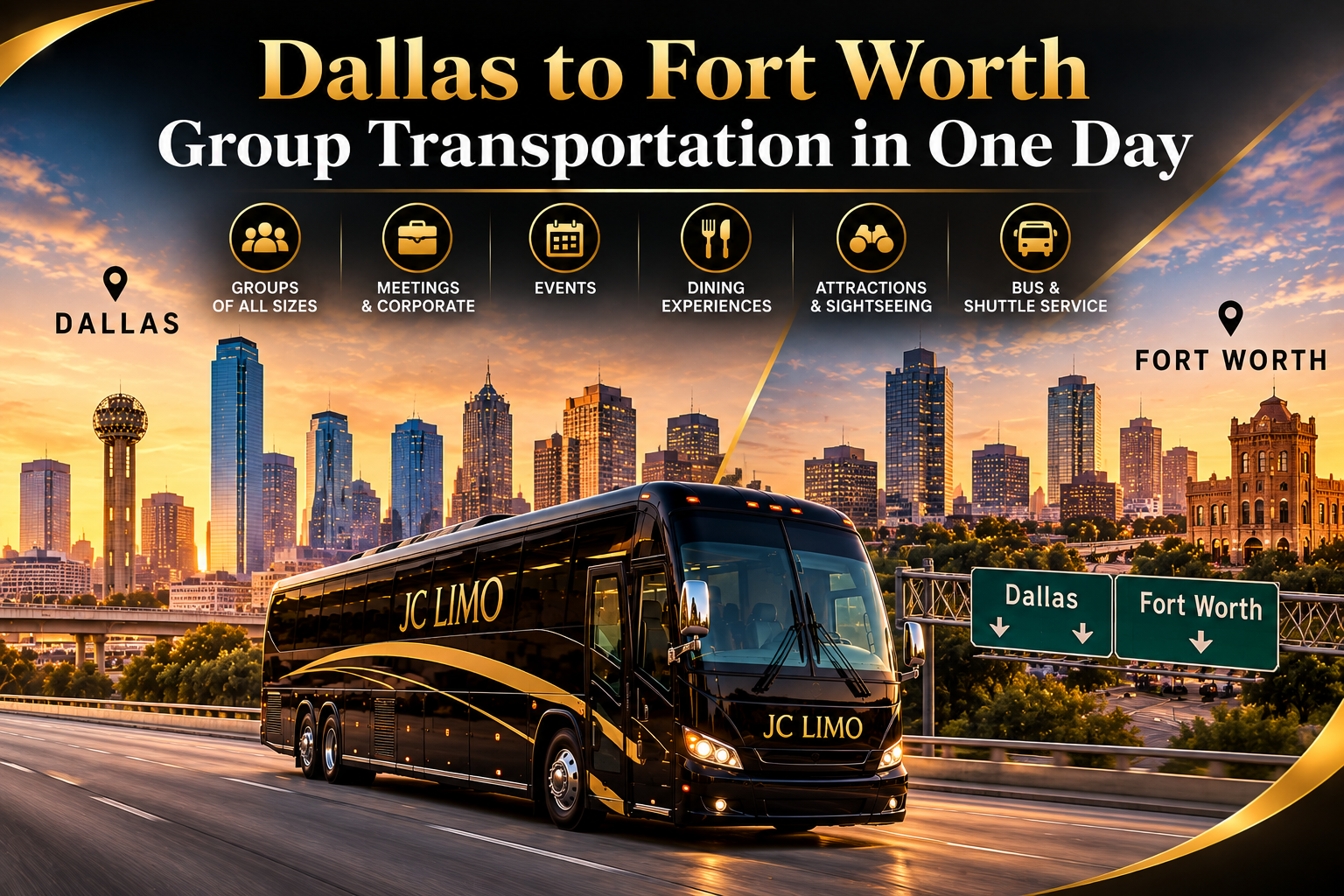
Dallas and Fort Worth are often mentioned together.
For visitors, that can create the impression that moving between the two cities is just a quick part of the day.
Then the itinerary begins.
Breakfast is in Dallas. The group has a morning meeting near the hotel. An afternoon activity is scheduled in Fort Worth. Dinner is somewhere else. The hotel is back in Dallas, and everyone needs to return together at the end of the evening.
What looked like a straightforward day can quickly become a transportation challenge.
For individuals, moving between cities may simply require getting in a car and following directions. For a large group, every transition involves more planning. Passengers need to gather. Everyone needs to board. Travel time has to be realistic. The schedule needs to account for traffic, stops, meals, and the possibility that one activity runs longer than expected.
When a group itinerary includes both Dallas and Fort Worth, Texas, transportation should be one of the first parts of the day to be planned.
With coordinated JC LIMO bus and shuttle transportation, groups can connect multiple destinations across the Dallas–Fort Worth area without requiring every passenger to manage the journey independently.
Dallas and Fort Worth Should Be Planned as Two Destinations
The term “Dallas–Fort Worth” is useful when describing the broader Metroplex.
For transportation planning, however, Dallas and Fort Worth should not be treated as though they are one compact city center.
A group could start the morning in downtown Dallas and have an afternoon commitment in Fort Worth. That movement becomes a meaningful part of the itinerary.
The same applies in reverse.
A group staying in Fort Worth may need to attend a Dallas conference, corporate event, game, dinner, or private function.
Travel time has to be included in the schedule rather than added as an afterthought.
This becomes even more important when the group has multiple activities in both cities.
Start With the Most Important Arrival Time
When planning a full day, identify the activity with the least flexibility.
Maybe it is a corporate meeting that starts at 2:00 p.m.
Perhaps it is a ticketed event.
It could be a wedding ceremony, conference session, reservation, tour, performance, or private event with a fixed start.
That commitment should become an anchor for the transportation schedule.
Then work backward.
How much time should the group allow to travel there?
How long will boarding take?
Is there another activity immediately beforehand?
Does everyone need to return to the hotel before leaving?
Will the group have luggage, equipment, or other belongings?
Planning backward from the required arrival time creates a more realistic transportation schedule than simply estimating when everyone should leave.
Avoid Packing Too Much Into the Morning
One of the easiest ways to make a Dallas-to-Fort Worth itinerary stressful is filling every available minute.
A group may technically have enough time for breakfast, a meeting, a tour, lunch, and then the trip to Fort Worth.
But technical availability is different from practical availability.
Groups rarely move instantly.
A meeting scheduled to finish at noon may run until 12:15.
Lunch can take longer than expected.
Someone may need to return to the hotel.
Passengers need time to find the bus and board.
Each small delay reduces the transportation buffer.
If an afternoon Fort Worth activity has a strict start time, keeping the morning slightly less crowded can protect the rest of the day.
One Bus Can Simplify a Cross-Metroplex Day
When everyone is following approximately the same itinerary, using dedicated bus transportation can make a multi-city day easier to manage.
Passengers leave together.
They arrive together.
There is one transportation schedule instead of dozens of individual travel plans.
This can be particularly valuable for visitors unfamiliar with North Texas.
Instead of every traveler navigating Dallas and Fort Worth separately, the group follows the planned itinerary.
For organizers, that can also simplify communication.
Rather than asking whether everyone has found transportation to the next location, the focus becomes getting everyone to the designated boarding point on time.
Corporate Groups Often Need Both Cities
Business travel is one situation where Dallas and Fort Worth may easily appear on the same itinerary.
A company could have meetings with different clients throughout the Metroplex.
Employees may attend a conference in Dallas before traveling to a corporate dinner in Fort Worth.
Visiting executives might tour facilities in several locations during the same day.
A team could also be staying near one city while the main business activity takes place in another.
In these situations, transportation is part of the working day.
If every employee arranges a separate ride, the group can become fragmented.
Some people arrive early.
Others get delayed.
Someone goes to the wrong entrance.
Another traveler may underestimate how much time is required to reach the next destination.
Coordinated JC LIMO transportation gives the group one schedule and one central plan.
Full-Day Transportation Is Different From a Single Transfer
A one-way transfer is relatively simple.
Pick up the group.
Drive to the destination.
Drop everyone off.
A full-day itinerary requires more thought.
Where does the bus go while the group is inside a meeting?
When should passengers return?
Does the next activity begin immediately?
Will there be an unscheduled break?
Does the group need transportation to lunch?
Are there multiple pickup or drop-off locations?
Will some passengers leave the group early?
These questions are why full-day transportation should be planned as a complete itinerary rather than a series of unrelated rides.
Every movement affects what happens next.
Lunch Can Make or Break the Schedule
Lunch looks harmless on an itinerary.
It can also become one of the easiest places to lose time.
If 30 or 40 passengers need to order, eat, pay, and regroup, a short lunch can easily become longer than expected.
For a day involving both Dallas and Fort Worth, consider where lunch fits geographically.
If the group is already traveling toward the next destination, choosing a stop that fits naturally into the route may reduce unnecessary backtracking.
Another option is having lunch before beginning the longer transportation portion of the day.
The best arrangement depends on the group’s schedule.
The important point is that meals should be considered part of the transportation plan rather than completely separate from it.
Build a Buffer Before Crossing the Metroplex
Schedules should have room to absorb normal delays.
This is particularly useful before an important cross-city movement.
If the group absolutely must reach Fort Worth at a certain time, avoid scheduling the previous Dallas activity to end at the last possible minute.
A buffer can help account for slower boarding, an activity running late, traffic, or another small disruption.
Without that flexibility, one minor delay can affect every later activity.
With it, the itinerary can remain on track without forcing passengers to rush.
Different Groups May Need Different Shuttles
Not every passenger will always follow the same schedule.
A corporate trip might have executives leaving for Fort Worth earlier while other employees remain in Dallas.
At a conference, one department could have an off-site meeting while the larger group stays at the venue.
Wedding guests may have one schedule while the wedding party has another.
In these cases, shuttle transportation can provide more flexibility than forcing the entire group onto one route.
Separate transportation movements can reconnect later at a common destination.
The objective is not necessarily to keep every person physically together all day.
It is to keep the transportation organized around the overall event.
Plan Pickup Locations Carefully
Pickup location can affect timing almost as much as travel distance.
A large group needs somewhere practical to gather and board.
At a hotel, that may be a designated bus entrance.
At an event venue, passengers may need to walk to a specific loading area.
In busy areas, the bus may not be able to stop exactly where individual vehicles would.
Passengers should know the meeting point before the activity ends.
Clear instructions prevent the familiar situation where half the group is waiting at one entrance and the other half is somewhere else.
For multi-stop days, consistency can help.
Whenever possible, use obvious and easy-to-remember pickup points.
Consider What Passengers Need During the Day
A group leaving its hotel in Dallas in the morning and returning late at night may need more than transportation.
Passengers may carry bags, jackets, presentation materials, event items, or personal belongings.
Corporate teams may have equipment.
Tour groups could make purchases throughout the day.
If the group will not return to the hotel between activities, organizers should consider what passengers will bring with them.
This is another reason the entire itinerary should be discussed when arranging bus transportation in Dallas and Fort Worth.
The transportation plan should reflect how the group is actually traveling.
Evening Plans Require Another Timing Decision
After a full day, groups often want dinner or entertainment.
This can be a good way to finish a Dallas–Fort Worth itinerary, but it introduces another question:
Should dinner happen before or after the return trip?
For example, a group spending the afternoon in Fort Worth may choose to stay there for dinner before returning to a Dallas hotel.
That can be more efficient than traveling back to Dallas, stopping at the hotel, and leaving again.
On another itinerary, dinner near the hotel may make more sense because passengers want time to change or rest.
There is no universal answer.
The best choice depends on geography, timing, and what the group wants from the day.
Looking at transportation and activities together helps reveal the more practical option.
Don’t Forget the Final Hotel Return
By the end of a long group day, transportation should become easier, not more complicated.
Passengers are tired.
People may have bags or purchases.
Some have spent the entire day in meetings or activities.
This is not the ideal time to ask everyone to arrange separate rides back to the hotel.
Including the final hotel drop-off in the transportation schedule gives the day a clear endpoint.
Guests know how they are returning.
Organizers know the transportation plan covers the complete itinerary.
And passengers can finish the evening without another logistical decision.
Communication Becomes More Important on Long Days
The more activities an itinerary contains, the easier it becomes for passengers to lose track of the schedule.
Morning instructions may be forgotten by the afternoon.
Plans can change.
People may become separated during free periods.
Keep transportation communication simple.
Tell passengers where they need to meet.
Tell them when they need to be there.
Make the next destination clear.
If something changes, communicate the revised information consistently.
For particularly large groups, having designated coordinators can make communication easier.
One organizer should not have to individually contact dozens of passengers every time the bus is ready.
Multi-Day Trips Should Not Repeat the Same Route Automatically
If a group is spending several days in North Texas, it may be tempting to organize each day in the same way.
But different activities may call for different transportation strategies.
One day might focus entirely on Dallas.
Another could be centered around Fort Worth.
A third could include Arlington, Irving, Plano, or another Metroplex destination.
Grouping activities geographically when possible can reduce unnecessary travel.
Instead of repeatedly crossing the region, planners can create days around clusters of destinations.
That gives passengers more time at activities and less time in transit.
Make Travel Time Part of the Experience
Transportation does not always have to feel like lost time.
For corporate groups, time on the bus can provide an opportunity to talk informally between meetings.
Families and private groups can relax together.
Tour groups can regroup before the next destination.
Event attendees can simply take a break instead of concentrating on directions and traffic.
Keeping everyone together can make the movement between Dallas and Fort Worth feel like part of the group experience rather than an interruption.
That is one of the advantages of dedicated transportation.
The journey itself becomes simpler for the passengers.
A Better Way to Experience Dallas and Fort Worth in One Day
Visiting both Dallas and Fort Worth during the same day is possible for many group itineraries.
The key is respecting the transportation involved.
Start with the activities that have fixed times.
Build the schedule backward.
Avoid filling every minute.
Plan meals strategically.
Include realistic boarding time.
Create buffers before important arrivals.
Choose clear pickup locations.
And consider the complete day, including the final return to the hotel.
For corporate groups, conference attendees, families, wedding guests, tour groups, teams, and other travelers throughout North Texas, JC LIMO provides bus and shuttle transportation designed to connect the different parts of an itinerary.

Related posts
 13Oct, 26
Dallas Group Transportation With Luggage and Equipment
 13Oct, 26
Dallas Group Transportation With Multiple Drop-Offs
 13Oct, 26
- October 13, 2026
- 0
- 10
