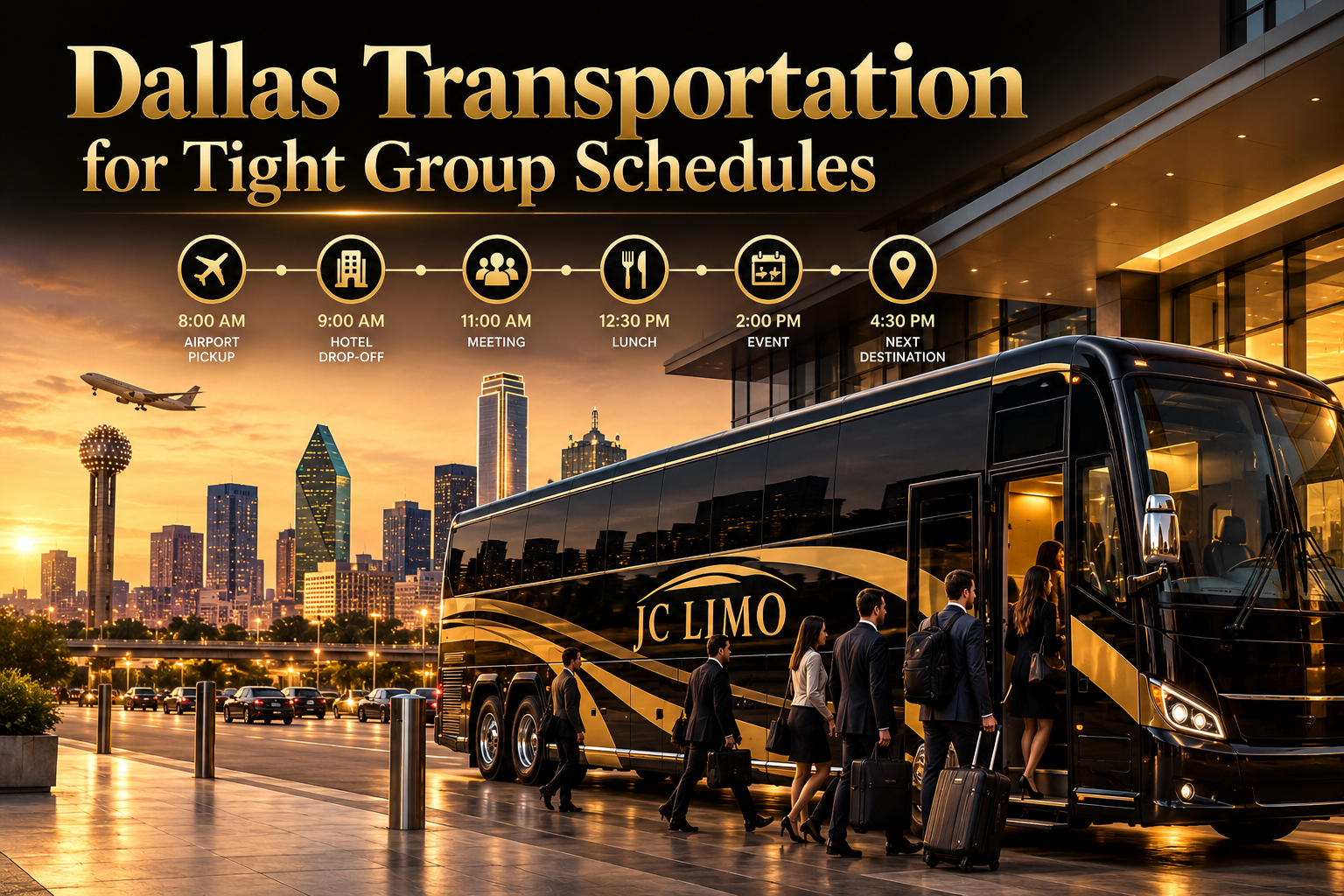
When a group has plenty of time between destinations, transportation is usually one of the easier parts of the day.
The challenge begins when the schedule gets tight.
A meeting ends at 11:30 AM and lunch starts at noon. A conference session finishes in downtown Dallas and the group needs to reach another venue shortly afterward. Guests land at the airport and have a limited amount of time to check into their hotel before the first event begins. Employees finish a morning program and need to move together to an afternoon activity without losing half the group along the way.
In situations like these, transportation is no longer just about getting from one address to another.
Timing becomes part of the experience.
For groups traveling throughout Dallas, Fort Worth, and surrounding Texas communities, organized bus and shuttle transportation can help create a more structured way to move between time-sensitive activities.
JC LIMO provides group transportation options for corporate programs, events, airport transfers, private groups, conferences, and other trips where keeping passengers together matters.
A Tight Schedule Changes Transportation Planning
Transportation planning often starts with two simple questions:
Where are we going?
What time do we need to arrive?
For a group with a packed schedule, that is not enough.
You also need to consider when the previous activity ends, how quickly passengers can gather, where the bus can load, how long the drive may take, and how much time the group needs after arrival.
Imagine a corporate program scheduled like this:
Morning meeting ends at 11:00 AM.
Lunch reservation begins at 11:45 AM.
Afternoon presentation begins at 1:30 PM.
Networking event starts at 4:00 PM.
Dinner begins at 7:00 PM.
There may be enough time between those activities on paper.
But every transition contains smaller steps.
The group needs to leave the room, reach the pickup location, board the bus, travel to the next destination, unload, enter the venue, and get settled.
A 30-minute gap can become surprisingly short.
That is why transportation should be built into the schedule rather than added after the itinerary has already been finalized.
Dallas–Fort Worth Travel Times Need Breathing Room
Dallas–Fort Worth covers a large geographic area.
Groups frequently travel between Dallas, Fort Worth, Arlington, Irving, Plano, Frisco, Grapevine, and other communities throughout North Texas.
A corporate group might stay at a hotel in Dallas while attending meetings in Plano.
An event group may travel from a hotel near DFW Airport to a venue in downtown Dallas.
A conference schedule could include an evening activity in Arlington after daytime sessions elsewhere in the Metroplex.
These trips require realistic timing.
Distance is only one part of the calculation.
Traffic, major events, road conditions, venue access, passenger loading, and the time of day can all influence transportation.
A route that appears simple when planning the event may take longer when dozens of passengers are moving together.
The goal is not to create huge gaps between every activity.
It is to create enough flexibility that one small delay does not disrupt everything that follows.
One Bus Can Help Keep Everyone on the Same Clock
When individuals arrange their own transportation, they naturally travel at different speeds.
One passenger orders a ride immediately.
Another waits ten minutes.
Someone walks to a different pickup location.
Another person stops at the hotel.
One driver takes a different route.
Before long, a group that left the same meeting is arriving at the next destination over a wide period of time.
For casual plans, that may not matter.
For scheduled activities, it can.
Using a bus or group shuttle creates a shared transportation schedule.
Passengers have one departure time.
They have one pickup location.
They travel together.
They arrive as a group.
That structure can be especially valuable for conferences, corporate events, tours, weddings, private functions, and other programs where activities depend on passengers arriving within a particular timeframe.
The Schedule Should Include Boarding Time
A common planning mistake is treating departure time as the moment an activity ends.
If a presentation ends at 2:00 PM, the bus probably should not be scheduled as though every passenger will be seated at exactly 2:00 PM.
People need time to leave the venue.
Some may need to collect personal items.
Others may stop for a conversation.
A larger group can take several minutes simply to reach the vehicle and board.
The bigger the group, the more important this becomes.
If the next destination is time-sensitive, build a realistic boarding window into the transportation plan.
For example, instead of:
Meeting ends: 2:00 PM
Bus departs: 2:00 PM
Consider:
Meeting ends: 1:50 PM
Passengers proceed to pickup area: 1:50–2:00 PM
Bus departure: 2:00 PM
That small adjustment makes the itinerary more realistic.
Know Where the Bus Can Actually Pick Up
The address of a venue and the pickup location for a bus are not always the same place.
This matters when the schedule is tight.
Large hotels may have designated areas for buses.
Convention centers can have specific loading zones.
Office campuses may require commercial vehicles to enter from another street.
Stadiums and entertainment venues may have transportation procedures that change during major events.
Airports have their own pickup rules.
If passengers walk out of a building expecting the bus directly in front of them but the vehicle is actually around the corner at a designated loading area, valuable time can be lost.
For time-sensitive transportation, organizers should communicate the exact meeting point before the group begins moving.
Clear pickup instructions are often just as important as the driving schedule.
Corporate Transportation Depends on Punctual Transitions
Corporate groups frequently work with tightly planned agendas.
A company may bring employees or clients to Dallas for meetings, training sessions, site visits, dinners, presentations, and networking activities.
The schedule can look completely reasonable until transportation between those activities is considered.
For example, imagine 35 employees attending a morning meeting.
The meeting finishes slightly late.
Everyone then arranges individual transportation to lunch.
Several people are waiting for rides.
Others have already left.
Someone goes to the wrong restaurant location.
Another passenger gets caught in traffic.
The lunch reservation starts before the entire group arrives.
A centralized shuttle or bus does not eliminate every possible delay, but it creates a much clearer structure for moving everyone between scheduled activities.
For organizers, that can mean fewer individual transportation questions throughout the day.
Conferences Create Important Transportation Windows
Conference transportation can be particularly time-sensitive.
Attendees may need to travel from hotels to a convention center early in the morning.
Later, groups might leave the conference for dinners, networking events, tours, or private functions.
The schedule may involve hundreds of people moving during relatively short windows.
Even smaller conference groups can face the same challenge.
If a session ends at 5:00 PM and an evening event begins at 6:00 PM, transportation has to fit into that hour.
The group needs time to exit the conference venue, locate the shuttle, board, travel, and enter the next location.
Scheduled shuttles can help create predictable movement between locations.
Instead of asking every attendee to solve the journey individually, organizers can provide specific departure windows and meeting locations.
Hotel Departures Need a Clear Meeting Strategy
Hotels are common starting points for Dallas group transportation.
They can also become bottlenecks.
Imagine telling 50 guests:
“The bus leaves at 8:00.”
Some people interpret that as arriving in the lobby at 8:00.
Others come downstairs at 7:55.
A few are ready at 7:40.
Someone is still checking out.
Another person realizes their bag is upstairs.
If the group needs to arrive somewhere at a specific time, the communication should be more precise.
For example:
Meet in hotel lobby: 7:30 AM
Boarding begins: 7:40 AM
Bus departure: 7:50 AM
That creates a sequence everyone can understand.
It also gives the group coordinator time to identify missing passengers before the scheduled departure.
Airport Connections Need Additional Flexibility
Airports introduce variables that organizers cannot completely control.
Flights can arrive early or late.
Baggage collection can take longer than expected.
Passengers may land at different terminals.
Someone may have checked luggage while another passenger travels with only a carry-on.
If the group has another scheduled activity shortly after arrival, these details become important.
Dallas–Fort Worth International Airport is a major travel hub, and Dallas Love Field also serves travelers heading into the region.
When planning airport transportation for groups, avoid building an itinerary that depends on everything happening at the earliest possible moment.
Give passengers enough time to deplane, collect their belongings, find the correct meeting point, and board the transportation.
If people are arriving on different flights, organizers may also consider grouping passengers into planned transportation windows rather than attempting to move every traveler individually.
Avoid Creating a Schedule That Depends on Perfect Conditions
A schedule that works only if nothing goes wrong is not a strong schedule.
If every transition has exactly the minimum required travel time, one delay can affect the rest of the day.
The morning meeting runs ten minutes late.
Now lunch is late.
Lunch takes longer than expected.
Now the afternoon activity starts late.
That delay affects the next departure.
By dinner, the original schedule may be completely different.
Adding reasonable buffers gives the itinerary some protection.
That does not mean wasting large amounts of time.
Even 10 or 15 minutes in strategic places can help.
The most important buffers are often before activities that cannot easily move, such as flights, ticketed events, scheduled presentations, reservation times, and major meetings.
Communicate Changes Quickly
Even with good planning, schedules change.
An event ends early.
A meeting runs late.
The group decides to stay longer at a location.
A restaurant changes the reservation time.
Weather affects traffic.
An activity moves to another venue.
The important thing is to communicate those changes as soon as possible.
If a transportation provider knows about an adjustment early, there may be more opportunity to adapt the transportation schedule.
Waiting until passengers are already standing outside can make the situation harder to coordinate.
For groups with complicated or time-sensitive itineraries, designate one person as the main transportation contact.
That person can communicate updates and help avoid conflicting instructions from multiple passengers.
The Right Vehicle Supports the Schedule
Vehicle selection can also influence how smoothly a tight itinerary works.
Passenger count is the obvious starting point, but organizers should also consider luggage, equipment, accessibility needs, trip duration, and the number of scheduled stops.
A group traveling from an airport may require more luggage capacity than the same number of passengers traveling from a hotel to a restaurant.
A corporate group carrying presentation materials may have different requirements from a group attending an evening event.
The goal is to choose transportation that supports the trip rather than simply fitting the number of passengers.
JC LIMO provides bus and shuttle transportation for different group travel requirements throughout Dallas and Fort Worth.
Multiple Vehicles Need One Coordinated Schedule
Some groups are too large for one vehicle.
When several buses or shuttles are involved, consistency becomes even more important.
Each driver and group coordinator should have the correct destination information.
Passengers should understand whether vehicles are traveling together or departing at different times.
If there are several hotel pickups, organizers need to know which passengers belong at each location.
The transportation plan should answer these questions before the day begins.
Without clear organization, multiple vehicles can create multiple versions of the schedule.
With a coordinated plan, they can operate as part of one transportation system.
Keep Important Information Easy to Access
For a busy group itinerary, organizers should keep the essential transportation information in one place.
That may include:
Pickup addresses
Exact loading locations
Departure times
Destination addresses
Group coordinator contact information
Passenger counts
Hotel information
Flight information when relevant
Event start times
Special transportation requirements
Having this information organized makes communication easier if the itinerary needs to change.
It also reduces the chance of an outdated address or schedule being shared with part of the group.
Transportation Should Protect the Experience
People often remember the main parts of a trip: the conference, dinner, game, wedding, meeting, tour, or celebration.
But transportation connects all of those moments.
If the group spends the entire day worrying about how to reach the next location, the experience becomes more stressful than it needs to be.
Organized transportation should work quietly in the background.
Passengers know where to meet.
They know when to leave.
They board the bus.
They reach the next destination.
Then they focus on whatever brought them to Dallas in the first place.
That is particularly valuable for visitors who are unfamiliar with the Dallas–Fort Worth area.
Instead of asking everyone to navigate a large Texas metropolitan region independently, the transportation plan provides structure throughout the day.
Keep Your Dallas Group Schedule Moving
A busy itinerary does not have to feel rushed.
The difference often comes down to planning.
Account for boarding time.
Use realistic travel windows.
Confirm bus pickup locations.
Build buffers around important activities.
Keep passengers informed.
And choose a transportation setup that fits the size and requirements of the group.
Whether the day includes corporate meetings, airport transfers, conferences, private events, restaurants, hotels, entertainment, or several destinations across North Texas, JC LIMO can provide bus and shuttle transportation designed around the group’s schedule.
For groups traveling throughout Dallas, Fort Worth, and surrounding Texas communities, the objective is simple: make each transition organized enough that passengers can focus on the destination rather than the journey between stops.

Related posts
 13Oct, 26
Dallas Group Transportation With Luggage and Equipment
 13Oct, 26
Dallas Group Transportation With Multiple Drop-Offs
 13Oct, 26
- October 13, 2026
- 0
- 10
