Not every group trip follows a perfectly packed schedule.
Sometimes a group has a morning meeting and nothing scheduled again until dinner.
A sports team may finish its first activity at noon but not need to be at the next venue until 5:00 p.m. Conference attendees might have several free hours between sessions. A tour group may check out of its hotel in the morning even though its flight does not leave until later that evening.
Those empty hours can look harmless when you are building an itinerary.
Once the group arrives in Dallas or Fort Worth, however, they can become a transportation challenge.
Where does everyone go?
Does the group stay together?
Can passengers return to the hotel?
What happens to luggage?
How will everyone reach the next activity?
When dozens of passengers are involved, a three- or four-hour gap is not simply “free time.” It is part of the transportation plan.
With thoughtful scheduling and professional group transportation, those gaps can become easier to manage.
JC LIMO provides bus and shuttle transportation for groups throughout Dallas, Fort Worth, and surrounding Texas areas, helping organizers connect the different parts of an itinerary even when activities are separated by several hours.
Why Schedule Gaps Create Transportation Problems
Imagine organizing a corporate trip for 35 employees.
The morning meeting finishes at 11:30 a.m.
Dinner is scheduled for 6:00 p.m.
At first, that looks like plenty of free time.
But what should happen during those six and a half hours?
If everyone returns to the hotel individually, the organizer now has to coordinate transportation again before dinner.
If people separate into smaller groups, some may travel across Dallas while others remain near the meeting location.
By 5:30 p.m., the organizer may be trying to determine where everyone is.
This is why itinerary gaps need to be treated as deliberately as scheduled activities.
Transportation should connect the entire day rather than only the major events.
Look at the Whole Day Before Planning Transportation
One of the best ways to organize group travel is to view the day as a complete journey.
Do not plan each transfer separately.
Instead of thinking:
Hotel to meeting.
Meeting to lunch.
Dinner to hotel.
Look at the entire sequence:
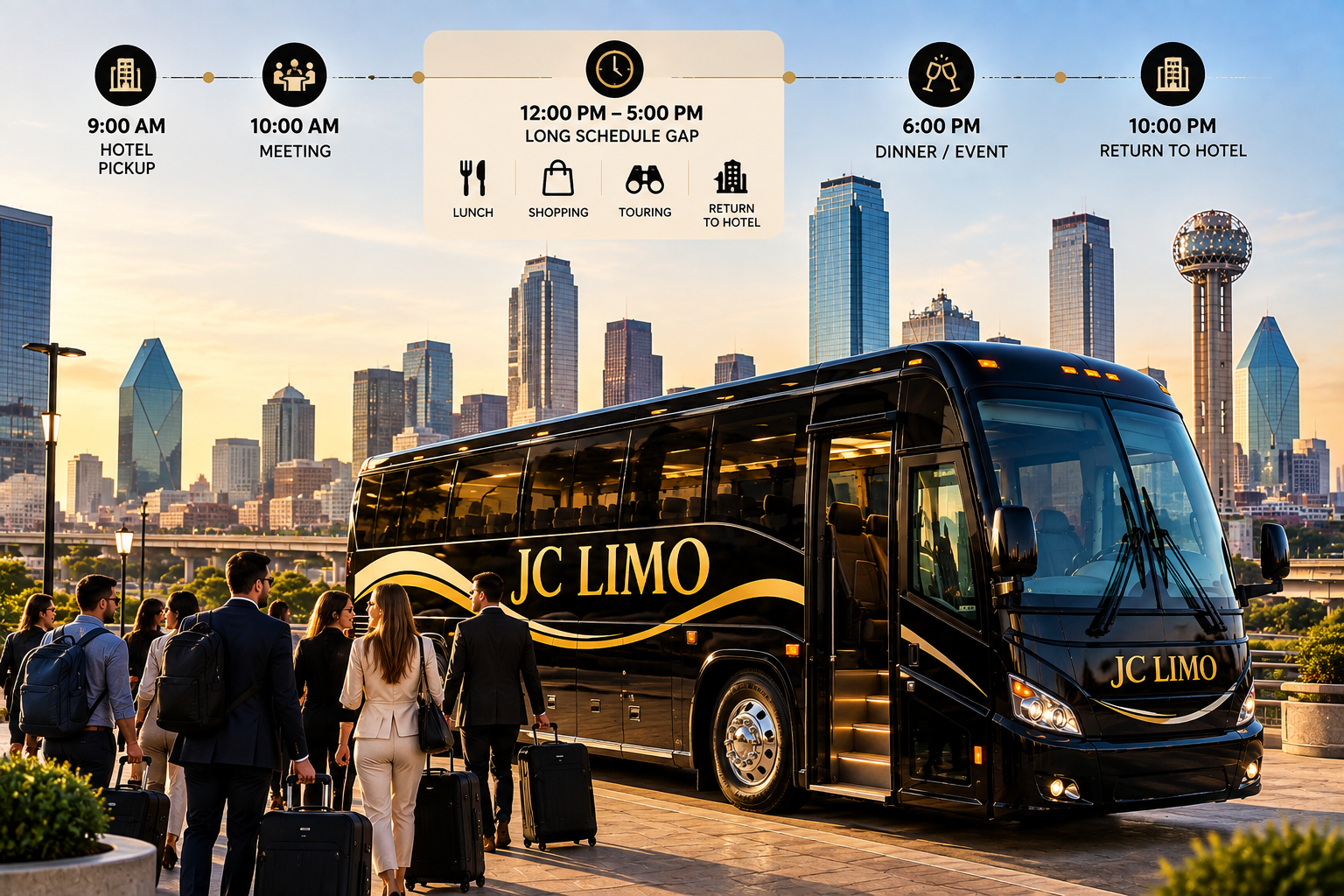
Hotel → Meeting → Free Time → Dinner → Hotel.
This gives you a clearer understanding of where transportation may be required.
It also highlights the periods when passengers might otherwise be left without a plan.
For groups traveling through Dallas–Fort Worth, this is especially important because destinations can be spread across a wide area.
Returning to the hotel during every gap may not always make sense.
Sometimes it is more efficient to plan another stop nearby.
In other situations, returning to the hotel may be exactly what passengers need.
The right choice depends on the itinerary.
Free Time Does Not Mean Transportation Stops
When an itinerary says “free time,” organizers sometimes assume transportation planning is finished until the next scheduled event.
But passengers still need to be somewhere.
A conference group may want lunch.
A tour group might want to explore.
A sports team may need somewhere to eat and rest.
Corporate travelers may want to return to their rooms before an evening function.
If people are unfamiliar with Dallas or Fort Worth, asking them to arrange their own transportation during these periods can create confusion.
A planned bus or shuttle can give the group more structure.
For example, passengers might be transported from a morning event to a central dining or entertainment area and collected again at a predetermined time.
That still gives people freedom without completely losing the transportation schedule.
The important part is establishing the next meeting point before the group separates.
Corporate Groups With Gaps Between Meetings
Business travel frequently includes awkward schedule gaps.
A morning presentation might finish earlier than expected.
A site visit could be scheduled several hours before an evening dinner.
Conference attendees may have free periods between sessions.
If employees are traveling independently, each gap creates another transportation decision.
Where should they go?
How will they get there?
How will they reach the next meeting?
For a small team, this may be manageable.
For a large group, it can become distracting.
Coordinated JC LIMO transportation can keep the day organized.
The group could travel from the hotel to the morning meeting, continue to lunch, return to the hotel for a break, and then depart together for the evening event.
The exact schedule depends on the group, but the principle remains the same:
Transportation should follow the rhythm of the day.
What to Do Between Hotel Checkout and a Late Flight
One of the most common schedule gaps happens on departure day.
Hotel checkout may be late morning.
The group’s flight may not leave until evening.
That creates several hours when passengers have luggage but no hotel rooms.
For one or two travelers, this is usually easy to manage.
For 40 people, it requires more thought.
The organizer needs to consider what happens to everyone’s bags and where the group will spend the remaining time.
A planned transportation itinerary can make the final day more useful.
Depending on the schedule, the group may travel from the hotel to lunch, sightseeing, a final meeting, shopping, or another activity before continuing toward the airport.
The main goal is to avoid reaching checkout time with no plan for the next several hours.
When airport transportation is incorporated into the full day’s itinerary, departure day can feel much more organized.
Sports Teams Often Have Unusual Gaps
Sports schedules rarely line up perfectly with hotel schedules.
A team might finish a morning practice and have several hours before a game.
Tournament schedules may include long breaks between matches.
Players may need to eat, rest, change, or prepare equipment during those periods.
This makes transportation an important part of team logistics.
If players split into several cars, bringing everyone back together before the next event can take time.
A group bus allows coaches and organizers to keep the transportation schedule centralized.
The team can travel to lunch together.
It can return to the hotel if appropriate.
Players can then depart together for the next game or activity.
This also helps when the team is carrying equipment.
Instead of moving bags between multiple personal vehicles throughout the day, transportation can be planned around the team’s actual needs.
Build Lunch Into the Transportation Plan
Lunch often falls directly in the middle of a schedule gap.
That makes it a useful anchor point.
Suppose a group finishes an activity in Dallas at noon and needs to be in Fort Worth later in the afternoon.
Rather than returning to the hotel and then making another trip, the itinerary could include lunch along the route.
This reduces unnecessary movement.
For groups, choosing a lunch location should also involve transportation considerations.
Can the location accommodate the number of passengers?
Is there an appropriate place for the bus to load and unload?
How much time should be allowed?
How far is it from the next destination?
A meal is not separate from transportation planning.
It is another stop in the itinerary.
When the route is designed logically, the day feels less fragmented.
Avoid Unnecessary Trips Across DFW
Schedule gaps sometimes create inefficient transportation because planners automatically send passengers back to their hotel.
That may be convenient if the hotel is nearby.
But what if the hotel is far from both the current location and the next activity?
The group could spend a significant portion of its free time simply traveling back and forth.
Before deciding what to do during a gap, look at the geography of the day.
Where is the group now?
Where does it need to be next?
Where is the hotel?
Are there practical activities or dining options between those locations?
A well-planned route can reduce unnecessary mileage and help passengers spend less of the day on the road.
This becomes particularly important when an itinerary involves both Dallas and Fort Worth.
The goal should not be to fill every empty hour.
It should be to use the available time intelligently.
Give Passengers a Clear Meeting Time
If passengers are given free time, the organizer should establish the next meeting time before everyone separates.
Do not rely on people figuring it out later.
For example:
“The shuttle departs at 4:30 p.m. Please meet at the same drop-off point by 4:15 p.m.”
That is much clearer than:
“We’ll message everyone when we’re ready.”
Specific instructions help passengers plan their free time.
They know how long they have.
They know where they need to return.
They know when the bus or shuttle is leaving.
For large groups, this simple communication can prevent significant delays.
Think About Luggage and Personal Belongings
Schedule gaps become more complicated when passengers are carrying luggage.
This is common on arrival and departure days.
A group may land in Dallas early in the morning but not be able to check into its hotel until later.
Or passengers may check out of the hotel hours before an evening flight.
Those situations need to be considered when selecting transportation and planning the itinerary.
The organizer should understand how much luggage the group is carrying and whether the transportation arrangement can accommodate it.
A vehicle that works well for passengers traveling without bags may have different practical requirements when everyone has suitcases.
This is why passenger count should never be the only factor considered when planning group transportation.
People and their belongings both need space.
Don’t Overfill Every Gap
There can be a temptation to turn every free hour into another activity.
If the group has four hours between meetings, someone may immediately suggest adding a tour.
That can work.
But sometimes the group simply needs a break.
Travel can be tiring.
Conferences can be mentally demanding.
Sports teams need recovery time.
Wedding parties may have been active since early morning.
A good itinerary balances activities with rest.
Transportation should support that balance.
If returning to the hotel for several hours makes sense, that can be the best plan.
The important thing is that the return trip and next departure are coordinated.
Free time should feel intentional rather than like the organizer forgot to plan part of the day.
Groups With Several Different Interests
Sometimes passengers do not all want to do the same thing during a long break.
Some people may want to explore Dallas.
Others might prefer to return to the hotel.
Another group may want lunch or shopping.
For larger groups, this creates an important planning question.
Does everyone need to remain together?
Not necessarily.
But if the group separates, there should be a clear plan for bringing everyone back together.
The organizer should establish a central meeting location and time before people leave.
Depending on the size and structure of the group, transportation can then continue according to the main itinerary.
What you want to avoid is trying to locate dozens of passengers across the city ten minutes before the next scheduled departure.
Evening Activities After a Long Break
Long gaps often happen between daytime and evening activities.
A corporate conference ends at 3:00 p.m.
Dinner begins at 7:00 p.m.
A wedding rehearsal takes place in the afternoon.
The evening event starts several hours later.
These breaks can actually make the day more comfortable when planned properly.
The group can return to the hotel, rest, change clothes, and prepare for the evening.
Transportation then resumes at a clearly communicated time.
For example:
3:30 p.m. — Return to hotel.
6:15 p.m. — Meet in lobby.
6:30 p.m. — Bus departure.
7:00 p.m. — Dinner.
This structure gives passengers freedom while maintaining organization.
Everyone knows when they are off schedule and when the group itinerary resumes.
Flexible Schedules Still Need Structure
Some organizers avoid detailed transportation planning because they want the trip to feel flexible.
Flexibility is useful.
But flexibility and organization are not opposites.
A transportation plan can include buffers.
Pickup times can account for activities that may finish early or late.
Passengers can have free periods.
The key is maintaining a basic framework.
Groups should know the important transportation points:
Where are we leaving from?
When are we leaving?
Where are we going?
Where do we meet afterward?
Those four questions solve a large percentage of group transportation confusion.
Everything between those points can still have room for flexibility.
Choosing the Right Bus or Shuttle
Long schedule gaps can affect vehicle planning.
A group may need transportation throughout the day rather than just one point-to-point transfer.
Before arranging a vehicle, consider the full itinerary.
How many passengers are traveling?
How much luggage do they have?
How many stops are planned?
Will the group return to the hotel?
Does the itinerary include both Dallas and Fort Worth?
Is the final stop an airport?
Are there several hours between activities?
JC LIMO offers bus and shuttle transportation for different types of groups and itineraries across the DFW area.
Providing the complete schedule when planning transportation can help ensure the arrangement reflects what the group actually needs.
A Better Itinerary Connects the Empty Spaces
The best group itineraries are not simply collections of reservations.
They connect the entire day.
The meeting matters.
The dinner matters.
The flight matters.
But the three hours between the meeting and dinner matter too.
That is when passengers still need transportation, information, and a clear understanding of what happens next.
Ignoring those periods can create confusion.
Planning them can make the entire trip feel more organized.
For group organizers, the goal is not to control every minute.
It is to make sure passengers always understand the next important step.
Keep the Whole Day Moving With JC LIMO
Long breaks between activities do not have to disrupt a group itinerary.
With the right transportation plan, those hours can be used for meals, rest, sightseeing, hotel breaks, shopping, preparation, or simply giving passengers time to recharge.
JC LIMO provides professional group transportation throughout Dallas, Fort Worth, and surrounding Texas areas, with bus and shuttle options for corporate groups, sports teams, event guests, tour groups, families, organizations, and other travelers.
Instead of planning transportation only around major events, look at the entire day.
Consider where passengers will be during the gaps.
Plan the next pickup before the group separates.
Think about luggage.
Keep travel distances realistic.
And make sure everyone knows when and where the group comes back together.
When transportation connects every part of the itinerary—including the empty spaces—traveling through Dallas and Fort Worth becomes much easier to manage.

