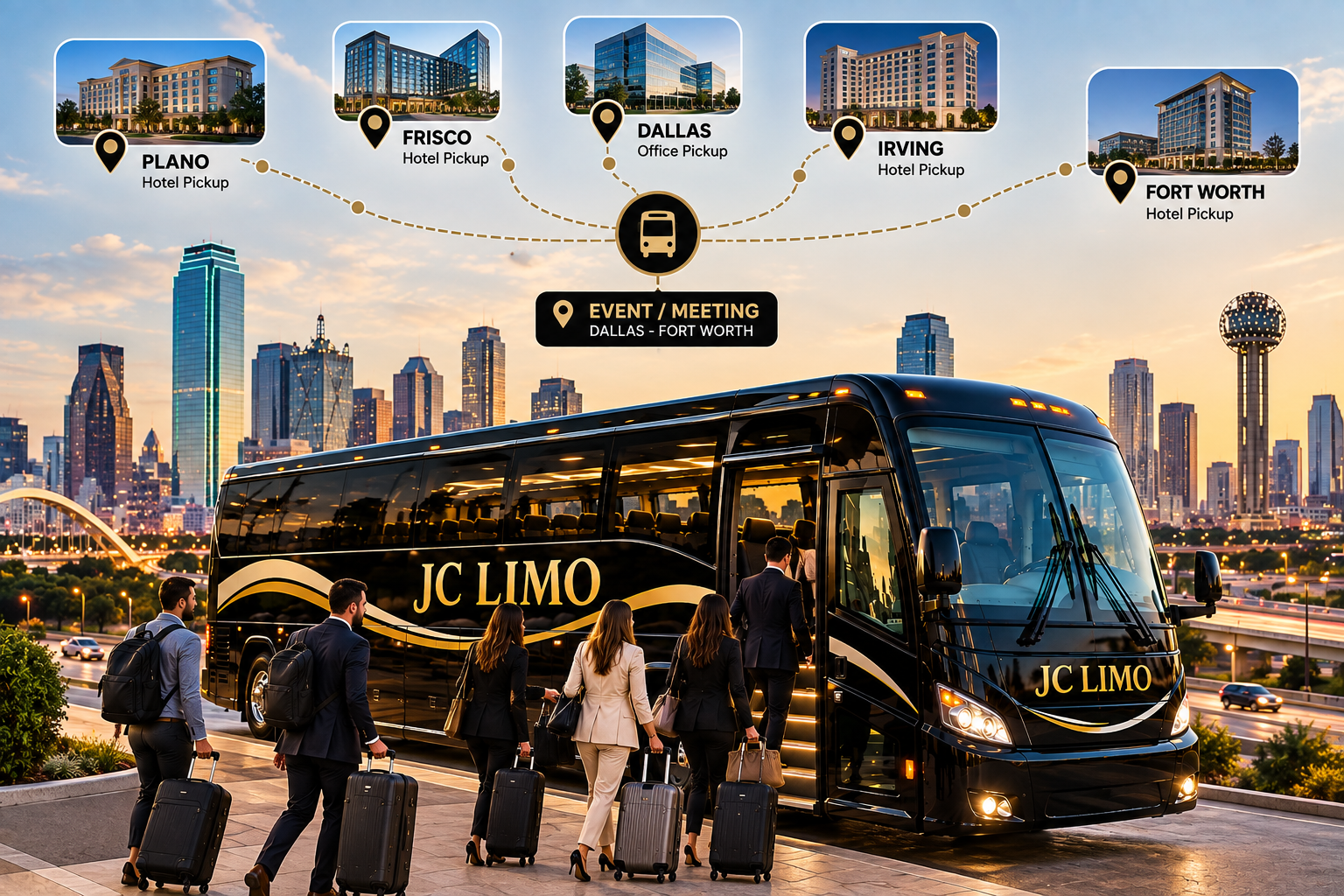
A group trip does not always begin with everyone standing in the same hotel lobby.
Sometimes passengers are spread across Dallas.
Some may be staying in hotels near a conference venue. Others may be with family or friends. A few employees could be coming from local offices. Another part of the group might be staying in Fort Worth, Irving, Plano, or elsewhere in the Dallas–Fort Worth area.
Then everyone needs to be at the same event at the same time.
That is where transportation becomes more complicated.
Moving a group from one location to another is relatively straightforward. Bringing passengers together from several locations requires a different level of planning.
Pickup order matters.
Timing matters.
Communication matters.
The final destination matters.
And when the group includes dozens of passengers, small transportation decisions can affect the entire schedule.
With a coordinated bus or shuttle transportation plan, groups can create centralized pickup points and bring passengers together before continuing to meetings, events, airports, venues, dinners, and other destinations.
JC LIMO provides group transportation throughout Dallas, Fort Worth, and surrounding Texas communities, helping organizers create transportation plans around the way their passengers are actually distributed across DFW.
Why Groups End Up Staying in Different Locations
Keeping every passenger at one hotel sounds ideal, but real trips do not always work that way.
A large conference may fill nearby hotels.
Wedding guests may choose accommodations based on their own budgets and preferences.
Employees traveling for a corporate event may book rooms independently.
Local participants may travel from their homes instead of staying overnight.
Sports teams may have players, coaches, families, and staff staying in separate locations.
Private groups may combine local residents with visitors arriving from outside Texas.
As a result, a group that looks like one unit on the attendee list may actually begin the day scattered across the Metroplex.
If organizers wait until the event day to think about this, transportation can become difficult.
The better approach is to understand where passengers will be staying before building the route.
Start by Mapping the Group
Before deciding how many pickups are needed, determine where everyone will actually be.
You do not necessarily need an individual stop for every passenger.
In fact, that would often make the route inefficient.
Instead, look for clusters.
Perhaps 20 people are staying in one Dallas hotel.
Another 15 are staying at a nearby property.
Ten local employees are coming from the same office.
A smaller group is staying elsewhere.
Once these clusters are identified, you can begin thinking about central meeting points.
The goal is to turn many individual locations into a manageable number of transportation stops.
This is one of the most important differences between individual travel and group transportation.
You are not trying to design the perfect route for each passenger.
You are designing a route that works effectively for the group as a whole.
Central Pickup Points Can Simplify the Route
Imagine 40 passengers staying at six different locations.
A bus could theoretically visit all six.
But that may not be the best plan.
If three of those locations are close together, passengers may be able to meet at one central pickup point.
Now six stops become four.
That matters.
Every additional stop requires time.
The bus needs to reach the location, enter the pickup area, allow passengers to board, confirm that everyone is ready, and return to the route.
Even a short stop can add significant time when repeated several times.
Centralized pickup points can make the schedule more efficient.
They also make communication easier.
Instead of coordinating many small pickups, the organizer can communicate a smaller number of clear meeting locations and times.
Don’t Choose the Pickup Order Randomly
When several locations are involved, the order matters.
A poorly planned route could send a bus back and forth across Dallas unnecessarily.
For example, imagine collecting passengers in one area, driving across the city for another pickup, and then returning close to the original area before heading toward the destination.
That adds unnecessary transportation time.
A better route generally moves logically toward the final destination.
The exact order depends on the locations involved, but organizers should consider geography before assigning times.
This becomes even more important if the itinerary includes both Dallas and Fort Worth.
DFW covers a large area.
A route that looks simple on a list of hotel names may involve substantial driving when viewed on a map.
Transportation should be planned geographically, not alphabetically.
Give Every Pickup Point Its Own Time
When passengers are staying across several locations, telling everyone that the bus will arrive “around 8:00” is not enough.
Each pickup location should have a specific time.
For example:
Location A — 7:15 a.m.
Location B — 7:35 a.m.
Location C — 8:00 a.m.
Final destination — 8:45 a.m.
The exact schedule will depend on the route, but the concept is important.
Passengers need to understand when they are expected to be ready.
They should ideally arrive at the meeting point before the JC LIMO shuttle or bus reaches them.
If passengers begin coming downstairs only after the vehicle arrives, every stop can become longer than planned.
One late pickup affects every pickup after it.
Why the First Pickup Matters So Much
The first stop can determine whether the entire route stays on schedule.
If the bus is scheduled to begin boarding at 7:00 a.m. but passengers do not arrive until 7:15, every later pickup is already affected.
That means the first group should receive particularly clear instructions.
The organizer might ask passengers to meet 10 or 15 minutes before the planned departure.
This gives people time to gather, check belongings, and be ready when transportation arrives.
For early morning schedules, this can be especially important.
Passengers may be tired or unfamiliar with the hotel.
Building a small buffer into the first departure can help protect the rest of the itinerary.
Corporate Groups Spread Across Dallas
Corporate events frequently involve passengers staying in different areas.
A company may have employees traveling from outside Texas while local employees are coming from offices or homes around Dallas.
Everyone needs to attend the same conference, meeting, training session, or company event.
Asking each employee to travel independently can result in inconsistent arrival times.
Some may arrive early.
Others may encounter traffic.
Several people may spend time looking for parking.
Coordinated corporate shuttle transportation provides another option.
Visiting employees can meet at their hotel.
Local employees can gather at a designated office or another central point.
The bus can collect passengers according to the route and continue to the final destination.
This creates a more unified arrival and reduces the number of individual transportation plans involved.
Wedding Guests Rarely Stay in One Place
Weddings are another situation where passengers may be distributed across DFW.
The wedding party might stay at one hotel.
Family members could be at another.
Local guests may be coming from home.
Friends traveling from outside Dallas may choose their own accommodations.
If transportation is being provided, organizers need to decide who will use it and where those passengers should meet.
Trying to collect guests from every individual hotel may make the route too complicated.
Instead, one or two central hotel pickup locations can sometimes work better.
Guests staying elsewhere can travel to the nearest designated pickup point.
The shuttle then transports everyone to the ceremony or reception.
After the event, the same structure can be used for the return journey.
The simpler the instructions, the easier they are for guests to follow.
Sports Groups May Include More Than the Team
A sports transportation plan may involve more than players and coaches.
There can be staff, families, supporters, organizers, and equipment.
Not everyone may be staying in the same hotel.
The team itself may have one central accommodation, while families are distributed around Dallas or Fort Worth.
This is where organizers need to decide who is part of the main transportation plan.
The team bus may focus on players, coaches, and equipment.
Another pickup arrangement may be used for other passengers if needed.
Trying to combine every person into one complicated route can sometimes make the schedule less efficient.
The right solution depends on the group.
What matters is defining the transportation structure before game day.
Conferences With Multiple Hotels
Large conferences often use several hotels.
Some attendees may be within walking distance of the event.
Others may be staying farther away.
For an organization bringing its own group to a conference, a private shuttle can create consistency.
Instead of employees arranging separate rides from different hotels, the organizer can establish pickup points.
If two hotels are close together, one could serve as the meeting location for both.
Passengers then travel to the conference under one schedule.
The same process can work for evening dinners or private company events.
At the end of the day, the bus can return passengers according to the planned route.
For multi-day conferences, this system becomes even easier after the first day because passengers learn the routine.
Don’t Add Stops Just Because You Can
One of the biggest mistakes in multi-location transportation is trying to make the route convenient for every single passenger.
That sounds helpful.
But too many stops can make transportation inconvenient for everyone.
Suppose 40 passengers are distributed among eight locations.
If the bus spends ten minutes at each location, pickups alone could take more than an hour before accounting for the travel between them.
Passengers collected first may spend a long time sitting on the bus while later pickups are completed.
Sometimes asking a small number of passengers to meet at a central location creates a much better experience for the whole group.
Group transportation always involves balancing individual convenience with overall efficiency.
Consider Where the Group Is Going
Pickup planning should not happen without considering the final destination.
If the event is in Fort Worth, the route may be structured differently than if the destination is in downtown Dallas.
The same passenger locations could require a different pickup order depending on where the bus ultimately needs to go.
This is why transportation planning should always include both sides of the route:
Where is everyone starting?
Where does everyone need to finish?
Once those two questions are answered, the stops between them can be organized more logically.
The goal is to create a route that moves toward the destination rather than constantly moving away from it.
What About Passengers Arriving at DFW Airport?
Some members of a group may not be at a hotel at all.
They may be arriving at the airport on the day of the event.
This adds another layer to the itinerary.
If their flight arrival aligns reasonably with the group schedule, airport transportation might be incorporated into the plan.
If not, separate arrangements may be more practical.
Organizers should be cautious about building a time-sensitive group schedule around a flight arriving shortly before an important event.
Flights can be delayed.
Passengers need time to exit the aircraft and collect luggage.
If the event cannot wait, build enough time into the schedule.
Transportation works best when the itinerary allows realistic transitions.
The Return Route May Be Different
A multi-pickup route in the morning does not automatically need to be reversed at night.
Passenger needs may change.
Some people may return to hotels.
Others may continue to dinner.
Local employees might prefer a different drop-off location.
A few passengers could be leaving for the airport.
That means the return journey deserves its own plan.
Do not assume:
“We’ll just do everything backward.”
Review where passengers actually need to go after the event.
Sometimes the reverse route works perfectly.
Other times, a different sequence is more practical.
The important thing is deciding before passengers board.
Keep Communication Simple
The more locations involved, the more important clear communication becomes.
Passengers do not need to understand the entire route.
They mainly need to know their own instructions.
Tell them:
Where to meet.
What time to be there.
How to identify the pickup location.
Where the group is going.
What the return plan is.
If a hotel has several entrances, specify which entrance.
If passengers should meet in the lobby rather than outside, say so.
If the bus cannot wait beyond a certain point because other groups are waiting, communicate that expectation.
Clear information helps the transportation schedule work.
One Group Does Not Always Mean One Bus
For very large or geographically scattered groups, trying to put everyone on one vehicle may not always be the most efficient approach.
Suppose half the passengers are in Dallas and the other half are in Fort Worth.
Sending one bus through every location before the event may create unnecessary travel.
Depending on passenger numbers and itinerary requirements, using separate transportation routes could make more sense.
The groups can then arrive at the same final destination.
This is why transportation planning should start with the itinerary rather than with the assumption that there is only one solution.
The best setup is the one that makes practical sense for the actual group.
Plan for Luggage When Necessary
If passengers are simply traveling from hotels to a meeting, luggage may not matter.
But if the transportation route includes airport arrivals, hotel checkouts, or passengers changing accommodations, baggage becomes important.
A vehicle needs to accommodate more than the passenger count.
Ask how many people will have luggage.
Consider whether anyone is carrying sports equipment, conference materials, instruments, or other large items.
This information can affect which bus or shuttle is appropriate for the trip.
A multi-location route is already more complex than a simple point-to-point transfer.
Planning for belongings beforehand prevents another complication from being added on travel day.
Build Buffer Time Into Important Arrivals
If the final destination has a strict arrival time, avoid designing a schedule with no flexibility.
A passenger may be slightly late.
A pickup could take longer than expected.
Traffic may affect part of the route.
A group of 40 people may simply take longer to board than expected.
A small amount of buffer time can protect the schedule.
This does not mean arriving hours early.
It means recognizing that group transportation involves more variables than individual travel.
If the event starts at 9:00 a.m., the goal should not be for the bus to arrive at exactly 9:00.
The group should arrive with enough time to unload and get where it needs to be.
Bring a Scattered Group Together With JC LIMO
Your passengers do not have to begin in the same place to travel as one group.
With thoughtful planning, multiple hotels, offices, accommodations, and meeting points can be organized into a practical transportation route.
JC LIMO provides professional bus and shuttle transportation for groups throughout Dallas, Fort Worth, and surrounding Texas areas, helping connect passengers with meetings, events, conferences, airports, weddings, sports activities, dinners, and other destinations.
Start by understanding where passengers are staying.
Create central pickup points when possible.
Choose the route based on geography.
Give every stop a specific time.
Plan the return journey separately.
And avoid adding unnecessary stops that make the entire group wait.
When passengers are spread across DFW, the transportation plan is what brings the trip together.
With JC LIMO Dallas–Fort Worth group transportation, your group can begin in different places and still arrive at the destination under one organized plan.

Related posts
 13Oct, 26
Dallas Group Transportation With Luggage and Equipment
 13Oct, 26
Dallas Group Transportation With Multiple Drop-Offs
 13Oct, 26
- October 13, 2026
- 0
- 10
