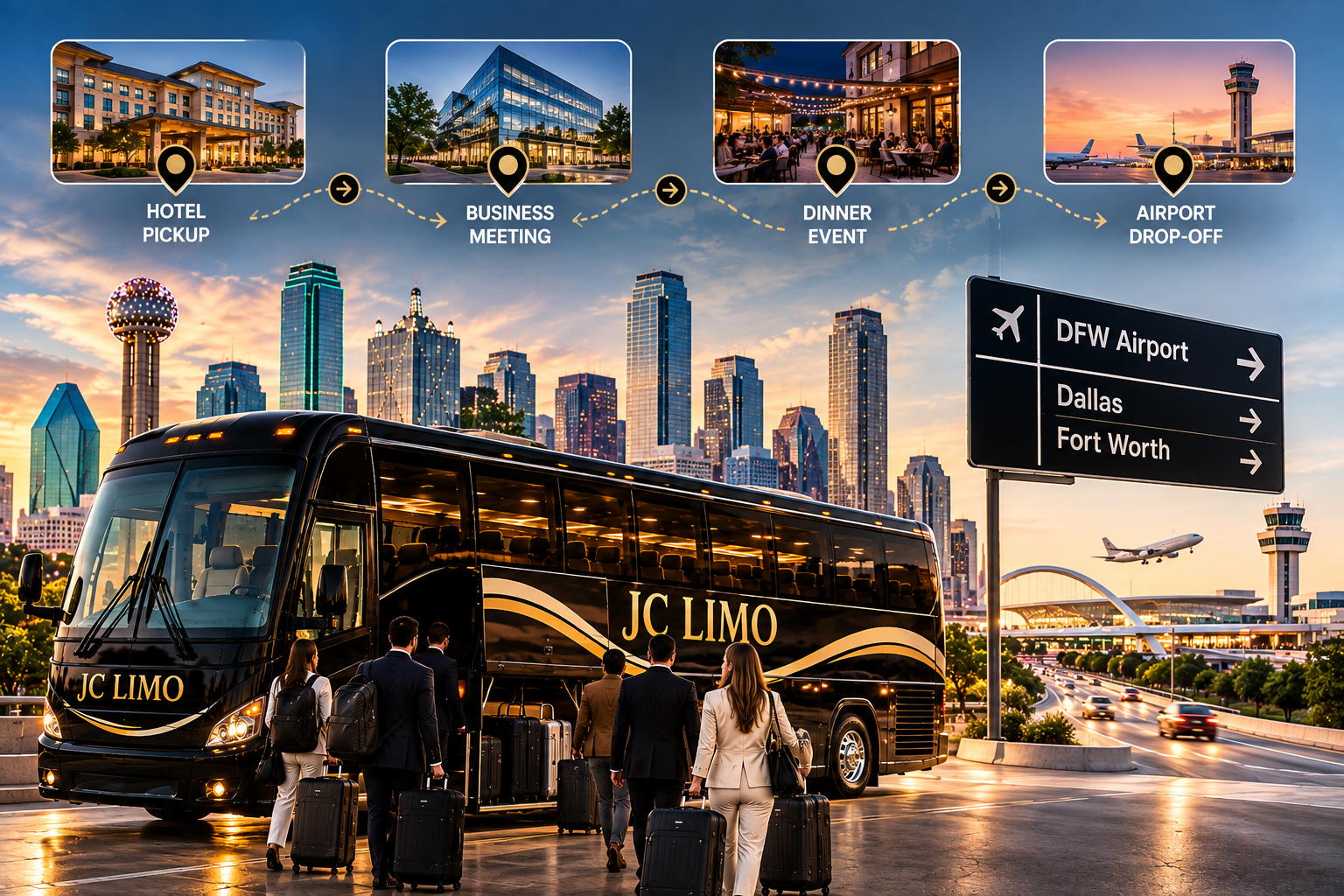
Not every group trip is a round trip.
Sometimes the day begins at a hotel in Dallas and ends at DFW Airport.
A corporate team may leave its hotel in the morning, spend the day at meetings, attend dinner in Fort Worth, and then continue to a different hotel.
A tour group could check out in the morning, visit several destinations with luggage, and finish the day at the airport.
A sports team may begin at one hotel but relocate to another part of Texas after an event.
These itineraries create a transportation challenge that is easy to overlook.
If passengers are not returning to where they started, their belongings, luggage, vehicle requirements, pickup times, and final destinations all need to be considered from the beginning.
For groups, transportation should not automatically be planned as:
Point A → Point B → Point A.
Sometimes the real itinerary is:
Point A → Point B → Point C → Point D.
Professional group transportation can make these one-way and multi-destination days much easier to manage.
With JC LIMO, groups can coordinate bus and shuttle transportation throughout Dallas, Fort Worth, and surrounding Texas areas based on the complete itinerary—not just the first transfer of the day.
Why the Final Destination Changes the Whole Plan
Imagine 40 corporate travelers staying at a hotel in Dallas.
They check out at 8:00 a.m.
The group has meetings throughout the day, followed by an evening event.
Afterward, everyone needs to travel directly to DFW Airport for a late flight.
If transportation is planned only around the meetings, an important question has been missed:
Where will 40 people’s luggage be all day?
The fact that the group is not returning to the hotel changes the transportation requirements.
Passengers may need to bring their suitcases when they board in the morning.
The vehicle choice should account for those belongings.
Every stop should be planned with the final airport journey in mind.
This is why the end of the day should be considered before the transportation plan begins.
Start Planning From Both Ends
Most people naturally plan travel from the beginning.
Where are we being picked up?
What is our first destination?
Where are we going after that?
For more complex group itineraries, it can be useful to plan from both directions.
Start with the first pickup.
Then identify the final destination.
Everything else fits between those two points.
Suppose the itinerary is:
Dallas hotel → corporate meeting → lunch → Fort Worth event → DFW Airport.
Knowing that the airport is the final destination immediately raises useful questions.
Does everyone have luggage?
What time are the flights?
Does the group need to arrive at one terminal or several?
How much time is available after the Fort Worth event?
Will passengers need to change clothes or collect anything before leaving?
Those questions might not appear if the organizer only thinks about the first transfer.
Hotel Checkout Often Creates One-Way Transportation Days
Hotel checkout is one of the most common reasons a group does not return to its starting point.
Rooms may need to be vacated in the morning even though the group’s trip continues all day.
For example, conference attendees may check out before heading to the final day of an event.
When the conference finishes, they go directly to the airport.
Returning to the hotel simply to collect luggage may add unnecessary travel.
Instead, transportation can be designed around the fact that the group is checking out.
Passengers board the bus in the morning with their belongings.
The day’s route then continues toward the final destination.
This can create a much smoother itinerary when planned correctly.
The important part is recognizing the luggage requirement before selecting transportation.
Luggage Matters on One-Way Group Trips
Passenger capacity is only one part of choosing group transportation.
A bus carrying 40 people from a hotel to dinner may have different practical requirements from a bus carrying 40 people who have checked out and are traveling with suitcases.
If the group will have luggage all day, the transportation plan should reflect that.
Ask passengers what they are likely to bring.
Is everyone carrying one suitcase?
Are there additional bags?
Does the group include sports equipment?
Are there conference materials or presentation items?
Will people be shopping during the day and adding more belongings?
These details can affect the type of bus or shuttle that makes sense for the itinerary.
Planning for belongings is especially important when passengers will not have an opportunity to return to the hotel.
Corporate Groups Often Have Changing End Points
Business travel rarely follows a perfectly simple schedule.
A team may begin at a hotel but finish at an office.
Employees could attend a conference during the day and then separate after dinner.
Visiting executives may travel directly from a final meeting to the airport.
A corporate retreat might end in a completely different part of the Dallas–Fort Worth area from where it began.
When transportation is planned around the full day, these movements can be organized in advance.
For example:
7:30 a.m. — Hotel pickup.
8:30 a.m. — Meeting.
12:30 p.m. — Lunch.
2:00 p.m. — Site visit.
5:30 p.m. — Dinner.
8:00 p.m. — Airport transfer.
The group never needs to return to its original hotel.
Instead, the JC LIMO transportation follows the itinerary from the first activity through the final destination.
Airport Endings Require Careful Timing
When a group day ends at an airport, timing becomes particularly important.
Missing a dinner reservation is inconvenient.
Missing a flight can affect the entire trip.
Organizers should therefore work backward from the flight schedule.
Passengers need enough time to reach the airport, unload belongings, find the appropriate terminal, check luggage if necessary, and complete the airport process.
If the group has several different flights, the transportation plan may need additional consideration.
Are the flights close together?
Do passengers need different terminals?
Does part of the group need to arrive earlier?
These questions should be answered before the final activity of the day.
The last transfer should not become an emergency because earlier activities were allowed to run too long.
Groups Moving to a Different Hotel
Not every changing destination involves an airport.
Sometimes the group is changing hotels.
This can happen during multi-day tours, corporate programs, sports tournaments, and longer trips across Texas.
A group might spend the first two nights in Dallas and then move to Fort Worth.
Instead of dedicating a separate trip purely to changing hotels, the move can sometimes be incorporated into the day’s transportation.
Passengers check out in the morning.
Their luggage travels with the group.
They attend scheduled activities.
At the end of the day, the bus takes everyone to the new hotel.
This approach can reduce unnecessary backtracking.
However, it requires careful luggage planning and a realistic schedule.
Passengers should also know that they will not have access to their new rooms until later in the day.
Sports Teams Frequently Move Between Bases
Sports travel can involve changing accommodations depending on the tournament or competition schedule.
A team may begin in Dallas, compete in another part of the DFW area, and stay closer to the next day’s event afterward.
That means players, coaches, staff, and equipment are all changing locations.
Using multiple personal vehicles can make this more difficult.
Equipment may end up separated.
Some vehicles may reach the new hotel before others.
Players might need to coordinate room check-in while the rest of the team is still traveling.
A dedicated group bus can keep the team and its belongings under one transportation schedule.
The group leaves together, attends the event, and continues to the next accommodation.
For multi-day Texas trips, this can create a much more consistent travel experience.
Tour Groups Benefit From Forward-Moving Routes
Tour itineraries are another good example.
Suppose a group is exploring both Dallas and Fort Worth.
If every day is designed around returning to the same location, the group may spend unnecessary time retracing its route.
Sometimes a forward-moving itinerary makes more sense.
The group could check out of a Dallas hotel, spend the day visiting destinations along the route, and finish at a hotel in Fort Worth.
Instead of driving back to Dallas and then returning toward Fort Worth the next day, the itinerary keeps moving forward.
This can reduce unnecessary travel.
It can also allow the group to experience more of the area without adding additional transportation purely for repositioning.
The exact route should always be designed around the group’s activities and accommodations.
Don’t Assume Everyone Has the Same Final Destination
A group can travel together all day and still separate at the end.
This is common with conferences and corporate trips.
Some passengers may be staying another night.
Others have flights.
Local employees might return home.
Executives could have a separate dinner or meeting.
If everyone boards the shuttle without a clear final plan, confusion can begin quickly.
Before the last activity, organizers should know where passengers are going.
That does not necessarily mean the vehicle needs to take every individual to a different location.
Central drop-off points may make more sense.
But the transportation structure should be clear.
Passengers need to know which transportation applies to them and where they will finish the day.
Plan Drop-Off Order as Carefully as Pickup Order
When several final destinations are involved, the order matters.
A poorly planned drop-off route can add unnecessary time.
Suppose the bus has passengers going to two hotels and an airport.
The route should be considered based on geography, timing, and urgency.
Airport passengers with scheduled flights may have stricter requirements than passengers returning to a hotel.
Likewise, a destination that appears close on a map may not be the logical first stop depending on the overall route.
The goal is not simply to choose the nearest destination.
It is to create a sequence that works for the group.
This is where providing the full itinerary when planning transportation becomes important.
Avoid Unnecessary Returns to the Starting Point
Many group itineraries include unnecessary backtracking simply because organizers assume everyone needs to return to the original hotel.
Sometimes they do.
Sometimes they do not.
If the group has checked out and the final destination is somewhere else, returning to the hotel may add an entire extra transfer.
Consider whether anything actually requires the group to go back.
Are belongings still there?
Does someone need to change?
Is there another passenger joining?
If the answer is no, a forward-moving transportation plan may be more efficient.
For groups traveling across Dallas and Fort Worth, avoiding unnecessary backtracking can save valuable itinerary time.
Changing Clothes Can Affect the Plan
One practical issue often overlooked in full-day transportation is clothing.
A corporate group may attend meetings during the day and a formal dinner at night.
Wedding guests might participate in daytime activities before an evening celebration.
A sports group could need to change after a competition.
If passengers are not returning to their hotel, when and where will they change?
This is not strictly a transportation issue, but it directly affects the itinerary.
If a hotel stop is necessary for passengers to prepare for the evening, it needs to be included.
If not, the schedule may be able to continue directly toward the next destination.
The more accurately the itinerary reflects what passengers actually need to do, the better the transportation plan can support it.
Communicate the One-Way Plan Clearly
Passengers often assume they are returning to their hotel unless told otherwise.
That can create problems.
Someone leaves a jacket in the room.
Another passenger leaves luggage with the hotel because they expect to return.
Then the organizer announces that the group is going directly to the airport after dinner.
Clear communication prevents this.
Before departure, passengers should know:
Whether they are returning to the hotel.
Whether they need to bring luggage.
Where the day will end.
What belongings they need with them.
Whether there are multiple final drop-off locations.
These instructions should ideally be shared before the morning departure.
Once the group has left the hotel, changing the plan may be difficult.
Different End Points Can Make the Trip More Efficient
A trip that ends somewhere different from where it started may sound more complicated.
Sometimes it is actually more efficient.
Returning to the original pickup location simply because that is where the day began can add unnecessary travel.
A forward-moving route allows transportation to follow the actual itinerary.
This is particularly useful during trips involving multiple areas of North Texas.
A group can begin in Dallas, continue through scheduled activities, visit Fort Worth, and finish closer to the next day’s destination.
The transportation plan becomes part of the travel strategy rather than simply a way to get back and forth.
Consider the Next Morning Too
If the group is changing hotels or ending in another city, today’s final destination affects tomorrow’s transportation.
This is another reason to look beyond a single transfer.
Suppose a sports team has an early competition in Fort Worth tomorrow.
Moving from a Dallas hotel to a Fort Worth hotel tonight may make the next morning easier.
A corporate group may have meetings in a different area the following day.
Repositioning the group after today’s final event could reduce tomorrow’s travel.
Transportation planning becomes much more effective when organizers consider how each day connects to the next.
For multi-day group travel, every final drop-off is also the starting point for another part of the itinerary.
Flexibility Still Requires a Clear Framework
Complex group itineraries can change.
Meetings run late.
Events finish early.
Passengers change flights.
Dinner plans move.
A good transportation plan should allow reasonable flexibility.
But flexibility works best when there is a clear original structure.
Everyone should know the intended route.
The organizer should know the priority destinations.
Passengers should understand where they are expected to finish.
When something changes, adjustments can then be made around an existing plan.
Without that structure, every change becomes another round of transportation decisions.
Plan the Whole Route With JC LIMO
Group transportation does not always need to bring passengers back to where they started.
Sometimes the most practical itinerary keeps moving forward.
JC LIMO provides professional bus and shuttle transportation throughout Dallas, Fort Worth, and surrounding Texas areas for groups with simple transfers, full-day schedules, changing hotels, airport departures, events, meetings, sports trips, tours, and other travel requirements.
When your group will finish somewhere different from where it began, plan that final destination from the start.
Consider luggage.
Think about hotel checkout.
Build airport timing into the schedule.
Determine who is traveling to each final destination.
Avoid unnecessary backtracking.
And communicate clearly so passengers know w
Not every group trip is a round trip.
Sometimes the day begins at a hotel in Dallas and ends at DFW Airport.
A corporate team may leave its hotel in the morning, spend the day at meetings, attend dinner in Fort Worth, and then continue to a different hotel.
A tour group could check out in the morning, visit several destinations with luggage, and finish the day at the airport.
A sports team may begin at one hotel but relocate to another part of Texas after an event.
These itineraries create a transportation challenge that is easy to overlook.
If passengers are not returning to where they started, their belongings, luggage, vehicle requirements, pickup times, and final destinations all need to be considered from the beginning.
For groups, transportation should not automatically be planned as:
Point A → Point B → Point A.
Sometimes the real itinerary is:
Point A → Point B → Point C → Point D.
Professional group transportation can make these one-way and multi-destination days much easier to manage.
With JC LIMO, groups can coordinate bus and shuttle transportation throughout Dallas, Fort Worth, and surrounding Texas areas based on the complete itinerary—not just the first transfer of the day.
Why the Final Destination Changes the Whole Plan
Imagine 40 corporate travelers staying at a hotel in Dallas.
They check out at 8:00 a.m.
The group has meetings throughout the day, followed by an evening event.
Afterward, everyone needs to travel directly to DFW Airport for a late flight.
If transportation is planned only around the meetings, an important question has been missed:
Where will 40 people’s luggage be all day?
The fact that the group is not returning to the hotel changes the transportation requirements.
Passengers may need to bring their suitcases when they board in the morning.
The vehicle choice should account for those belongings.
Every stop should be planned with the final airport journey in mind.
This is why the end of the day should be considered before the transportation plan begins.
Start Planning From Both Ends
Most people naturally plan travel from the beginning.
Where are we being picked up?
What is our first destination?
Where are we going after that?
For more complex group itineraries, it can be useful to plan from both directions.
Start with the first pickup.
Then identify the final destination.
Everything else fits between those two points.
Suppose the itinerary is:
Dallas hotel → corporate meeting → lunch → Fort Worth event → DFW Airport.
Knowing that the airport is the final destination immediately raises useful questions.
Does everyone have luggage?
What time are the flights?
Does the group need to arrive at one terminal or several?
How much time is available after the Fort Worth event?
Will passengers need to change clothes or collect anything before leaving?
Those questions might not appear if the organizer only thinks about the first transfer.
Hotel Checkout Often Creates One-Way Transportation Days
Hotel checkout is one of the most common reasons a group does not return to its starting point.
Rooms may need to be vacated in the morning even though the group’s trip continues all day.
For example, conference attendees may check out before heading to the final day of an event.
When the conference finishes, they go directly to the airport.
Returning to the hotel simply to collect luggage may add unnecessary travel.
Instead, transportation can be designed around the fact that the group is checking out.
Passengers board the bus in the morning with their belongings.
The day’s route then continues toward the final destination.
This can create a much smoother itinerary when planned correctly.
The important part is recognizing the luggage requirement before selecting transportation.
Luggage Matters on One-Way Group Trips
Passenger capacity is only one part of choosing group transportation.
A bus carrying 40 people from a hotel to dinner may have different practical requirements from a bus carrying 40 people who have checked out and are traveling with suitcases.
If the group will have luggage all day, the transportation plan should reflect that.
Ask passengers what they are likely to bring.
Is everyone carrying one suitcase?
Are there additional bags?
Does the group include sports equipment?
Are there conference materials or presentation items?
Will people be shopping during the day and adding more belongings?
These details can affect the type of bus or shuttle that makes sense for the itinerary.
Planning for belongings is especially important when passengers will not have an opportunity to return to the hotel.
Corporate Groups Often Have Changing End Points
Business travel rarely follows a perfectly simple schedule.
A team may begin at a hotel but finish at an office.
Employees could attend a conference during the day and then separate after dinner.
Visiting executives may travel directly from a final meeting to the airport.
A corporate retreat might end in a completely different part of the Dallas–Fort Worth area from where it began.
When transportation is planned around the full day, these movements can be organized in advance.
For example:
7:30 a.m. — Hotel pickup.
8:30 a.m. — Meeting.
12:30 p.m. — Lunch.
2:00 p.m. — Site visit.
5:30 p.m. — Dinner.
8:00 p.m. — Airport transfer.
The group never needs to return to its original hotel.
Instead, the JC LIMO transportation follows the itinerary from the first activity through the final destination.
Airport Endings Require Careful Timing
When a group day ends at an airport, timing becomes particularly important.
Missing a dinner reservation is inconvenient.
Missing a flight can affect the entire trip.
Organizers should therefore work backward from the flight schedule.
Passengers need enough time to reach the airport, unload belongings, find the appropriate terminal, check luggage if necessary, and complete the airport process.
If the group has several different flights, the transportation plan may need additional consideration.
Are the flights close together?
Do passengers need different terminals?
Does part of the group need to arrive earlier?
These questions should be answered before the final activity of the day.
The last transfer should not become an emergency because earlier activities were allowed to run too long.
Groups Moving to a Different Hotel
Not every changing destination involves an airport.
Sometimes the group is changing hotels.
This can happen during multi-day tours, corporate programs, sports tournaments, and longer trips across Texas.
A group might spend the first two nights in Dallas and then move to Fort Worth.
Instead of dedicating a separate trip purely to changing hotels, the move can sometimes be incorporated into the day’s transportation.
Passengers check out in the morning.
Their luggage travels with the group.
They attend scheduled activities.
At the end of the day, the bus takes everyone to the new hotel.
This approach can reduce unnecessary backtracking.
However, it requires careful luggage planning and a realistic schedule.
Passengers should also know that they will not have access to their new rooms until later in the day.
Sports Teams Frequently Move Between Bases
Sports travel can involve changing accommodations depending on the tournament or competition schedule.
A team may begin in Dallas, compete in another part of the DFW area, and stay closer to the next day’s event afterward.
That means players, coaches, staff, and equipment are all changing locations.
Using multiple personal vehicles can make this more difficult.
Equipment may end up separated.
Some vehicles may reach the new hotel before others.
Players might need to coordinate room check-in while the rest of the team is still traveling.
A dedicated group bus can keep the team and its belongings under one transportation schedule.
The group leaves together, attends the event, and continues to the next accommodation.
For multi-day Texas trips, this can create a much more consistent travel experience.
Tour Groups Benefit From Forward-Moving Routes
Tour itineraries are another good example.
Suppose a group is exploring both Dallas and Fort Worth.
If every day is designed around returning to the same location, the group may spend unnecessary time retracing its route.
Sometimes a forward-moving itinerary makes more sense.
The group could check out of a Dallas hotel, spend the day visiting destinations along the route, and finish at a hotel in Fort Worth.
Instead of driving back to Dallas and then returning toward Fort Worth the next day, the itinerary keeps moving forward.
This can reduce unnecessary travel.
It can also allow the group to experience more of the area without adding additional transportation purely for repositioning.
The exact route should always be designed around the group’s activities and accommodations.
Don’t Assume Everyone Has the Same Final Destination
A group can travel together all day and still separate at the end.
This is common with conferences and corporate trips.
Some passengers may be staying another night.
Others have flights.
Local employees might return home.
Executives could have a separate dinner or meeting.
If everyone boards the shuttle without a clear final plan, confusion can begin quickly.
Before the last activity, organizers should know where passengers are going.
That does not necessarily mean the vehicle needs to take every individual to a different location.
Central drop-off points may make more sense.
But the transportation structure should be clear.
Passengers need to know which transportation applies to them and where they will finish the day.
Plan Drop-Off Order as Carefully as Pickup Order
When several final destinations are involved, the order matters.
A poorly planned drop-off route can add unnecessary time.
Suppose the bus has passengers going to two hotels and an airport.
The route should be considered based on geography, timing, and urgency.
Airport passengers with scheduled flights may have stricter requirements than passengers returning to a hotel.
Likewise, a destination that appears close on a map may not be the logical first stop depending on the overall route.
The goal is not simply to choose the nearest destination.
It is to create a sequence that works for the group.
This is where providing the full itinerary when planning transportation becomes important.
Avoid Unnecessary Returns to the Starting Point
Many group itineraries include unnecessary backtracking simply because organizers assume everyone needs to return to the original hotel.
Sometimes they do.
Sometimes they do not.
If the group has checked out and the final destination is somewhere else, returning to the hotel may add an entire extra transfer.
Consider whether anything actually requires the group to go back.
Are belongings still there?
Does someone need to change?
Is there another passenger joining?
If the answer is no, a forward-moving transportation plan may be more efficient.
For groups traveling across Dallas and Fort Worth, avoiding unnecessary backtracking can save valuable itinerary time.
Changing Clothes Can Affect the Plan
One practical issue often overlooked in full-day transportation is clothing.
A corporate group may attend meetings during the day and a formal dinner at night.
Wedding guests might participate in daytime activities before an evening celebration.
A sports group could need to change after a competition.
If passengers are not returning to their hotel, when and where will they change?
This is not strictly a transportation issue, but it directly affects the itinerary.
If a hotel stop is necessary for passengers to prepare for the evening, it needs to be included.
If not, the schedule may be able to continue directly toward the next destination.
The more accurately the itinerary reflects what passengers actually need to do, the better the transportation plan can support it.
Communicate the One-Way Plan Clearly
Passengers often assume they are returning to their hotel unless told otherwise.
That can create problems.
Someone leaves a jacket in the room.
Another passenger leaves luggage with the hotel because they expect to return.
Then the organizer announces that the group is going directly to the airport after dinner.
Clear communication prevents this.
Before departure, passengers should know:
Whether they are returning to the hotel.
Whether they need to bring luggage.
Where the day will end.
What belongings they need with them.
Whether there are multiple final drop-off locations.
These instructions should ideally be shared before the morning departure.
Once the group has left the hotel, changing the plan may be difficult.
Different End Points Can Make the Trip More Efficient
A trip that ends somewhere different from where it started may sound more complicated.
Sometimes it is actually more efficient.
Returning to the original pickup location simply because that is where the day began can add unnecessary travel.
A forward-moving route allows transportation to follow the actual itinerary.
This is particularly useful during trips involving multiple areas of North Texas.
A group can begin in Dallas, continue through scheduled activities, visit Fort Worth, and finish closer to the next day’s destination.
The transportation plan becomes part of the travel strategy rather than simply a way to get back and forth.
Consider the Next Morning Too
If the group is changing hotels or ending in another city, today’s final destination affects tomorrow’s transportation.
This is another reason to look beyond a single transfer.
Suppose a sports team has an early competition in Fort Worth tomorrow.
Moving from a Dallas hotel to a Fort Worth hotel tonight may make the next morning easier.
A corporate group may have meetings in a different area the following day.
Repositioning the group after today’s final event could reduce tomorrow’s travel.
Transportation planning becomes much more effective when organizers consider how each day connects to the next.
For multi-day group travel, every final drop-off is also the starting point for another part of the itinerary.
Flexibility Still Requires a Clear Framework
Complex group itineraries can change.
Meetings run late.
Events finish early.
Passengers change flights.
Dinner plans move.
A good transportation plan should allow reasonable flexibility.
But flexibility works best when there is a clear original structure.
Everyone should know the intended route.
The organizer should know the priority destinations.
Passengers should understand where they are expected to finish.
When something changes, adjustments can then be made around an existing plan.
Without that structure, every change becomes another round of transportation decisions.
Plan the Whole Route With JC LIMO
Group transportation does not always need to bring passengers back to where they started.
Sometimes the most practical itinerary keeps moving forward.
JC LIMO provides professional bus and shuttle transportation throughout Dallas, Fort Worth, and surrounding Texas areas for groups with simple transfers, full-day schedules, changing hotels, airport departures, events, meetings, sports trips, tours, and other travel requirements.
When your group will finish somewhere different from where it began, plan that final destination from the start.
Consider luggage.
Think about hotel checkout.
Build airport timing into the schedule.
Determine who is traveling to each final destination.
Avoid unnecessary backtracking.
And communicate clearly so passengers know what belongings they need to bring.
A well-designed Dallas–Fort Worth group transportation plan should follow the real journey—not automatically return to Point A.
hat belongings they need to bring.
A well-designed Dallas–Fort Worth group transportation plan should follow the real journey—not automatically return to Point A.

Related posts
 13Oct, 26
Dallas Group Transportation With Luggage and Equipment
 13Oct, 26
Dallas Group Transportation With Multiple Drop-Offs
 13Oct, 26
- October 13, 2026
- 0
- 10
