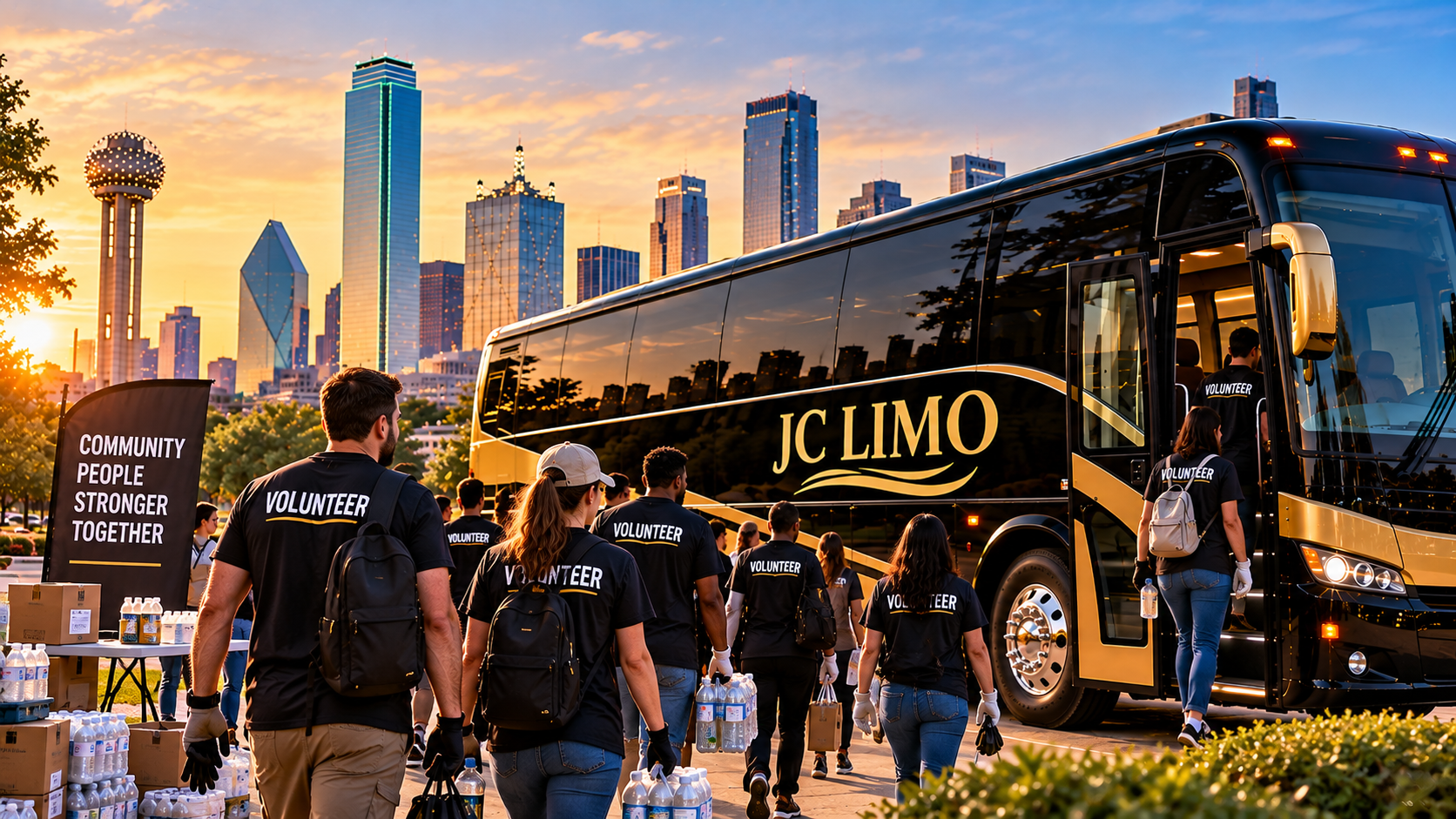
Dallas Volunteer Group Transportation: A Guide to Community Events
A successful volunteer project begins long before the first donation is distributed, the first tree is planted, or the first community event opens its doors. Behind every organized volunteer effort is a team coordinating people, supplies, schedules, and locations.
Transportation is one of those details that can make a meaningful difference.
Across Dallas and Fort Worth, Texas, nonprofit organizations, businesses, schools, and community groups regularly bring volunteers together for service activities. These may include neighborhood cleanups, food distribution programs, charity events, environmental projects, and corporate volunteer days.
While the purpose of these events is to support the community, moving dozens of volunteers between locations can create unexpected logistical challenges.
Participants may be coming from different neighborhoods, some may not have personal transportation, and others may be unfamiliar with the event location.
When volunteers arrive at different times, organizers may need to delay instructions, redistribute responsibilities, or adjust the schedule.
That’s why Dallas volunteer group transportation should be considered during the early stages of event planning.
With group transportation options from JC LIMO, organizations can explore charter bus and shuttle services that help coordinate volunteer travel throughout Dallas, Fort Worth, and surrounding North Texas communities.
Why Transportation Matters for Volunteer Programs
Volunteer events depend on people arriving ready to contribute.
Unlike casual social gatherings, many community service activities follow specific schedules.
Food distribution programs may begin at designated times. Environmental projects may require teams to arrive before equipment is distributed. Charity events often need volunteers in place before participants or visitors arrive.
When transportation is left entirely to individuals, organizers may face inconsistent arrival times.
Imagine a nonprofit organization arranging a community cleanup involving 40 volunteers.
The project begins at 8:00 AM, and participants are expected to gather at a location outside central Dallas.
Some volunteers arrive early, while others experience traffic delays or difficulty locating the meeting point.
As a result, organizers must repeat instructions and adjust team assignments.
A coordinated bus or shuttle service can help simplify these arrangements.
Volunteers can gather at a central location, travel together, and arrive according to a planned schedule.
This allows organizers to spend more time managing the project and less time coordinating individual journeys.
Types of Volunteer Events That Benefit From Group Transportation
Volunteer transportation requirements vary depending on the organization and the nature of the project.
Some events take place at a single location, while others involve multiple destinations throughout the day.
Community Cleanup Projects
Neighborhood cleanup activities often involve volunteers working in parks, public spaces, and community areas.
These projects may require participants to travel to locations with limited parking.
A shared bus can help transport volunteers from a designated meeting point to the project site.
Food Distribution and Charity Programs
Food banks, nonprofit organizations, and community outreach programs frequently organize volunteer activities.
Participants may need transportation to warehouses, distribution facilities, or event locations.
For projects involving several teams, scheduled shuttles can help coordinate arrivals.
Corporate Volunteer Days
Many companies organize volunteer activities as part of their corporate social responsibility initiatives.
Employees may spend a day supporting local charities, environmental programs, or community organizations.
When employees are traveling from an office to a volunteer location, group transportation can simplify the process.
School and University Volunteer Programs
Educational institutions often encourage students to participate in community service activities.
These programs may involve students traveling to nonprofit organizations or approved volunteer sites.
Transportation planning should follow the institution’s policies and any applicable requirements for student travel.
Fundraising and Community Events
Large charity events may require volunteers to move between parking areas, registration points, and event venues.
Shuttle transportation can support these movements when walking distances or parking limitations make individual travel less convenient.
Planning Transportation for a Volunteer Event
Effective transportation planning begins with understanding the event’s requirements.
Organizers should identify the number of volunteers, project location, schedule, and any additional destinations.
Confirm Volunteer Attendance
Volunteer registrations may change as the event approaches.
Some participants may cancel, while others may join close to the event date.
Organizers should confirm expected attendance before finalizing transportation arrangements.
Accurate passenger counts help determine the appropriate vehicle size.
Select a Practical Pickup Location
A central pickup location can simplify group travel.
For corporate volunteer events, this may be the company office.
For nonprofit programs, it might be a community center, school, or designated parking area.
The location should be accessible to participants and suitable for bus boarding.
Establish Clear Departure Times
Volunteers should receive the meeting time and scheduled departure time in advance.
These should not necessarily be identical.
Allowing time for attendance checks and boarding helps the group depart more efficiently.
Coordinate With the Volunteer Site
Before the event, organizers should confirm whether the destination can accommodate buses.
Some locations may have restricted access, narrow roads, or designated loading areas.
Discussing these details with the transportation provider helps avoid confusion on arrival.
Choosing the Right Bus for Volunteer Transportation
The appropriate vehicle depends on passenger numbers, travel distances, and the event schedule.
JC LIMO offers group transportation options that can support different types of organized travel.
Mini Buses for Smaller Volunteer Teams
Mini buses can be suitable for smaller nonprofit teams or company departments participating in volunteer activities.
They allow participants to travel together without requiring multiple personal vehicles.
Shuttle Buses for Community Events
Shuttle buses are useful when volunteers need repeated transportation between locations.
For example, an event organizer may arrange transportation between a parking area and a community project site.
Depending on the schedule, shuttles may operate during designated arrival and departure periods.
Charter Buses for Larger Volunteer Groups
Larger volunteer programs may require full-sized charter buses.
These vehicles can accommodate more passengers, making them useful for company-wide volunteer activities or large nonprofit initiatives.
Before booking, organizers should confirm vehicle capacity, accessibility needs, and any equipment or luggage requirements.
Corporate Volunteer Transportation in Dallas–Fort Worth
Corporate volunteer programs are an opportunity for businesses to support local communities while encouraging employees to work together outside their normal roles.
However, coordinating transportation for employees can become challenging when the volunteer site is located away from the workplace.
Consider a Dallas company organizing a volunteer day for 50 employees.
The team plans to support a community organization in Fort Worth.
If employees drive separately, the company may need to manage parking, directions, and different arrival times.
A charter bus can provide a shared transportation option.
Employees can meet at the office, travel together, participate in the activity, and return according to the planned schedule.
This approach can also make attendance coordination easier.
For companies organizing recurring volunteer programs, establishing a consistent transportation process may simplify future events.
Transportation for Volunteer Projects at Multiple Locations
Some community service programs involve several locations.
For example, a nonprofit organization may coordinate volunteers across different neighborhoods during a citywide cleanup.
Another organization might operate multiple distribution sites throughout Dallas and Fort Worth.
These projects require more detailed transportation planning.
Divide Volunteers Into Teams
Organizers should determine how many volunteers are needed at each location.
This helps establish transportation requirements for individual teams.
Review Distances Between Sites
Travel times should be considered when assigning volunteers to different destinations.
Moving a group between locations on opposite sides of the Metroplex may require significant time.
Establish Transfer Schedules
If volunteers need to move between sites during the day, the itinerary should include planned transfer times.
These schedules should account for traffic and boarding.
Create a Communication Process
A designated transportation coordinator should communicate any changes to the driver or transportation provider.
This helps reduce confusion when volunteer assignments or event schedules change.
Managing Equipment and Supplies During Volunteer Trips
Volunteer groups may travel with more than personal belongings.
Depending on the project, participants may need gloves, safety vests, cleaning materials, tools, food supplies, or other equipment.
Transportation organizers should identify these requirements before booking.
However, not all equipment can be transported in passenger vehicles.
Certain tools, chemicals, or bulky supplies may require separate transportation arrangements.
Organizers should confirm what items are permitted and whether the vehicle has suitable storage capacity.
For projects involving significant equipment, using a separate supply vehicle may be more appropriate.
Keeping passenger transportation and equipment logistics clearly organized can help the event run more smoothly.
Volunteer Transportation Across North Texas
Dallas–Fort Worth includes numerous communities where nonprofit organizations and volunteer groups operate.
Transportation needs may vary depending on the project location.
Dallas
Dallas hosts a wide range of community service programs, nonprofit initiatives, and volunteer activities.
Groups should consider traffic conditions and site access when planning transportation.
Fort Worth
Fort Worth offers opportunities for volunteer projects involving community organizations, schools, and neighborhood initiatives.
Groups traveling from Dallas should account for the distance between the two cities.
Arlington
Arlington is centrally located within the Metroplex and may be a practical destination for regional volunteer activities.
Event-related traffic should be considered when scheduling transportation.
Plano and Frisco
Businesses and community organizations in Plano and Frisco may organize volunteer programs locally or travel to projects elsewhere in North Texas.
Shared transportation can help coordinate employee and volunteer groups.
Irving and Grand Prairie
Irving and Grand Prairie also provide locations for community events and nonprofit activities.
Transportation schedules should reflect the actual addresses and expected travel conditions.
How Shared Transportation Supports Volunteer Teamwork
Volunteer projects depend on collaboration.
Participants often need to understand their responsibilities, work together, and communicate throughout the event.
Shared transportation can support this process.
During the journey, organizers may provide general instructions, review the day’s schedule, or explain how volunteers will be divided into teams.
Participants also have an opportunity to meet other volunteers before arriving.
For corporate groups, this can create informal interaction between employees from different departments.
For community organizations, it may help new volunteers feel more connected to the group.
Transportation should not replace proper on-site training or safety briefings, but it can provide additional time for coordination.
Common Mistakes When Organizing Volunteer Transportation
One common mistake is booking transportation before confirming the expected passenger count.
Volunteer attendance can change, so organizers should establish a reliable registration process.
Another mistake is failing to confirm site access.
Some volunteer locations may not have suitable areas for large buses.
A third mistake is overlooking equipment requirements.
Passenger buses may not be appropriate for transporting certain materials.
Organizers should also avoid scheduling transportation too close to the event start time.
Traffic, boarding, and attendance checks can affect departure and arrival schedules.
Finally, volunteer coordinators should ensure participants understand the return transportation arrangements.
Clear communication helps prevent confusion at the end of the event.
How to Make Volunteer Transportation More Efficient
A well-organized transportation plan can simplify volunteer coordination.
Start by assigning one person to manage transportation arrangements.
This person should communicate with the transportation provider and maintain the passenger list.
Next, create a detailed itinerary that includes pickup locations, destinations, departure times, and expected return times.
Share this information with volunteers before the event.
For larger groups, consider assigning team leaders who can assist with attendance checks.
It is also useful to confirm transportation details shortly before the event.
These steps help organizers identify potential problems early and maintain a more predictable schedule.
Why Consider JC LIMO for Dallas Volunteer Group Transportation?
Volunteer organizations need transportation arrangements that support their schedules, passenger requirements, and project locations.
JC LIMO provides charter bus and shuttle transportation services throughout Dallas, Fort Worth, and surrounding North Texas communities.
These services can support nonprofit activities, corporate volunteer days, community events, and organized group travel.
Volunteer coordinators can contact JC LIMO to discuss passenger numbers, pickup locations, destinations, and transportation schedules.
Providing a complete itinerary helps the transportation team assess suitable vehicle options and service arrangements.
Whether an organization is planning a single volunteer activity or coordinating travel across multiple locations, early transportation planning can make the process easier.
Frequently Asked Questions About Dallas Volunteer Transportation
Can JC LIMO provide transportation for nonprofit volunteer groups?
JC LIMO offers group transportation, charter bus, and shuttle services. Nonprofit organizations can contact the company to discuss their transportation requirements.
What type of bus is suitable for a volunteer group?
The appropriate vehicle depends on passenger numbers, travel distances, and accessibility requirements. Mini buses, shuttle buses, and charter buses may be suitable for different groups.
Can volunteer transportation include multiple project locations?
Organizations can request transportation involving multiple destinations. The final arrangements depend on route distances, schedules, passenger numbers, and vehicle availability.
Is group transportation suitable for corporate volunteer events?
Yes. Group transportation can help companies coordinate employee travel between offices and volunteer project locations.
How early should volunteer organizations arrange transportation?
Organizations should begin planning once the event date, destination, and estimated passenger count are confirmed. Early planning provides more time to review vehicle availability and coordinate schedules.
Make Your Next Volunteer Event Easier With JC LIMO
Volunteer programs bring people together to support meaningful causes.
Whether your organization is coordinating a community cleanup, organizing a charity event, or planning a corporate volunteer day, transportation plays an important supporting role.
A coordinated bus or shuttle service can simplify travel arrangements, reduce confusion, and help volunteers arrive ready to participate.
By planning transportation early, organizers can spend less time managing logistics and more time focusing on the communities they serve.
Plan your next volunteer group trip with JC LIMO.
Explore charter bus and shuttle transportation options for nonprofits, businesses, and community organizations throughout Dallas–Fort Worth.

Related posts
 13Oct, 26
Dallas Group Transportation With Luggage and Equipment
 13Oct, 26
Dallas Group Transportation With Multiple Drop-Offs
 13Oct, 26
- October 13, 2026
- 0
- 10
