Dallas Bus Transportation for Corporate Product Launches
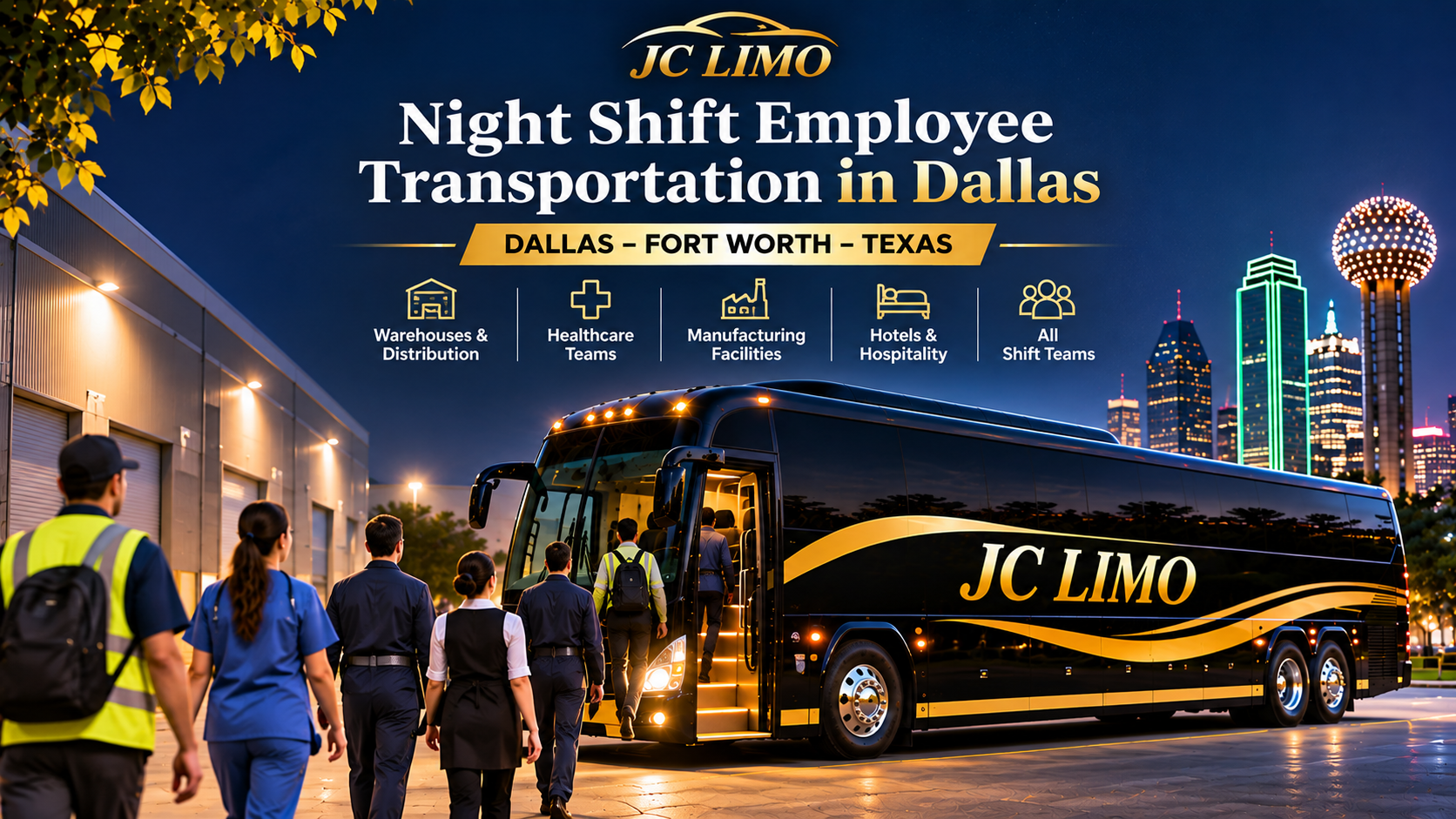
Night Shift Employee Transportation in Dallas: Keeping Your Business Moving After Dark
At 11:30 PM, most offices in Dallas are dark, restaurants are closing, and families are settling in for the night.
But across North Texas, thousands of employees are just beginning their workday.
Warehouse teams are preparing overnight shipments. Healthcare professionals are starting late shifts. Hotel staff are supporting guests, and manufacturing employees are keeping production lines running.
For these workers, the daily commute looks very different from a typical nine-to-five schedule.
Public transportation options may be limited during certain hours. Rideshare availability can vary, and employees driving long distances may face additional commuting challenges.
For businesses operating overnight, these transportation difficulties can affect staffing, shift transitions, and daily operations.
That’s why night shift employee transportation in Dallas is becoming an important consideration for companies that depend on workers arriving at unusual hours.
A private employee shuttle offers a coordinated transportation option designed around specific shift schedules and pickup locations.
At JC LIMO, we understand that business transportation needs don’t stop when the sun goes down.
Whether you’re managing a distribution center in Fort Worth, a healthcare facility in Dallas, or a manufacturing operation elsewhere in North Texas, organized group transportation can help support your workforce.
The Workforce That Keeps Dallas–Fort Worth Running Overnight
Dallas–Fort Worth is home to a diverse range of industries that operate beyond traditional business hours.
While many people associate the region with corporate offices and business districts, its economy also depends on logistics, manufacturing, healthcare, hospitality, and other essential services.
These industries frequently require employees to work early mornings, late evenings, or overnight shifts.
A warehouse employee may begin work at midnight.
A healthcare professional might finish a shift at 7:00 AM.
A hotel employee could leave work after the final guests have checked in.
For these workers, transportation schedules can be more complicated than those of daytime employees.
Traditional commuting options may not align with their working hours.
Employers that understand these challenges can explore transportation arrangements that better support their teams.
A dedicated employee shuttle is one option worth considering.
Why Night Shift Commuting Is Different
Commuting after dark presents several challenges that daytime workers may not experience as frequently.
One of the biggest differences is transportation availability.
Some public transit routes operate less frequently late at night, while others may not serve certain industrial or commercial areas during overnight hours.
Rideshare availability can also vary depending on the location and time.
Employees who drive their own vehicles may face different concerns, including fatigue after long shifts.
For workers living farther from their workplace, the commute can add significant time to an already demanding schedule.
These challenges become more complicated when businesses depend on large numbers of employees arriving at the same time.
A private shuttle can create a scheduled transportation option between designated pickup locations and the workplace.
This provides employees with a clearer commuting plan and helps employers coordinate shift arrivals.
How Night Shift Employee Shuttle Services Work
Night shift shuttle services are typically designed around a company’s operating schedule.
Unlike conventional public transportation, private shuttles can be planned according to specific pickup points and shift times.
For example, imagine a distribution center in Fort Worth operating three shifts.
The overnight shift begins at 10:00 PM and ends at 6:00 AM.
Employees live in several nearby communities, and many need transportation to the facility.
The company could explore a shuttle route that collects employees from designated meeting points before the shift begins.
After work, a return shuttle could transport participating employees back to those locations.
Another business might require transportation between an off-site parking facility and a workplace operating around the clock.
In that case, the shuttle schedule could be organized around employee arrival and departure periods.
The most suitable arrangement depends on passenger numbers, route distances, shift schedules, and service availability.
JC LIMO can discuss these requirements with businesses exploring private workforce transportation.
Warehouse and Distribution Center Transportation
Warehouses and distribution centers are among the businesses that may benefit from organized employee transportation.
Many logistics operations depend on workers arriving before scheduled loading, sorting, or shipping activities begin.
Some facilities operate multiple shifts to support continuous operations.
When employees face commuting difficulties, managers may need to adjust staffing arrangements.
For example, a distribution center near Dallas Fort Worth International Airport might employ workers living in Irving, Arlington, and Fort Worth.
If several employees have similar shift schedules and commuting routes, a private shuttle could provide a practical group transportation option.
Rather than relying entirely on individual travel arrangements, the business can establish a scheduled pickup plan.
However, route planning should reflect actual employee demand.
A shuttle is most useful when enough workers can conveniently access the designated pickup locations.
Employers should survey employees before introducing a transportation program.
Healthcare Transportation for Overnight Staff
Healthcare facilities operate at all hours.
Hospitals, emergency departments, and other medical organizations depend on staff members working evenings, nights, weekends, and holidays.
For healthcare employees, reliable commuting arrangements can be especially important.
A nurse finishing a demanding overnight shift may prefer not to navigate a long drive immediately after work.
A hospital employee starting work late in the evening may have limited public transportation options.
Private shuttle services can provide an additional transportation choice.
For example, a healthcare organization could arrange scheduled transfers between an approved parking location and its main campus.
Another facility might explore employee transportation from designated community pickup points.
These arrangements should be developed around staff schedules, accessibility requirements, and operational needs.
While shuttle transportation cannot eliminate fatigue or guarantee attendance, it can reduce the need for participating employees to drive themselves.
Manufacturing Shift Transportation in Fort Worth
Manufacturing facilities often rely on carefully coordinated shift changes.
Production schedules may require employees to arrive before the previous shift finishes.
When transportation problems affect staffing, supervisors may need to adjust assignments or delay certain activities.
For manufacturing businesses in Fort Worth and surrounding areas, employee shuttles can offer a structured commuting option.
Imagine a facility with employees traveling from several nearby neighborhoods.
The company could establish designated pickup points and schedule transportation around shift start times.
This approach may be particularly useful when workers share similar commuting routes.
However, the transportation plan must account for realistic travel times.
A route involving too many stops may become inefficient.
Employers should balance passenger convenience with operational requirements when designing shuttle schedules.
Hotel and Hospitality Employee Transportation
Hotels and hospitality businesses frequently operate outside conventional working hours.
Front desk teams, housekeeping employees, maintenance staff, and other workers may begin or finish shifts late at night.
In busy hospitality areas such as downtown Dallas, Irving, and Grapevine, employees may commute from different parts of the Metroplex.
For workers without convenient access to personal vehicles, late-night transportation can be challenging.
A private employee shuttle may provide an additional option.
For example, a hotel group could explore transportation between designated pickup points and one or more properties.
The schedule could be planned around staff shift changes.
This may be especially relevant for businesses operating multiple nearby locations.
Before introducing the service, employers should assess employee demand, route distances, and the cost of maintaining the transportation arrangement.
Why Transportation Can Influence Employee Retention
Employee retention is affected by many factors, including compensation, workplace culture, management, scheduling, and career opportunities.
Commuting can also influence how employees experience their jobs.
For workers facing long or inconvenient journeys, transportation may become a daily source of frustration.
This can be particularly challenging for overnight employees whose schedules differ from those of friends and family members.
Offering an organized shuttle service may help reduce one commuting barrier.
Employees who can access a convenient pickup location may appreciate having an alternative to driving or arranging individual rides.
However, transportation alone does not guarantee improved retention.
Its value depends on whether the service addresses actual employee needs.
Businesses should consider workforce feedback before investing in a shuttle program.
How Night Shift Shuttles Can Support Workplace Scheduling
Shift scheduling requires careful coordination.
Managers need to know when employees are expected to arrive, when teams will transition, and whether staffing levels meet operational requirements.
Transportation challenges can introduce uncertainty into this process.
A dedicated shuttle provides a shared arrival schedule for participating employees.
For example, a company might schedule a shuttle to reach its facility 20 minutes before a shift begins.
This allows time for passengers to enter the workplace and prepare for their responsibilities.
Return transportation can be planned around the scheduled shift ending.
Of course, traffic, weather, and unexpected circumstances can still affect travel times.
Employers should avoid assuming that a shuttle guarantees punctuality.
Instead, transportation should be treated as one component of a broader workforce scheduling strategy.
Choosing Safe and Practical Pickup Locations
Pickup location selection is especially important for overnight transportation.
Employees may be waiting outside during hours when nearby businesses are closed.
Employers should prioritize locations that are accessible, well-lit, and appropriate for passenger boarding.
The pickup point should also provide suitable vehicle access.
A location that works for a passenger car may not accommodate a larger shuttle bus.
Before finalizing routes, businesses should review the proposed meeting points with their transportation provider.
Employees should receive clear instructions about where to wait and when the shuttle will arrive.
Organizations should also establish communication procedures for missed pickups or unexpected schedule changes.
Thoughtful planning helps create a more practical transportation experience.
What Type of Bus Is Best for Night Shift Employees?
The appropriate vehicle depends on the size of the workforce and the transportation route.
A smaller group traveling between nearby locations may benefit from a minibus.
Larger groups may require a shuttle bus or motor coach, depending on passenger numbers and travel requirements.
Vehicle selection should also consider accessibility needs and the length of the journey.
For recurring transportation, businesses should discuss how often the vehicle will operate and whether the schedule involves several shifts.
JC LIMO offers group transportation options that can be reviewed according to passenger capacity, itinerary, and availability.
Choosing the right vehicle helps balance comfort, convenience, and operational efficiency.
How to Calculate the Cost of Night Shift Transportation
Businesses considering employee shuttle services should evaluate the complete cost of the program.
Pricing may depend on vehicle type, route distance, passenger count, service frequency, and booking duration.
A shuttle operating once before and after a shift will have different requirements from a service running continuously throughout the night.
Employers should also consider how many employees are expected to use the transportation.
Cost per passenger can be a useful measurement.
For example, a shuttle carrying 25 employees regularly may provide different value from the same vehicle transporting only five passengers.
Businesses should compare program costs with the operational benefits they hope to achieve.
These may include improved commuting convenience, reduced parking demand, or more coordinated shift arrivals.
The most effective approach is to request a detailed quote and evaluate the program against clear business objectives.
Planning a Night Shift Shuttle Program Step by Step
Introducing overnight employee transportation requires preparation.
Step 1: Understand employee commuting needs. Survey workers to identify preferred pickup areas, shift schedules, and interest in using a shuttle.
Step 2: Identify practical routes. Look for areas where several employees can conveniently access the same pickup point.
Step 3: Review operating hours. Confirm the shift start and end times that transportation must support.
Step 4: Select appropriate vehicles. Consider passenger numbers, route distance, and accessibility requirements.
Step 5: Establish communication procedures. Employees should know pickup times, meeting locations, and whom to contact about transportation questions.
Step 6: Monitor participation. Track ridership and collect feedback to determine whether the service meets employee needs.
These steps can help businesses develop a transportation program based on real demand.
Why Choose JC LIMO for Night Shift Employee Transportation?
At JC LIMO, we understand that businesses across Dallas–Fort Worth operate on different schedules.
With more than 15 years of experience serving North Texas, JC LIMO provides private group transportation for corporate teams, events, and other travel requirements.
Companies exploring night shift employee transportation can contact our team to discuss passenger numbers, pickup locations, shift schedules, and available vehicle options.
Whether your business needs transportation for an early-morning shift, an evening team, or a recurring overnight schedule, we can review the proposed itinerary and service requirements.
Our focus is on professional chauffeur service, passenger comfort, and organized transportation planning.
Recurring or overnight service arrangements are subject to availability and should be confirmed before implementation.
Frequently Asked Questions About Night Shift Employee Transportation
Can JC LIMO provide transportation for overnight employees?
Businesses can inquire about overnight employee shuttle arrangements based on their schedules, routes, passenger numbers, and service availability.
Are employee shuttles suitable for warehouses?
Yes. Warehouses and distribution centers may benefit from scheduled transportation when employees share similar commuting routes.
Can shuttles operate between Dallas and Fort Worth?
Routes between Dallas, Fort Worth, and surrounding North Texas communities can be discussed based on the itinerary and transportation requirements.
Can transportation be arranged for multiple shifts?
Companies can request transportation plans involving different shift times, subject to vehicle and driver availability.
How much does an overnight employee shuttle cost?
Pricing depends on vehicle type, route distance, passenger capacity, operating frequency, and booking duration.
How early should businesses plan a shuttle program?
Businesses should begin planning several weeks in advance, particularly when recurring routes or multiple vehicles are required.
Keep Your Workforce Moving With JC LIMO
The businesses that operate overnight play an important role in keeping Dallas–Fort Worth moving.
From warehouses and manufacturing facilities to hospitals and hotels, these organizations depend on employees working outside traditional business hours.
For many workers, transportation can be one of the most challenging parts of the schedule.
A carefully planned employee shuttle program may provide a more convenient commuting option while helping businesses coordinate shift arrivals and departures.
The key is understanding employee needs, designing practical routes, and selecting appropriate transportation arrangements.
Looking for night shift employee transportation in Dallas–Fort Worth?
Contact JC LIMO to discuss your workforce transportation requirements and explore available shuttle options.

Related posts
 22Nov, 26
Why Employee Shuttle Services Matter in Dallas–Fort Worth
 22Nov, 26
How Private Bus Transportation Simplifies Family Holidays
 22Nov, 26
