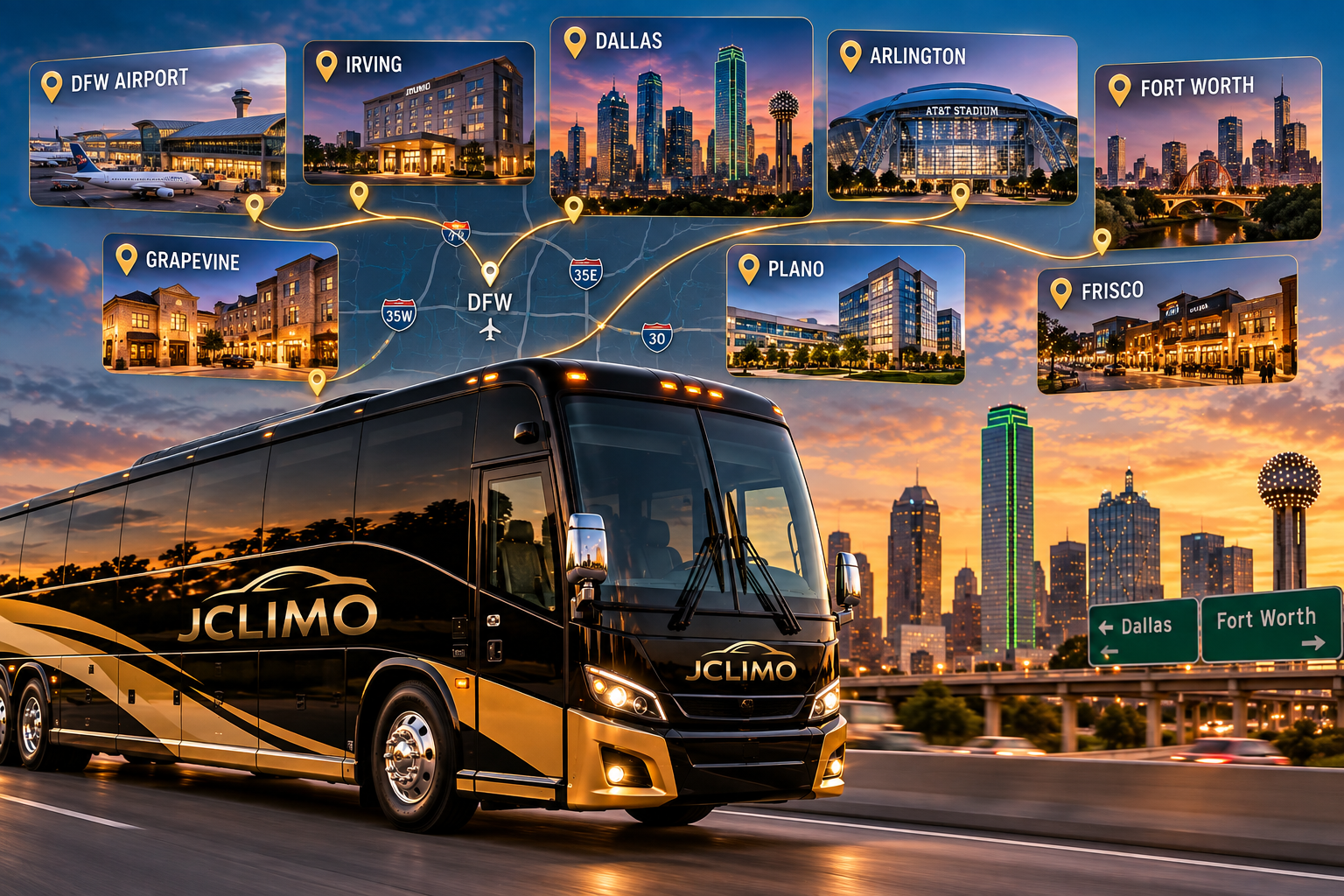
When people imagine a group trip to Dallas, downtown often comes to mind first.
But Dallas–Fort Worth travel extends far beyond downtown.
Hotels, corporate offices, restaurants, entertainment venues, event spaces, universities, shopping destinations, airports, and attractions are spread throughout a large part of North Texas. A group may stay in one area, attend an event in another, have dinner somewhere else, and return to its hotel at the end of the evening.
That can create a transportation challenge that visitors do not always expect.
A hotel may be described as being in the Dallas area while still requiring a significant drive to a venue. A business group staying near DFW Airport could have meetings in several surrounding communities. Guests attending an event in Arlington may be staying at hotels in Dallas or Fort Worth.
JC LIMO provides group transportation using buses and shuttles for travel throughout Dallas, Fort Worth, and the wider DFW area.
When your destinations are spread across North Texas, planning transportation around the geography of the trip can make the entire experience easier to manage.
Dallas–Fort Worth Is Bigger Than One Downtown
One of the first things visitors discover about the DFW Metroplex is its size.
Dallas and Fort Worth are major cities in their own right, and they are surrounded by numerous communities that are important for business, tourism, events, dining, shopping, and entertainment.
A group trip may involve Dallas, Fort Worth, Arlington, Irving, Grapevine, Plano, Frisco, and other surrounding areas.
Those destinations are connected, but they are not all in the same neighborhood.
That matters when building a group schedule.
If the hotel is in one city and the main event is in another, transportation time becomes a meaningful part of the day.
For a group, arranging a bus or shuttle can create a clear connection between those locations without requiring every passenger to navigate the Metroplex independently.
Your Hotel Location Changes the Transportation Plan
Hotel selection often happens before transportation planning.
An organizer may choose a hotel because of its room availability, meeting facilities, price, proximity to an airport, or relationship with an event.
Only afterward does the group begin thinking about how everyone will travel.
That order can create surprises.
For example, a hotel that is convenient for airport arrivals may not be close to a downtown Dallas event.
A hotel near a corporate office may be far from an evening entertainment venue.
A property chosen for a conference might not be near the restaurant selected for a group dinner.
None of these situations are necessarily problems.
They simply require transportation planning.
Once the hotel is confirmed, organizers should map every important destination against it.
That creates a clearer picture of when the group will need transportation and how long those trips may take.
Staying Near DFW Airport
Hotels around Dallas/Fort Worth International Airport can be practical for groups arriving from different cities.
Travelers can get relatively close to their accommodation after landing, and departure-day transportation can be easier to organize.
However, the rest of the group’s activities may take place elsewhere.
A company staying near DFW Airport might need transportation to meetings in Dallas, Irving, Plano, or Fort Worth.
A private group might travel from its airport-area hotel to an event venue, restaurant, or attraction.
That means airport-area accommodation should not automatically be treated as the center of the itinerary.
The hotel is simply one point on the transportation map.
JC LIMO buses and shuttles can connect groups staying near the airport with destinations throughout the Dallas–Fort Worth area.
Irving as Part of a Dallas Group Trip
Irving can be an important destination for business and group travel in North Texas.
A group may have offices, meetings, hotels, restaurants, or events located there while other parts of the trip take place in Dallas.
Instead of thinking of every location as an independent journey, organizers can plan transportation based on the entire day’s route.
For example:
Hotel → Morning meeting → Lunch → Dallas event → Hotel
The group may cross between different parts of the Metroplex several times.
With a bus or shuttle arranged for the group, passengers do not need to repeatedly coordinate individual rides.
They can meet at an established pickup location and continue together.
Groups Traveling Between Dallas and Fort Worth
Some trips genuinely include both Dallas and Fort Worth.
A group could stay in Dallas while attending an activity in Fort Worth.
Another group may stay in Fort Worth and travel to Dallas for a corporate meeting, conference, or private event.
This is where visitors can underestimate the importance of geography.
Dallas and Fort Worth are not simply two neighborhoods of the same city.
Travel between them needs to be included in the schedule.
If a group has a morning activity in Dallas and an afternoon reservation in Fort Worth, organizers should consider the travel window between the two.
Boarding time and traffic conditions should also be included.
Group bus transportation can make these cross-Metroplex journeys easier to organize because everyone travels according to one plan.
Arlington Events Can Change the Route
Arlington is another destination that frequently becomes part of Dallas–Fort Worth group travel.
Groups may travel there for sports, entertainment, business activities, private events, or other scheduled programs.
The important transportation question is where everyone will be before and after the activity.
Are passengers staying in Dallas?
Fort Worth?
Near DFW Airport?
Will the group return directly to the hotel afterward, or is dinner planned somewhere else?
A transportation plan should connect the entire sequence.
For example:
Dallas hotel → Arlington event → Dinner → Hotel
Planning the full route is more useful than arranging transportation only to the event and deciding what to do afterward.
Plano and Frisco for Business Groups
Corporate travel can take visitors north of central Dallas.
Companies with meetings, offices, conferences, training sessions, or events in Plano or Frisco may have employees staying elsewhere in the DFW area.
If several employees need to reach the same destination, individual transportation can quickly become fragmented.
One person drives.
Another books a ride.
Someone else travels with a colleague.
Now the group has several different arrival times.
A scheduled shuttle or bus can give the company a common departure time and pickup location.
This can be especially useful when the group has additional activities later in the day.
After the meeting, everyone can continue to the next location instead of reorganizing transportation again.
Grapevine and Airport-Area Travel
Grapevine can also appear frequently in North Texas itineraries, particularly for groups traveling around the DFW Airport area.
A group might have accommodations, dining, meetings, or activities in the area while still needing to travel to Dallas or Fort Worth.
For travelers unfamiliar with Texas, the distances between these destinations may not be obvious when the trip is first planned.
Looking at the entire route in advance helps organizers understand how much of the schedule will involve transportation.
This is particularly important when activities begin at fixed times.
Transportation Between Hotels and Event Venues
One of the most common group transportation needs is also one of the simplest: hotel-to-venue travel.
The challenge appears when the hotel and venue are located in different parts of the Metroplex.
If 20 or 30 guests are expected at the same event, asking everyone to arrange transportation individually can create multiple arrival times.
Parking may also become another concern.
A shuttle creates a designated departure.
Guests meet at the hotel.
They travel to the venue together.
After the event, the group can meet at a designated pickup point for the return journey.
This structure works for corporate events, weddings, conferences, private celebrations, sports groups, family events, and many other occasions.
Don’t Forget the Return Trip
Getting somewhere is only half of the transportation plan.
The group also needs to leave.
This sounds obvious, but return transportation is sometimes treated as a separate decision.
An organizer spends time arranging how everyone will reach an event, but the end of the night remains unclear.
Will passengers leave at the same time?
Will there be one departure or several?
Are they returning to one hotel or multiple properties?
Is another destination planned after the event?
These questions should be answered before the trip.
A clearly planned return journey gives passengers a better understanding of what happens when the activity ends.
Multiple Hotels Add Another Layer
Large groups may not always stay at one hotel.
A conference, wedding, corporate gathering, or family event could involve passengers spread across multiple properties.
In that situation, transportation planning needs to account for several pickup or drop-off points.
One approach is to establish centralized pickup locations.
Another may involve a route that connects several hotels before continuing to the destination.
The right arrangement depends on the geography of the hotels, passenger numbers, schedule, and event location.
The important point is to plan these details early.
Waiting until the day of the event to decide how passengers from several hotels will travel together can create unnecessary confusion.
Think in Routes, Not Individual Rides
A useful way to plan transportation across Dallas–Fort Worth is to think in routes.
Instead of asking:
“How will we get to dinner?”
Ask:
“What is the group’s complete route today?”
That route might look like:
Hotel → Conference → Lunch → Office → Dinner → Hotel
Or:
DFW Airport → Hotel → Event → Restaurant → Hotel
Or:
Fort Worth hotel → Dallas meeting → Arlington activity → Fort Worth hotel
Thinking this way reveals the relationship between destinations.
It also helps organizers see where transportation will be needed, where extra time should be added, and whether a route makes sense.
Different Areas Can Mean Different Traffic Conditions
Distance is only one part of travel time.
Road conditions matter too.
The Dallas–Fort Worth area includes major highways and busy traffic corridors.
Travel time can change depending on the hour, road construction, accidents, weather, sporting events, concerts, conventions, and other local activity.
A route that seems comfortable in the middle of the day may require more time during a busy commuting period.
That is why transportation planning should avoid schedules that leave almost no margin between activities.
Groups need time to board, travel, arrive, and enter the next destination.
Building realistic travel windows into the itinerary can make the day easier to manage.
Why Group Transportation Helps Out-of-Town Visitors
Visitors who live in North Texas may already understand the geography.
Out-of-town travelers may not.
They might not know how Dallas relates to Fort Worth, where Arlington sits between them, or how far their hotel is from a particular venue.
Asking each visitor to independently navigate these locations can add another responsibility to the trip.
Group transportation removes much of that work.
Passengers can meet at the scheduled pickup point and travel with the rest of the group.
They do not need to determine the route, find parking, or coordinate multiple cars.
This can be particularly helpful for conferences, corporate programs, weddings, reunions, and organized tours.
Airport Transportation Should Connect With the Hotel Plan
Airport transportation should also reflect where the group is staying.
DFW International Airport serves a huge area, and the hotel may be located in Dallas, Fort Worth, Irving, Grapevine, Arlington, Plano, or another community.
If travelers are arriving together, a bus or shuttle can connect the airport with the hotel.
If the group has immediate plans after arrival, transportation can also be incorporated into the wider itinerary.
For example:
DFW Airport → Hotel → Welcome Dinner
Or:
DFW Airport → Meeting → Hotel
Thinking beyond the airport transfer helps organizers avoid treating each journey as a separate transportation problem.
Longer Texas Trips May Start in Dallas–Fort Worth
Not every trip ends within the Metroplex.
Groups may use Dallas or Fort Worth as the starting point for longer journeys across Texas.
A company could organize a retreat outside the city.
A family group might plan a day trip.
A sports team could travel to another community for an event.
A private organization might have activities beyond North Texas.
When the group needs to travel together over a longer distance, bus transportation can provide a practical alternative to coordinating multiple cars.
The itinerary should consider departure time, luggage, scheduled stops, destination requirements, and the return journey.
Transportation Planning Starts With a Map
Before finalizing a group itinerary, put every destination on a map.
Include:
The airport
Hotels
Meeting locations
Event venues
Restaurants
Attractions
Planned stops
Final drop-off points
Seeing the locations together can reveal potential issues immediately.
Perhaps the dinner reservation is much farther from the afternoon event than expected.
Maybe two activities could be scheduled in a more practical order.
Perhaps the hotel location means an earlier morning departure is necessary.
Transportation planning can therefore help improve the itinerary itself.
Choose Transportation Around the Actual Trip
There is no single transportation arrangement that fits every group.
Some groups need a simple shuttle between a hotel and an event.
Others need a bus for an entire day of travel.
Some need airport transfers.
Others have multiple hotels, several stops, or longer Texas journeys.
The right plan depends on where the group is going, how many people are traveling, how much luggage they have, and how the schedule is structured.
The important thing is to organize transportation around the real itinerary rather than treating it as an afterthought.
Explore More of DFW With JC LIMO
Dallas–Fort Worth group travel does not stop at the edge of downtown.
Your hotel may be near DFW Airport.
Your meeting could be in Plano.
Your event may be in Arlington.
Dinner might be in Dallas.
And tomorrow’s schedule could take the group to Fort Worth.
When destinations are spread across North Texas, transportation becomes the connection between every part of the trip.
JC LIMO provides buses and shuttles for groups traveling throughout Dallas, Fort Worth, and surrounding Texas communities.
Whether you need hotel transfers, event transportation, airport travel, corporate transportation, or a bus connecting several destinations across the Metroplex, planning ahead can make the journey easier to organize.

Related posts
 13Oct, 26
Dallas Group Transportation With Luggage and Equipment
 13Oct, 26
Dallas Group Transportation With Multiple Drop-Offs
 13Oct, 26
- October 13, 2026
- 0
- 10
