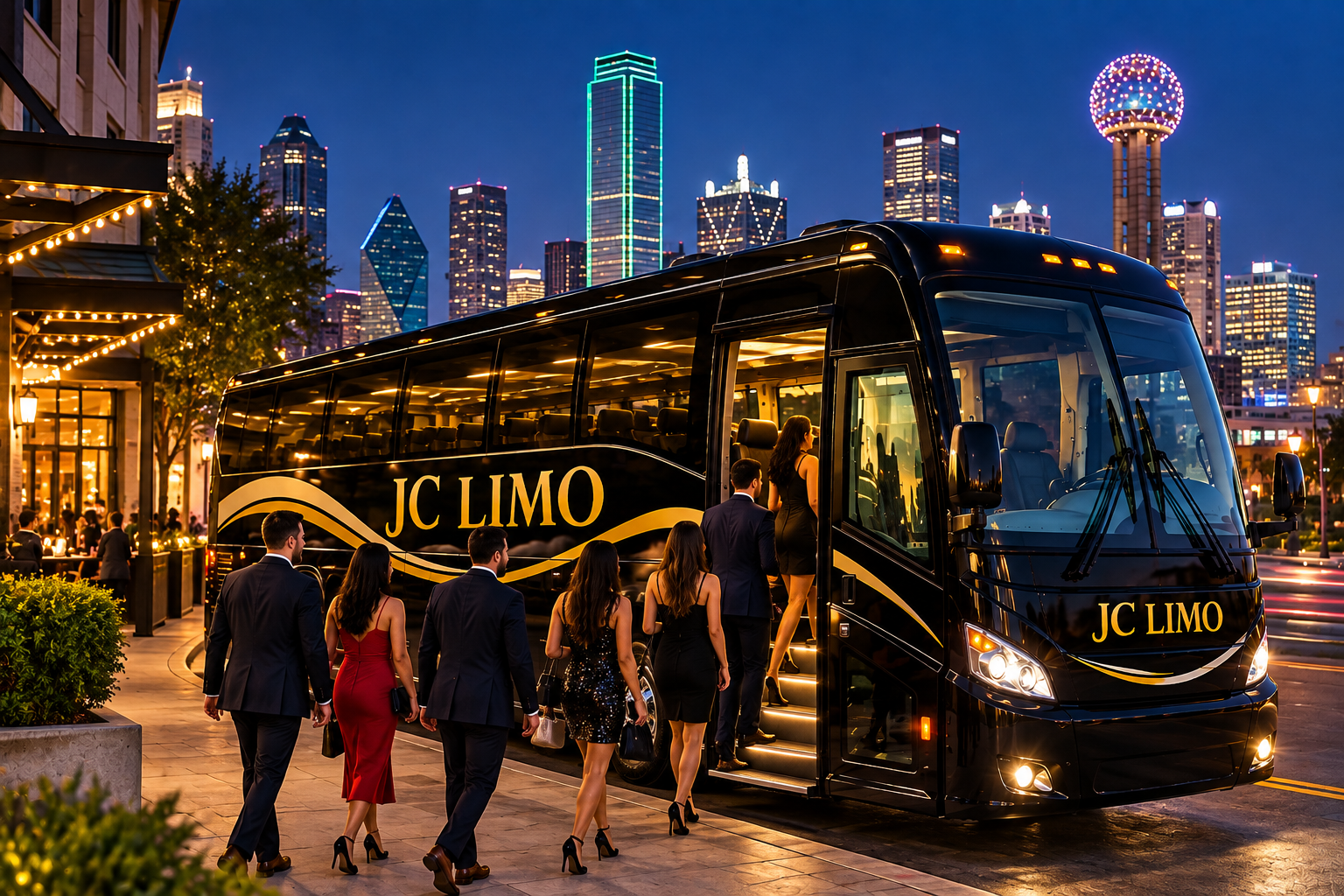
Visiting a new city with a group creates a different kind of transportation challenge.
Passengers may not know which highways con
Dallas and Fort Worth do not slow down when the workday ends.
For many groups, the most important part of the schedule actually begins in the evening.
A corporate team may finish a conference and head to dinner. Wedding guests may travel from a hotel to a reception. Friends could be attending a concert or celebration. A large group may have several evening destinations planned across the Dallas–Fort Worth area.
The activities may be different, but the transportation challenge is often the same:
How do you keep everyone moving together?
When 20, 30, 40, or more passengers need to travel at night, relying on separate cars and individual rides can quickly complicate the plan.
Some people are ready early. Others are still waiting for transportation. One group arrives at the restaurant while another is stuck somewhere else. After the event, everyone starts asking the same question again: How are we getting back?
Professional group transportation offers a simpler approach.
With a dedicated bus or shuttle, the transportation itself can become part of the itinerary.
For groups traveling throughout Dallas, Fort Worth, and surrounding Texas areas, JC LIMO helps coordinate evening transportation around the group size, destinations, schedule, and overall trip.
Why Evening Group Transportation Requires a Plan
During the daytime, groups often have a clear schedule.
There is a conference start time, meeting agenda, tournament schedule, tour itinerary, or business appointment.
Evening plans can feel more flexible.
That flexibility sometimes leads organizers to delay transportation planning.
“We’ll figure out rides after dinner.”
“Everyone can meet us there.”
“We’ll just book cars when the event finishes.”
Those plans may work for a few people.
They become more difficult as the group gets larger.
If 35 people need to leave a venue at the same time, transportation availability, vehicle capacity, pickup locations, and communication all become factors.
A dedicated group shuttle changes the situation.
Instead of 35 passengers making separate decisions, everyone follows one transportation plan.
That creates a much easier evening for both passengers and organizers.
Corporate Dinners After a Busy Workday
Corporate groups are a perfect example.
A company may bring employees or clients to Dallas for meetings, conferences, training, or an industry event.
After spending the entire day working, the group has a dinner reservation.
At that point, asking everyone to arrange individual transportation can interrupt the flow of the event.
Some attendees may return to their rooms first.
Others may leave immediately.
Several people may travel together while others arrange separate rides.
Suddenly, a simple dinner becomes a transportation coordination exercise.
A JC LIMO bus or shuttle can provide a central departure.
Attendees meet at a designated location, board together, and travel to dinner as a group.
When the dinner finishes, the transportation plan is already established.
Passengers do not need to stand outside arranging rides or asking where everyone is going next.
They know how they are returning to the hotel or continuing to the next destination.
Moving Groups Between Evening Events
Not every night involves only one destination.
A company might schedule dinner followed by entertainment.
A wedding party could move from a rehearsal dinner to another gathering.
A private group may want to visit several locations in Dallas during the same evening.
This is where coordinated shuttle transportation becomes particularly useful.
Instead of treating every transfer as a separate trip, organizers can build transportation around the entire evening.
For example:
Hotel → Dinner → Event → Hotel.
That simple route gives everyone a clear understanding of what is happening.
For a more complicated itinerary, the route might include several stops throughout Dallas or Fort Worth.
The key is to determine the sequence beforehand.
When transportation follows the itinerary, the group can move from one activity to another without repeatedly stopping to decide how everyone will travel.
Concert Transportation for Groups
Dallas–Fort Worth hosts concerts and entertainment events throughout the year.
For groups attending together, getting to the event is only one part of the experience.
Arrival traffic and parking can affect the schedule before the event even begins.
After the concert, thousands of people may be leaving the area around the same time.
If a group traveled in several separate vehicles, passengers then need to find those vehicles, navigate traffic, and potentially wait for other members of the group.
A dedicated bus gives the group a common transportation plan.
Passengers can board at a predetermined pickup location, travel to the event, and know where they need to meet afterward.
The return plan is especially important.
Before passengers leave the bus, everyone should understand the post-event meeting point.
That way, when the concert finishes, there is less uncertainty about what happens next.
Transportation for Weddings and Celebrations
Evening transportation is also an important part of many weddings.
Guests may be staying at hotels around Dallas while the ceremony or reception takes place elsewhere.
Some guests may be local.
Others may have flown into Texas and know very little about the area.
Providing group transportation can simplify the experience for everyone.
Guests meet at the designated hotel or pickup location.
The shuttle takes them to the wedding venue.
After the celebration, they return according to the transportation schedule.
This structure can also be useful for rehearsal dinners, welcome events, engagement celebrations, anniversary parties, and other private occasions.
When guests know transportation has already been arranged, they have one less logistical detail to manage.
For the hosts, it also means fewer individual questions about directions, parking, and return travel.
Late Finishes Need More Attention
An event that finishes at 4:00 p.m. is different from one that finishes at 11:30 p.m.
At the end of a long evening, people are often tired.
They may not want to begin searching for directions, locating vehicles, or coordinating rides.
That is why the return journey should be planned with the same attention as the outbound trip.
Where will the bus wait?
When should passengers meet?
Will there be one departure or multiple departures?
Is everyone returning to the same location?
Does part of the group need to go somewhere else?
These questions are easier to answer before the event than after it.
A well-planned return journey helps the evening end as smoothly as it began.
One Bus Can Replace Many Separate Travel Plans
Consider a group of 40 people.
If everyone travels in separate cars or small groups, the organizer could be dealing with ten or more different vehicles.
Every vehicle creates another variable.
One driver might miss an exit.
Another group may leave late.
Someone may struggle to find parking.
A few passengers could decide to change plans without telling the organizer.
With one appropriately sized group bus, many of those variables disappear.
The group has one main departure time.
One route.
One arrival plan.
One meeting point after the event.
That simplicity is valuable whenever the schedule matters.
It can be even more useful at night, when passengers may be less familiar with their surroundings.
Evening Transportation Between Dallas and Fort Worth
Some itineraries include both Dallas and Fort Worth.
A group might attend meetings in Dallas during the day before traveling to an evening event in Fort Worth.
Another group could stay in Fort Worth while attending dinner or entertainment elsewhere in the Metroplex.
These trips need realistic transportation timing.
Dallas and Fort Worth should not be treated as if they are two neighboring blocks.
Groups need to account for the actual travel involved.
If an event reservation is scheduled for a specific time, work backward from that time.
Allow enough time for passengers to gather.
Include boarding time.
Consider the journey itself.
Give the group enough room in the schedule so that a minor delay does not immediately become a major problem.
When a JC LIMO shuttle or bus is incorporated into the itinerary from the beginning, the organizer can build evening activities around a more structured transportation plan.
Group Dining Transportation
Dinner is one of the most common evening activities for groups.
Corporate teams, wedding guests, families, conference attendees, tour groups, and private parties may all need transportation to restaurants.
A restaurant reservation for a large group usually has a specific time.
That means transportation needs to support that reservation.
If 30 guests are expected for dinner at 7:00 p.m., asking everyone to “meet at the restaurant around seven” leaves a lot of room for variation.
Some guests may arrive at 6:40.
Others may walk through the door at 7:15.
If the group is using a bus, the organizer can set one departure schedule based on the reservation.
Passengers arrive together, making it easier for the restaurant and the event organizer to keep the evening on schedule.
After dinner, the bus can continue to the next destination or return passengers to their hotel.
Keep Visitors From Having to Navigate at Night
Visitors who are unfamiliar with Dallas or Fort Worth may be comfortable exploring during the day but less interested in navigating unfamiliar roads late at night.
This is particularly relevant for groups arriving from another state or country.
They may not know the neighborhoods.
They may not understand the distances between destinations.
They may be unfamiliar with venue entrances and parking areas.
Coordinated Dallas group transportation removes much of that responsibility from individual passengers.
Instead of navigating independently, visitors follow the group schedule.
For conferences, business trips, weddings, tours, and private events, this can create a more comfortable overall experience.
The passengers can focus on the evening rather than constantly checking directions.
Choose the Vehicle Around the Evening
Selecting transportation should begin with the actual itinerary.
Passenger count matters, but so do the activities.
A small corporate team traveling to dinner may have different requirements from a large wedding group.
A sports team may have bags and equipment.
Conference attendees might be traveling directly from an event with personal belongings.
A private group could have several destinations planned throughout the night.
When choosing between bus and shuttle transportation, consider the number of passengers, amount of luggage, pickup points, destinations, travel distance, number of stops, and expected return time.
The vehicle should support the plan rather than force the plan to change around the vehicle.
Multiple Pickup Locations
Evening groups do not always begin in one place.
Conference attendees may be staying in several hotels.
Employees could be coming from different offices.
Wedding guests might be divided among multiple accommodations.
In these cases, the transportation route needs to be organized logically.
One option is to have a shuttle collect passengers from several pickup points before traveling to the event.
Each location receives a specific boarding time.
Passengers should be ready before the vehicle arrives.
This prevents one late group from delaying everyone else.
For larger groups, separate vehicles may sometimes make more sense.
The right structure depends on passenger numbers, locations, and the evening schedule.
What matters most is deciding the plan in advance.
Communication Makes Evening Transportation Easier
Passengers should not have to guess where the bus will be.
Before the evening begins, provide clear information.
Tell everyone where they are meeting.
Tell them when they need to be there.
Explain the route if there are multiple stops.
Most importantly, explain the return plan.
If the pickup location after an event is different from the drop-off point, passengers should know that beforehand.
For large groups, it can also help to send a reminder before the scheduled departure.
Good transportation communication is usually simple.
Passengers do not need every operational detail.
They need the information required to be in the correct place at the correct time.
Plan for Different End Times
One challenge with evening events is that not everyone always wants to leave at the same time.
Some guests may want to return to the hotel earlier.
Others may stay until the event finishes.
A corporate dinner could end at one time while a smaller group continues to another activity.
This is where organizers should think about the actual behavior of the group before finalizing transportation.
If different return times are expected, the transportation plan should account for them.
The goal is to avoid reaching the end of the night and discovering that half the group wants to leave while the other half plans to stay.
When possible, establish the expected schedule before the event and communicate it clearly.
Transportation Can Improve the Group Experience
The benefit of organized transportation is not limited to logistics.
Travel time can become part of the shared experience.
Coworkers can continue conversations after a conference.
Wedding guests can enjoy traveling together.
Friends can talk about the concert on the way back.
Teams can stay together before and after an event.
When everyone is divided among separate cars, those moments disappear.
A group bus or shuttle keeps passengers connected throughout the journey.
For many events, that fits naturally with the reason people are traveling together in the first place.
They came as a group.
Their transportation can work the same way.
Plan the Full Evening Before It Starts
One of the easiest ways to improve evening group transportation is to plan beyond the first ride.
Do not stop at:
“How do we get everyone to dinner?”
Ask:
How do we get everyone to dinner?
Where are we going afterward?
When will the group leave?
Where will passengers meet the bus?
How will everyone return to the hotel?
Does anyone have a different destination?
When those questions are answered before the evening begins, transportation becomes much easier to manage.
The organizer spends less time coordinating rides and more time participating in the actual event.
Travel Together With JC LIMO
Evening plans should be about enjoying the event, dinner, celebration, conference, concert, or time together—not repeatedly figuring out transportation.
Whether your group is traveling within Dallas, heading to Fort Worth, moving between hotels and venues, or spending an entire evening visiting several destinations, a coordinated transportation plan can simplify the experience.
JC LIMO provides group transportation across Dallas, Fort Worth, and surrounding Texas areas, with bus and shuttle options for different group sizes and itineraries.
Plan the pickup.
Coordinate the stops.
Think about the return journey.
Keep passengers informed.
And give the group one clear transportation plan from the beginning of the evening to the final drop-off.
ort Worth. They may not realize how far their hotel is from an event venue. They might be unfamiliar with DFW Airport, local traffic patterns, pickup areas, parking arrangements, or the distances between different parts of North Texas.
For one traveler, these are relatively small problems.
For an entire group, they can quickly become part of the organizer’s job.
Instead of focusing on the conference, wedding, company event, family gathering, or trip itself, the person responsible for the group may spend time answering transportation questions.
“How are we getting there?”
“Is Fort Worth close to the hotel?”
“Where do we meet?”
“Do we need to rent cars?”
“Who is driving?”
“Where should we park?”
Organized group transportation can simplify those decisions.
JC LIMO provides buses and shuttles for groups traveling throughout Dallas, Fort Worth, and surrounding Texas communities. For visitors who are unfamiliar with the area, having transportation planned in advance can create a much clearer travel experience from arrival through departure.
Visiting Dallas Is Different From Living Here
Local residents already understand many things visitors do not.
They have a general idea of where Dallas, Fort Worth, Arlington, Irving, Plano, Frisco, and Grapevine are located.
They know that two destinations described as being in the Dallas–Fort Worth area may still require meaningful travel time.
Visitors may not.
When people plan a trip online, they often see “Dallas area” or “DFW” and assume every destination is relatively close.
Then they arrive and discover that their hotel, conference, restaurant, and evening event are spread across different parts of the Metroplex.
That is why transportation should be considered while the itinerary is being built—not after everyone arrives in Texas.
Start the Experience at DFW Airport
For many out-of-town groups, the first experience with Dallas–Fort Worth is the airport.
DFW International Airport is more than simply the place where the flight lands.
It is the beginning of the group’s local transportation plan.
Passengers may need to travel from the airport to a hotel in Dallas, Fort Worth, Irving, Grapevine, Arlington, Plano, or another surrounding community.
Some groups go directly to their hotel.
Others have a meeting or event before check-in.
A business team might follow a route such as:
DFW Airport → Hotel → Welcome Dinner
Another group could have:
DFW Airport → Corporate Office → Hotel
Planning airport transportation as part of the overall itinerary helps visitors know what happens as soon as they arrive.
Avoid Asking Every Visitor to Find Their Own Ride
When a group arrives in an unfamiliar city, telling everyone to “meet us at the venue” may sound simple.
In practice, it can create many separate journeys.
Passengers may use different transportation options.
Some leave immediately.
Others wait.
One person enters the wrong destination.
Another passenger goes to a different entrance.
Someone gets delayed.
Now the organizer is trying to determine whether everyone has arrived.
A bus or shuttle provides a common plan.
The group meets at an agreed pickup location, boards together, and travels to the destination according to the itinerary.
For visitors, this removes much of the uncertainty.
Hotels Can Be Far From the Main Activity
A group may choose its hotel for many reasons.
Room availability.
Price.
Conference arrangements.
Airport access.
Meeting facilities.
Proximity to one particular destination.
But the hotel may not be close to everything else on the schedule.
For example, a company might stay near DFW Airport because employees are arriving from several states.
The next morning, the group could have an event in Dallas.
Later, dinner might be in another part of the Metroplex.
Out-of-town travelers should not be expected to understand those distances automatically.
Providing group transportation between the hotel and scheduled activities gives visitors a much clearer plan.
Help Guests Focus on Why They Came to Dallas
Most people do not travel to Dallas because they want to spend time figuring out transportation.
They are here for something else.
A conference.
A wedding.
A meeting.
A sports event.
A family celebration.
A company retreat.
A tour.
A graduation.
Transportation should support that purpose.
When buses or shuttles are organized in advance, visitors can focus on the event rather than repeatedly determining how to reach the next destination.
For organizers, this can also reduce the number of questions they receive throughout the trip.
Corporate Visitors Need a Clear Plan
Companies frequently host employees, executives, clients, partners, and guests from outside Texas.
Some visitors may have been to Dallas before.
Others may be visiting for the first time.
A clear transportation plan can make the entire business trip feel more organized.
Imagine a company bringing 20 employees to Dallas for training.
The schedule includes:
Airport arrival
Hotel check-in
Welcome dinner
Morning training session
Office visit
Team activity
Client dinner
Final meeting
Airport departure
Without coordinated transportation, every stage requires another decision from the visitors.
With a bus or shuttle plan, employees know where they need to meet and when.
That simplicity can be valuable during a busy business trip.
Client Transportation Can Be Part of the Experience
When companies invite clients or business partners to Dallas, transportation can also become part of the hosting experience.
Visitors may not know the city well enough to confidently move between hotels, offices, restaurants, and event venues.
Instead of sending directions for every location, the host company can establish group transportation.
For example:
Hotel pickup → Company office → Client dinner → Hotel return
Guests receive a simple schedule rather than several addresses and transportation instructions.
The company also knows that the group is traveling according to the same plan.
Conferences Bring Visitors From Everywhere
Dallas–Fort Worth hosts business events, conferences, trade shows, meetings, and exhibitions that attract visitors from outside Texas.
Conference attendees may know the convention venue but be less familiar with everything around it.
They might stay at different hotels.
Their company could organize a private dinner.
There may be an evening reception at another venue.
A corporate team might schedule an office visit during the trip.
These additional activities create transportation needs beyond simply getting to the conference.
A JC LIMO bus or shuttle can connect the group’s hotel with the conference and other scheduled destinations throughout the visit.
Wedding Guests Often Need Extra Guidance
Weddings can bring friends and family to Dallas from across the country.
Some guests may rent cars.
Others may prefer not to drive in an unfamiliar city.
The ceremony and reception may also be located away from the main hotel.
Providing shuttle transportation gives guests a clear option.
They know:
Where to meet.
What time to be ready.
Where the transportation is going.
How they will return after the event.
This can be particularly helpful when a wedding involves multiple activities such as a welcome dinner, ceremony, reception, and farewell brunch.
Instead of asking guests to repeatedly find their own way around Dallas–Fort Worth, transportation becomes part of the wedding itinerary.
Family Groups May Have Different Levels of Travel Experience
Family trips can include passengers of different ages and different levels of comfort with travel.
Some relatives may be confident navigating a new city.
Others may prefer having everything arranged.
A family gathering could include grandparents, parents, young adults, teenagers, and children.
If everyone uses separate transportation, the organizer may need to track several cars.
A bus or shuttle allows more of the family to travel together.
This can be useful for reunions, graduations, milestone birthdays, weddings, sightseeing days, and other celebrations.
It also means the group spends more of the trip together rather than separating every time it leaves a location.
Sports Teams Need to Think Beyond the Game
An out-of-town sports team has more transportation needs than simply reaching the competition.
Players, coaches, and staff may need transportation between:
DFW Airport
Hotel
Practice facility
Game venue
Restaurants
Team activities
Other scheduled stops
The team may also have equipment and luggage.
When the group is unfamiliar with Dallas–Fort Worth, using organized bus transportation can create a consistent structure throughout the trip.
Players and staff know where to meet and when the team is leaving.
The transportation becomes part of the team schedule.
School and University Groups Benefit From Structure
Educational groups visiting North Texas may have highly structured itineraries.
A school group could visit several educational or cultural destinations.
A university program may include campus visits, presentations, meals, and hotel stays.
When students and staff are unfamiliar with Dallas, keeping the group together can simplify transportation.
A bus provides a central meeting point between activities.
Instead of asking participants to independently navigate to every destination, transportation connects the itinerary.
Visitors Shouldn’t Have to Understand Dallas Traffic
Out-of-town travelers may not know when local roads are busiest.
They may not be familiar with major highways or how traffic changes during the day.
They also may not know how large events can affect travel around certain areas.
That does not mean transportation will always be predictable.
Traffic, road construction, accidents, weather, sporting events, concerts, and other conditions can affect travel throughout Dallas–Fort Worth.
But visitors should not need to personally manage every route.
Group transportation gives the organizer one travel plan to work around instead of asking every passenger to independently navigate traffic.
Parking Can Be Another Unfamiliar Problem
Driving to an event is not only about knowing the route.
Passengers also need to know what happens when they arrive.
Where is the parking?
Which entrance should they use?
Is the parking area close to the venue?
Does everyone know where the group is meeting afterward?
For visitors, these details can make a simple journey feel more complicated.
Bus and shuttle transportation can reduce the number of individual vehicles the group needs to manage.
Passengers can focus on reaching the designated pickup point rather than understanding the parking arrangements at every destination.
Keep Everyone on the Same Schedule
One advantage of group transportation is that it creates a shared sense of timing.
If dinner transportation leaves the hotel at 6:30 p.m., everyone has a clear deadline.
If passengers arrange their own transportation, departure times become individual decisions.
One person leaves early.
Another waits until the last minute.
Someone gets delayed.
The group arrives in stages.
For activities where timing matters, traveling together can make the schedule easier to manage.
Make Pickup Instructions Easy to Follow
Visitors need simple instructions.
They should not receive a complicated paragraph describing every transportation detail.
Instead, give them the information they need:
Pickup: Main hotel entrance
Meet: 8:15 a.m.
Departure: 8:30 a.m.
Destination: Morning conference
Clear instructions are easier for visitors to follow.
For trips involving several days, organizers can provide the next day’s transportation schedule in advance.
This helps passengers know what to expect.
Build Transportation Into the Welcome Information
Companies, wedding planners, conference organizers, and group leaders often send welcome information before a trip.
Transportation should be included.
Instead of waiting for passengers to ask how they are getting around Dallas, explain the plan upfront.
Include information such as:
Airport transportation
Hotel pickup locations
Bus departure times
Event transportation
Return shuttle details
Important meeting points
Contact information
When guests understand the transportation plan before arriving in Texas, they can prepare accordingly.
Don’t Overload Visitors With Addresses
An itinerary filled with addresses may look organized, but it can also make a trip feel complicated.
If transportation is already arranged, passengers may not need every road and route detail.
They mainly need to know where to meet.
The organizer and transportation provider can handle the larger travel plan.
This keeps the passenger experience simple.
For example, instead of asking 25 people to independently navigate from a hotel to a corporate dinner, tell them when and where the bus will depart.
Group Travel Can Feel More Social
There is another benefit to keeping visitors together.
Travel time can become part of the group experience.
Employees can talk before a meeting.
Wedding guests can spend more time together.
Family members can catch up.
Sports teams can stay connected.
Conference attendees can discuss the day’s sessions.
When everyone uses separate vehicles, those moments disappear.
A bus or shuttle keeps the group connected even while moving between destinations.
Explore Dallas Without Constantly Replanning Transportation
Some groups want to experience more of Dallas while they are here.
A corporate trip might include a free afternoon.
A family could add sightseeing to a reunion weekend.
Conference attendees may have several hours before dinner.
Visitors might want to explore another part of the Metroplex.
Organized transportation can make optional activities easier to incorporate.
The group can travel to a selected destination and later continue to the next scheduled activity.
Instead of everyone separating and trying to reunite later, transportation keeps the day connected.
Traveling Between Dallas and Fort Worth
Out-of-town visitors may also want or need to spend time in both Dallas and Fort Worth.
These should be treated as distinct destinations when planning the itinerary.
Travel time needs to be considered.
If a group has an activity in Dallas followed by another in Fort Worth, organizers should allow enough time for boarding and transportation.
The same applies to trips involving Arlington, Irving, Plano, Frisco, Grapevine, and other surrounding communities.
The DFW Metroplex offers many destinations, but geography should always be part of the plan.
Departure Day Deserves a Transportation Plan Too
A well-organized trip should not become confusing on the final morning.
Passengers may need to check out of the hotel, collect luggage, attend one final activity, and travel to DFW Airport.
If flights leave at different times, transportation may need to be organized around departure groups.
The final day’s schedule should be communicated just as clearly as the first.
Visitors should know when to be ready and what happens after they leave the hotel.
That creates a more complete travel experience from arrival to departure.
Good Hosting Includes Clear Transportation
Whether you are hosting employees, clients, relatives, wedding guests, students, athletes, or conference attendees, transportation affects how they experience the trip.
Visitors should not spend their time repeatedly asking how to get somewhere.
They should know the plan.
That does not require an overly complicated itinerary.
It requires clear pickup information, realistic timing, and transportation that reflects where the group actually needs to go.
Welcome Your Group to Dallas With JC LIMO
Visiting Dallas–Fort Worth should be about the reason for the trip—not about repeatedly figuring out the next ride.
JC LIMO provides buses and shuttles for out-of-town groups traveling throughout Dallas, Fort Worth, and surrounding Texas communities.
From DFW Airport arrivals and hotel transfers to corporate meetings, conferences, weddings, sports trips, private events, and longer journeys across North Texas, group transportation can connect each part of the visit.
Your guests may not know Dallas.
They do not need to know every road to enjoy their time here.
Give them a clear meeting point, a clear schedule, and transportation that keeps the group connected.

Related posts
 13Oct, 26
Dallas Group Transportation With Luggage and Equipment
 13Oct, 26
Dallas Group Transportation With Multiple Drop-Offs
 13Oct, 26
- October 13, 2026
- 0
- 10
