Some group trips have plenty of downtime.
Others barely stop moving.
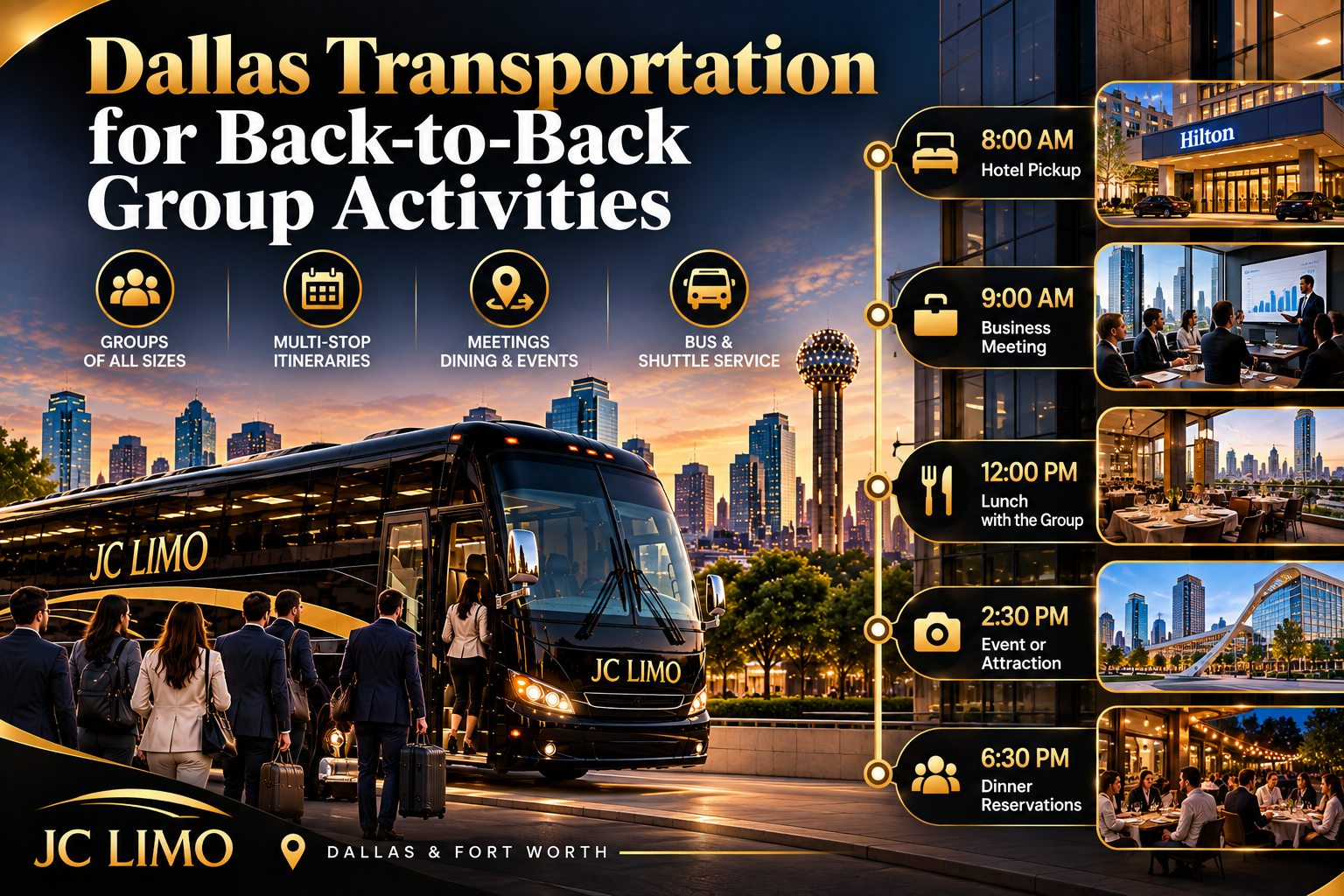
Breakfast begins early. A meeting follows. Then the group needs to reach another location for a presentation. Lunch is scheduled across town. An afternoon activity starts immediately afterward. There is just enough time to return to the hotel before everyone leaves again for dinner.
On a schedule like this, transportation is not simply a way to get from one place to another.
It is what holds the entire day together.
For groups traveling throughout Dallas, Fort Worth, and North Texas, a full day of back-to-back activities can quickly become stressful when transportation is planned one trip at a time.
Every departure affects the next arrival.
Every delay affects the next activity.
And every unnecessary stop takes time away from the schedule.
A coordinated JC LIMO bus and shuttle transportation plan can connect the entire day into one organized itinerary, giving passengers a clear way to move between meetings, events, hotels, restaurants, attractions, and other destinations throughout Dallas–Fort Worth.
Busy Group Days Need More Transportation Planning
A simple itinerary might require only two transportation movements.
Hotel to event.
Event back to hotel.
A busy itinerary could require six, eight, or even more.
Hotel to breakfast.
Breakfast to meeting.
Meeting to lunch.
Lunch to afternoon activity.
Activity to hotel.
Hotel to dinner.
Dinner to evening event.
Event back to hotel.
Every additional movement introduces another opportunity for delay.
That is why busy days should be planned as one continuous transportation program.
If every transfer is arranged independently, organizers may overlook how one part of the schedule affects another.
Looking at the entire day reveals where extra time is needed and where the route can potentially be simplified.
Start With the Complete Itinerary
Before arranging transportation, put every destination in order.
Include addresses whenever possible.
Then add the required arrival time at each location.
This creates the basic structure of the day.
From there, planners can ask more practical questions.
How long will the group actually spend at each location?
How much time is available between activities?
Does everyone need to travel to every stop?
Will passengers have luggage or equipment?
Does the group need to return to the hotel?
Are any destinations located close enough to be grouped together?
Does one activity have a fixed start time that cannot move?
A complete itinerary gives transportation planning the context it needs.
Don’t Confuse Drive Time With Transportation Time
This is one of the most important distinctions on a busy group schedule.
A map may show that two locations are 20 minutes apart.
That does not necessarily mean the group only needs 20 minutes between activities.
Passengers first need to finish the current activity.
Then they need to gather.
Everyone must reach the pickup point.
The group boards the bus.
Belongings may need to be loaded.
Then the vehicle begins the actual drive.
At the next destination, passengers still need to exit the bus and reach the correct entrance.
For a large group, those additional minutes matter.
If every transfer is planned using driving time alone, the itinerary can become progressively later as the day continues.
The First Departure Matters More Than You Think
When a group has a packed schedule, starting late creates pressure immediately.
A 15-minute delay in the morning may not disappear.
It can follow the group into the next meeting.
Lunch begins late.
The afternoon departure moves.
Eventually, the group is trying to recover time before an important evening activity.
A clear first pickup can help set the day up properly.
Passengers should know when they need to be at the boarding location, not simply when the vehicle is scheduled to leave.
If departure is at 8:00 a.m., everyone should already be gathered and prepared to board before that time.
Protect the Activities That Have Fixed Start Times
Not every stop has the same level of importance.
A casual lunch may have some flexibility.
A conference presentation may not.
A private tour could have a strict booking time.
A wedding ceremony certainly does.
A corporate client meeting may need to begin exactly as scheduled.
A concert, game, or ticketed event will not wait because the group’s previous activity ran late.
Identify these fixed points before the day begins.
Then give them extra protection in the transportation schedule.
If one part of the day needs additional buffer, it should usually be before an activity that cannot easily move.
Corporate Groups Often Have the Busiest Schedules
Business travel can create extremely dense itineraries.
Executives may have meetings at several offices.
Sales teams could visit multiple clients.
Employees attending a conference may also have private meetings, team dinners, and networking events.
A company off-site can combine presentations, team activities, meals, and evening entertainment in a single day.
If everyone arranges transportation independently, the group can easily become fragmented.
One person reaches the client meeting early.
Another is still waiting for a ride.
Someone goes to the wrong entrance.
A colleague decides to stop at the hotel without realizing the rest of the team is going directly to lunch.
Coordinated Dallas group transportation gives the company one movement plan instead of many separate ones.
A Bus Can Become the Connection Between Activities
On a full-day itinerary, the bus is more than transportation.
It becomes a consistent meeting point.
Passengers know where to return after each activity.
The group can move together.
The organizer does not need to repeatedly determine who has found transportation.
For visitors unfamiliar with Dallas–Fort Worth, this can make the day significantly easier.
Instead of navigating a new city after every meeting, passengers follow one established schedule.
This can also reduce the number of decisions travelers need to make during an already busy day.
Lunch Should Be Planned Strategically
Meals often create scheduling problems because they are treated separately from transportation.
A restaurant may be excellent but located far away from both the morning and afternoon activities.
That can turn lunch into a major detour.
When a day is already full, location matters.
A restaurant close to the next destination may create a smoother itinerary.
Alternatively, lunch near the morning activity could work if there is enough time afterward to travel.
The best choice depends on the route.
Looking at dining and transportation together can prevent unnecessary backtracking across Dallas or Fort Worth.
Returning to the Hotel Can Cost More Time Than Expected
Groups often assume they should return to the hotel between activities.
Sometimes that makes sense.
Passengers may need to change clothes.
People might want to rest.
Items may need to be collected.
But on a packed itinerary, a hotel return can add significant transportation time.
Suppose the afternoon activity finishes at 4:30 p.m. and dinner begins at 6:00.
Returning to the hotel sounds reasonable.
But if the hotel is 25 minutes away and dinner is another 25 minutes in the opposite direction, the group spends most of the available time traveling.
In some cases, continuing directly to the next area may be more practical.
In others, the hotel stop is necessary.
The decision should be based on the actual route, not habit.
Give Passengers the Full Day’s Schedule Early
People move more efficiently when they know what is happening.
If passengers believe they are returning to the hotel after lunch, they may leave belongings there that they need later.
If they do not know the bus is departing immediately after a meeting, they may remain inside talking.
If they expect free time but the next departure is in 10 minutes, the group will struggle to gather.
A clear itinerary helps passengers prepare.
It does not need to include every transportation detail.
At minimum, they should know the order of activities and when major departures occur.
Boarding Time Adds Up Across a Full Day
Ten minutes may not sound significant.
But if a group spends an extra 10 minutes boarding at six different stops, that is an hour added to the itinerary.
This is why efficient boarding becomes particularly important on back-to-back schedules.
Choose clear meeting points.
Tell passengers when to be there.
Avoid vague instructions such as “meet near the entrance.”
If a building has several entrances, specify which one.
For larger groups, designated coordinators can help gather passengers before the vehicle is ready to depart.
Small improvements at each stop can protect the overall schedule.
Different Activities May Require Different Passenger Groups
A full-day itinerary does not necessarily mean every passenger attends everything.
A corporate group might separate into departments for afternoon meetings.
Some conference attendees may participate in an optional activity.
Executives could have a separate dinner.
Families attending an event may split into different plans.
In these situations, shuttle transportation can help support multiple schedules.
The main group might use one bus while a smaller group follows a separate route.
Later, everyone can reconnect at the hotel or another common destination.
The transportation plan should reflect the actual passenger movements rather than assuming the group will always remain identical.
Keep Necessary Items With the Group
A packed day can become frustrating when someone realizes an important item is back at the hotel.
Corporate travelers may need laptops.
Event attendees could need tickets or credentials.
Speakers may have presentation materials.
Passengers might need jackets or a change of shoes later in the day.
If the itinerary does not include a hotel return, passengers should know this before leaving in the morning.
That allows everyone to bring what they need.
A simple reminder can prevent an unnecessary additional transportation stop.
Consider Luggage on Arrival and Departure Days
Back-to-back activities become even more complicated when the day begins or ends with travel.
Perhaps the group checks out of its hotel in the morning, attends two meetings, has lunch, and then goes directly to the airport.
Now luggage is part of every transportation movement.
Or a group arrives in Dallas in the morning and immediately begins its program before hotel check-in.
In these situations, the transportation plan should account for both passengers and belongings.
Discussing luggage requirements when arranging JC LIMO transportation helps ensure that the schedule reflects how the group is actually traveling.
Build Small Recovery Windows Into the Day
A packed itinerary does not need to mean every minute is scheduled.
In fact, small open periods can help the day run better.
A 20- or 30-minute buffer can absorb a meeting that runs slightly late.
It can give passengers time to use the restroom or grab a drink.
It can prevent a minor traffic delay from affecting the next important activity.
Without any buffer, every small disruption becomes an emergency.
A little flexibility can make the entire itinerary feel less rushed.
Don’t Use Every Buffer Too Early
There is another side to this.
If the group is running on time, avoid automatically filling every open period with another stop.
That extra time may be valuable later.
An organizer might see a 30-minute gap and decide to add an unscheduled activity.
Then the next meeting runs late and the buffer is gone.
On a busy day, open time is useful.
It protects the schedule.
Dallas and Fort Worth Require Geographic Planning
When the itinerary involves multiple parts of the Metroplex, the order of activities becomes especially important.
A group should avoid unnecessary back-and-forth travel whenever possible.
For example, several Dallas activities may make sense together before the group continues to Fort Worth.
If the itinerary repeatedly crosses between distant areas, passengers can spend a large part of the day in transit.
When organizers have flexibility over activity times, grouping destinations geographically can create a much smoother schedule.
This is particularly helpful for multi-day trips.
Instead of trying to visit every area each day, planners can organize activities around different parts of North Texas.
Traffic Can Affect the Entire Chain
Traffic is important on any transportation schedule.
On a back-to-back itinerary, its impact can multiply.
A delay during one transfer pushes the next departure later.
That movement then occurs at a different time than originally planned.
The entire day can shift.
This is another reason fixed-time activities need reasonable buffers.
The transportation schedule should not depend on ideal conditions for every movement.
Keep Schedule Changes Simple
Even well-planned days can change.
A meeting runs long.
Lunch ends early.
An activity is cancelled.
A venue changes.
If the itinerary needs to be adjusted, passengers should receive simple instructions.
New departure time.
New pickup location, if needed.
New destination.
Avoid sending several different versions of the schedule.
One clear source of information helps prevent confusion.
For large groups, a designated coordinator can manage these updates.
Evening Transportation Deserves Extra Attention
Passengers become tired after a long day.
By dinner or the final event, people may be less focused on the schedule.
This is when transportation should become simpler.
Make the evening pickup location clear.
Tell passengers whether the bus returns directly to the hotel.
If there are multiple departure times, communicate them before the event begins.
The final part of the day should not require passengers to solve another transportation problem.
Don’t Forget the Final Drop-Off
A full day needs a clear ending.
The transportation plan should include where every passenger ultimately needs to go.
One hotel?
Several hotels?
An airport?
A parking location?
A different destination?
If the group divided earlier in the day, confirm whether everyone returns together.
Planning the final drop-off completes the itinerary and helps passengers understand what to expect.
Make a Busy Dallas–Fort Worth Day Feel Simple
The best group transportation can make a complicated schedule feel surprisingly straightforward.
Passengers may visit five different locations.
The organizer may be tracking multiple arrival times.
Traffic may change.
Activities may run long.
Yet from the passenger’s perspective, the process can remain simple:
Finish the activity.
Meet at the designated location.
Board the bus.
Continue to the next destination.
That simplicity comes from planning.
For corporate teams, conference attendees, tour groups, wedding guests, families, organizations, and other groups traveling throughout Dallas, Fort Worth, and North Texas, JC LIMO provides bus and shuttle transportation that can connect the different parts of a busy itinerary.

Related posts
 13Oct, 26
Dallas Group Transportation With Luggage and Equipment
 13Oct, 26
Dallas Group Transportation With Multiple Drop-Offs
 13Oct, 26
- October 13, 2026
- 0
- 10
