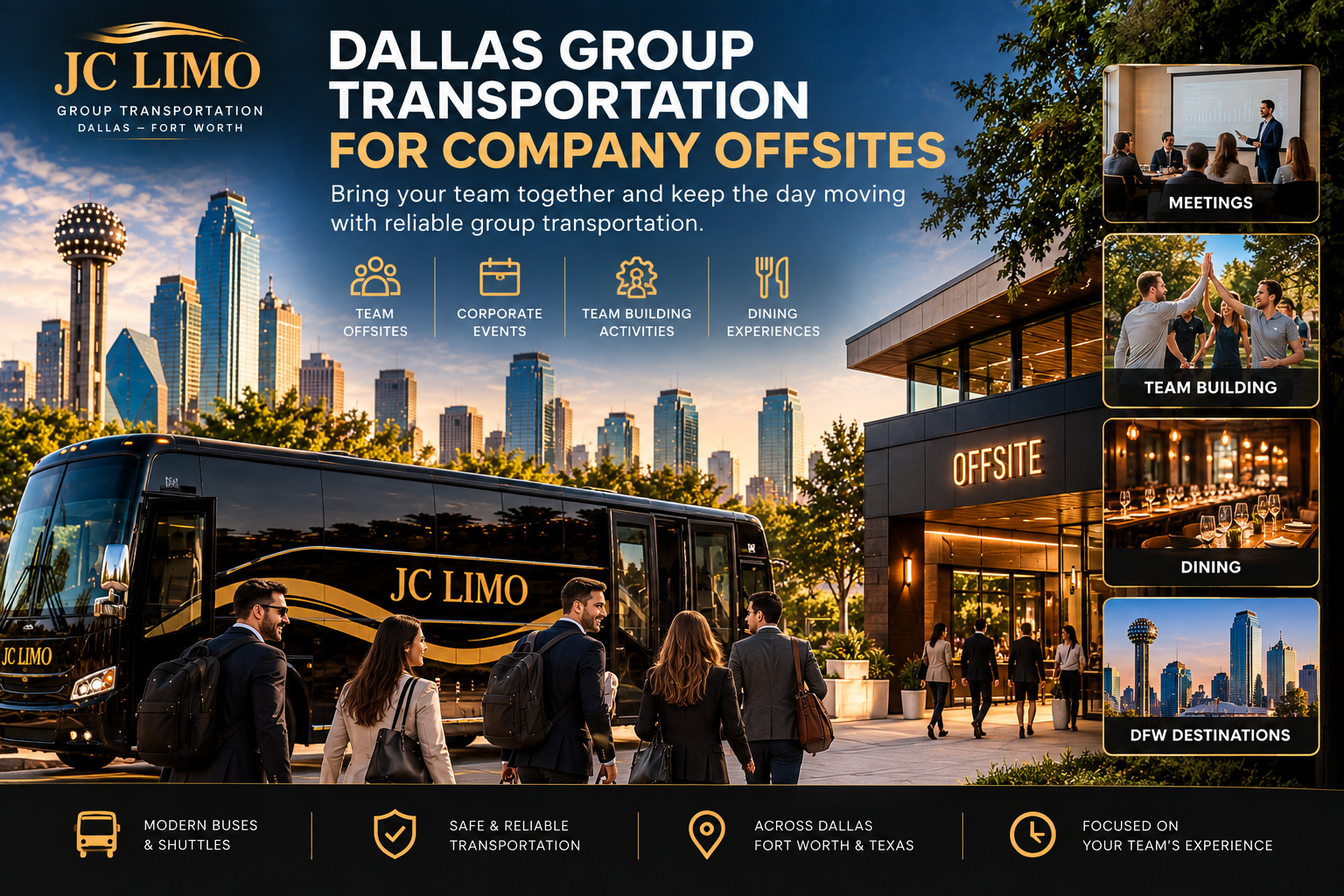
A company offsite is supposed to bring people together.
The transportation should do the same.
Whether the plan includes a strategy session, team-building activity, group lunch, outdoor experience, dinner, or a combination of several activities, moving an entire team around Dallas–Fort Worth can quickly become one of the most complicated parts of the day.
Employees may live in different areas.
Some may be visiting from another office.
Others may have flown into Texas specifically for the event.
The venue might be outside Downtown Dallas.
Lunch could be somewhere else.
The afternoon activity may require another transfer.
And by the evening, the team could be heading to a restaurant before returning to hotels or offices.
Without a transportation plan, a company offsite can easily turn into a collection of individual car trips.
With coordinated Dallas group transportation, the team can move together.
A dedicated JC LIMO bus or shuttle gives companies a practical way to connect offices, hotels, meeting venues, restaurants, activities, and other destinations throughout Dallas, Fort Worth, Texas, and the surrounding DFW Metroplex.
Transportation Is Part of the Offsite Experience
Companies often spend weeks planning the actual offsite.
They choose the venue.
Create the agenda.
Book speakers.
Plan activities.
Arrange meals.
Build presentations.
Then transportation is treated as a final detail.
But transportation can influence the entire experience.
If employees struggle to find the venue, the morning starts with frustration.
If half the team arrives late, the first session begins behind schedule.
If everyone drives separately to lunch, people may arrive at different times.
If parking is limited at an activity, another problem appears.
A good transportation plan removes many of these distractions before the event begins.
Start With the Purpose of the Offsite
Not every company offsite has the same goal.
Some are focused on strategy.
Others are designed around team building.
Some celebrate a company milestone.
Others combine business meetings with social activities.
Understanding the purpose helps shape transportation.
A leadership retreat with 12 executives has different requirements from a company-wide event with 80 employees.
A full-day program with four destinations needs more coordination than an afternoon activity at one venue.
Before arranging a bus or shuttle, map the structure of the day.
Map Every Destination Before Booking Transportation
Create a simple list of every location involved.
For example:
Office — Morning pickup
Meeting venue — Strategy session
Restaurant — Team lunch
Activity venue — Team building
Restaurant — Dinner
Hotel — Final drop-off
Once these destinations are visible, the transportation route becomes much easier to understand.
You can identify which transitions need a bus, which locations require longer travel, and where the schedule needs additional time.
This is much better than arranging each transfer independently.
Consider Where Employees Are Starting
Some offsites begin at the office.
Others involve employees coming from several locations.
A company with teams in Dallas, Plano, Irving, or Fort Worth may need multiple pickup areas.
Visiting employees may be staying at hotels.
Executives may arrive directly from the airport.
There is no single pickup model that works for every company.
The goal is to create a practical starting point.
For some teams, that means one central office.
For others, several pickup hubs may make more sense.
One Central Pickup Can Simplify the Morning
If most employees work from the same location, the office can become a natural meeting point.
Everyone arrives at a familiar place.
The JC LIMO bus collects the team.
Then the group travels together to the offsite.
This can make the morning easier because employees do not need to individually navigate to an unfamiliar venue.
It also allows organizers to confirm attendance before leaving.
Once the team is on board, the offsite can begin.
Multiple Offices May Need Multiple Pickups
Companies with several offices can still use one coordinated transportation plan.
For example, a bus might collect one group in North Dallas before continuing to another office on the way to the venue.
For larger teams, separate shuttles may serve different areas.
The important thing is to avoid creating a route that spends too much time crossing back and forth across the DFW Metroplex.
Pickup locations should be chosen based on both employee convenience and route efficiency.
Visiting Employees Need Clear Transportation
Company offsites often include employees traveling from other cities or states.
They may know very little about Dallas–Fort Worth.
Expecting visiting employees to independently arrange transportation between the airport, hotel, office, offsite venue, and dinner can create unnecessary complexity.
A structured corporate transportation plan makes the experience easier.
Employees receive clear instructions:
where to meet,
when the shuttle departs,
where the group is going,
and when transportation returns.
They can focus on the event rather than figuring out local travel.
Airport Arrivals Should Be Coordinated Separately
If employees are flying into Dallas for the offsite, review arrival times before planning airport transportation.
If 20 employees arrive within a similar period, group transportation may make sense.
If flights are spread across the entire day, several transfers may be needed.
The key is not to make one group wait unnecessarily for another.
Airport transportation should support the offsite schedule, not complicate it.
The same applies when employees return home.
Group passengers by departure windows when practical.
The Bus Can Become the First Team-Building Space
One advantage of traveling together is that the team begins interacting before reaching the venue.
Employees who normally work in different departments can talk.
Remote employees can meet colleagues in person.
New hires can become more familiar with the team.
People can discuss the day ahead.
The journey itself becomes part of the offsite.
This is difficult to achieve when everyone travels alone in separate vehicles.
A Dallas corporate bus can turn transportation time into shared time.
Keep the First Morning Simple
Offsite mornings can already feel busy.
Employees are checking schedules.
Organizers are preparing materials.
Managers are reviewing presentations.
People may be meeting colleagues they have never seen in person.
Avoid adding unnecessary transportation complexity.
Use clear instructions.
One meeting point.
One departure time.
One transportation contact.
If multiple pickups are necessary, make sure each group receives the correct details.
A simple morning can help the entire event start better.
Build Boarding Time Into the Schedule
If the bus should leave at 8:00 AM, employees should not be told to arrive at 8:00.
Give the group a ready time.
For example:
7:40 AM — Employees meet
7:45 AM — Boarding
8:00 AM — Departure
This gives the organizer time to confirm attendance.
It also reduces the risk that one late arrival delays the entire day.
For larger teams, a 15- or 20-minute boarding window can be useful.
Don’t Schedule the First Session Too Tightly
Suppose the offsite meeting begins at 9:00 AM.
The transportation plan should not aim to reach the venue at 8:59.
Employees need time to exit the bus.
Enter the building.
Find the meeting room.
Get coffee.
Settle in.
Organizers may need additional time to prepare.
A realistic arrival window allows the event to begin calmly rather than with everyone rushing into the room.
Team-Building Activities May Be Outside Central Dallas
Companies are not limited to traditional conference rooms.
Team-building days can involve outdoor activities, entertainment venues, sports, workshops, tours, or experiences throughout North Texas.
Some may be in Dallas.
Others could be in Arlington, Grapevine, Plano, Frisco, or Fort Worth.
When the activity is outside the team’s normal working area, dedicated transportation becomes even more useful.
Employees do not need to individually navigate unfamiliar roads or search for parking.
Everyone follows the same route.
Lunch Transportation Can Save Time
If lunch is at another location, transporting the group together can make the transition much smoother.
Without a shuttle, employees may leave the morning venue at different times.
Some arrive at the restaurant quickly.
Others take longer.
Parking may become another issue.
The meal cannot properly begin until most of the team arrives.
With group transportation, the transition is more controlled.
The session ends.
The team boards.
Everyone travels to lunch.
Then the group can continue to the next activity together.
Consider Catering Versus Restaurant Transportation
Not every offsite needs to travel for lunch.
If the schedule is tight, catering at the meeting venue may be more practical.
If the purpose of lunch is social interaction or experiencing a particular Dallas restaurant, transportation may be worthwhile.
The decision should support the event.
Do not add another destination simply because it sounds interesting.
Every additional stop requires boarding, travel, unloading, and schedule time.
Sometimes staying in one location creates a better offsite.
Afternoon Activities Need Transition Time
The transition between the business portion of an offsite and the social portion can be important.
Employees may need time to change clothes.
Some may need to return to a hotel.
Equipment may need to be collected.
If the afternoon activity requires different clothing or preparation, include that in the transportation plan.
A schedule that assumes employees can leave a formal meeting and instantly begin an outdoor activity may not be realistic.
Fort Worth Can Add a Different Experience
Companies based in Dallas may choose Fort Worth, Texas for part of an offsite.
It can create a sense of getting away from the normal office environment without requiring long-distance travel outside North Texas.
A team might hold the morning meeting in Dallas and spend the evening in Fort Worth.
Or the entire offsite could be hosted there.
If Dallas and Fort Worth are both part of the day, transportation should be planned as a significant transition.
The group needs enough time for the journey without compressing the activities on either side.
Dinner Can Be the Final Offsite Activity
Many company offsites end with a group dinner.
This gives employees time to relax after meetings and activities.
If transportation is provided, the team can move from the previous venue directly to the restaurant.
After dinner, the bus or shuttle can return passengers to hotels, offices, or other planned drop-off points.
This creates a clear end to the event.
Employees know how they are getting back before the evening begins.
Avoid Asking Employees to Move Their Cars All Day
Consider an offsite with four destinations.
If every employee drives separately, each person may need to:
find the first venue,
park,
leave,
navigate to lunch,
park again,
drive to the activity,
find another parking space,
drive to dinner,
park again,
then finally travel home.
That is a lot of individual transportation for one company event.
A dedicated group bus allows employees to leave their cars at the starting point and travel together throughout the program.
For organizers, that can remove dozens of separate journeys from the day.
Parking Can Influence Venue Choice
Before finalizing an offsite location, understand how group transportation works there.
Is there a designated bus loading area?
Can a larger vehicle enter?
Where will passengers board after the event?
Can the vehicle wait nearby?
These practical questions are easy to overlook when choosing a venue based only on meeting space or appearance.
Transportation access should be considered during planning, especially for larger groups.
Keep Employees Updated Throughout the Day
A written itinerary is useful even when everyone is traveling together.
It might look like:
8:00 AM — Depart Dallas office
8:45 AM — Arrive at offsite venue
9:00 AM — Strategy session
12:00 PM — Depart for lunch
1:45 PM — Team-building activity
5:30 PM — Depart for dinner
8:00 PM — Return transportation
Employees can see how the day fits together.
They know when they need to be ready.
And organizers receive fewer questions about what happens next.
Assign One Transportation Contact
One person should be responsible for transportation communication.
This might be someone from:
HR,
operations,
event management,
office administration,
or the planning team.
That person should know the itinerary, passenger count, pickup locations, and key times.
Employees then know who to contact if they have a transportation question.
This avoids conflicting instructions from several organizers.
Remote Teams Can Benefit Even More
Remote and hybrid companies may only bring the entire team together a few times each year.
When employees travel from different cities to Dallas, the offsite becomes more than a normal company meeting.
It may be one of the few opportunities for everyone to connect in person.
Coordinated transportation helps preserve that shared experience.
Instead of remote employees being left to independently navigate an unfamiliar city, the company can create a more organized journey from hotel to meeting to activities.
Multi-Day Offsites Need a Daily Transportation Plan
Some company retreats last two or three days.
In that case, transportation should be planned day by day.
Day one may involve airport arrivals and a welcome dinner.
Day two could include meetings and team-building activities.
Day three may involve a final session followed by airport departures.
The same bus schedule does not necessarily work every day.
Review each day’s passenger numbers and destinations separately.
This keeps transportation aligned with the actual agenda.
Leave Some Space in the Schedule
An offsite should not feel like employees are racing from one appointment to another.
Build reasonable buffers between major activities.
A session may run ten minutes late.
Lunch may take longer.
A team-building activity could finish early.
Dallas–Fort Worth traffic may affect travel time.
A little breathing room can prevent these normal variations from becoming problems.
Transportation Should Support the Culture of the Day
The transportation plan should match the experience the company is trying to create.
If the offsite is designed around collaboration, traveling together supports that goal.
If the event celebrates the team, employees should not spend half the day stressed about driving and parking.
If visiting employees are being welcomed to Dallas, clear transportation helps create a more organized experience from the beginning.
The bus or shuttle is not the main attraction.
But it can influence how smoothly every other part of the event works.
Plan Your Dallas Company Offsite With JC LIMO
A successful company offsite needs more than a meeting room and an agenda.
Employees need a practical way to move between every part of the experience.
JC LIMO provides professional bus and shuttle transportation throughout Dallas, Fort Worth, Texas, and the surrounding DFW area for corporate teams, meetings, activities, dinners, events, airport transfers, and company outings.
Start with the full itinerary.
Map every destination.
Choose practical pickup locations.
Allow enough boarding time.
Plan realistic transitions between activities.
Consider how visiting employees will travel.
Give the team one clear schedule.
And avoid turning every change of venue into dozens of separate car trips.

Related posts
 13Oct, 26
Dallas Group Transportation With Luggage and Equipment
 13Oct, 26
Dallas Group Transportation With Multiple Drop-Offs
 13Oct, 26
- October 13, 2026
- 0
- 10
