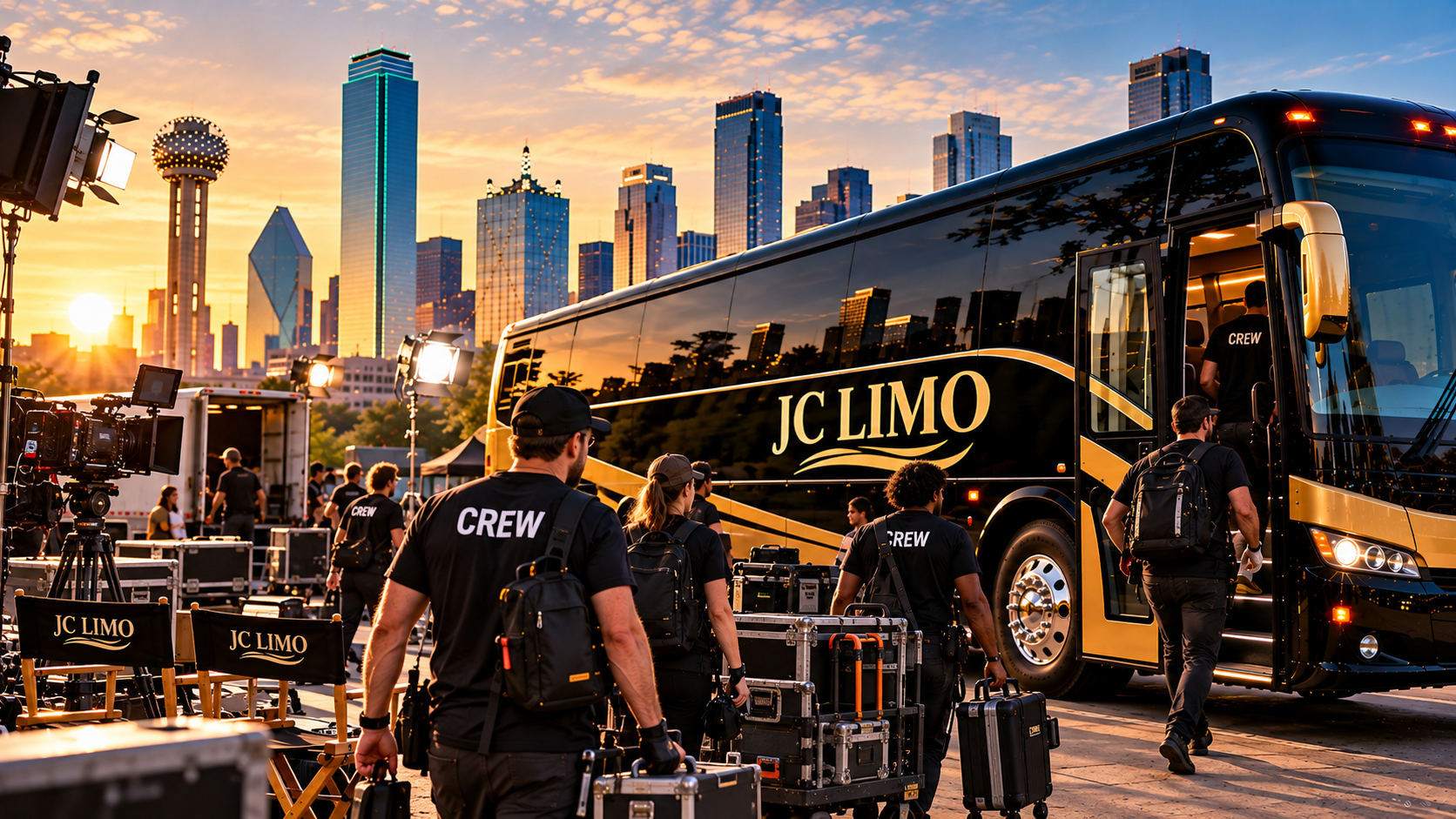
Dallas Film Production Transportation for Cast and Crew
A film production can involve dozens of people working toward the same creative goal. From directors and camera operators to lighting technicians, production assistants, actors, and makeup artists, every department plays an important role in bringing a project to life.
Behind the scenes, however, successful productions depend on more than cameras, equipment, and creative direction.
They also require careful logistical planning.
One of the most important operational considerations is transportation.
Film and commercial productions often involve multiple filming locations, early call times, changing schedules, and large teams traveling with equipment.
In Dallas, Texas, production companies may film in downtown locations, corporate offices, outdoor settings, residential neighborhoods, studios, or venues throughout the Dallas–Fort Worth Metroplex.
Moving cast and crew between these locations can become complicated when everyone relies on separate transportation.
That’s why Dallas film production transportation should be included in the production planning process.
With charter bus and shuttle transportation options from JC LIMO, production coordinators can explore group travel arrangements for cast, crew, and support teams throughout Dallas, Fort Worth, and surrounding North Texas communities.
Why Transportation Matters in Film Production
Time is one of the most valuable resources on a production set.
Filming schedules are carefully organized around location availability, talent schedules, lighting conditions, equipment preparation, and crew responsibilities.
When transportation is delayed, several departments may be affected.
Consider a commercial production involving 35 crew members and 10 cast members.
The production begins at an outdoor location in Dallas before moving to an indoor filming space in Plano.
If everyone drives separately, the team may arrive at different times.
Some crew members might encounter traffic, while others may struggle to find parking or locate the correct entrance.
These delays can affect equipment setup and filming schedules.
Coordinated transportation helps simplify group movement.
Instead of relying entirely on individual travel arrangements, production teams can establish shared departure times and designated pickup locations.
This allows production managers to maintain better visibility over crew arrivals and planned transfers.
Different Productions That Benefit From Group Transportation
Production transportation requirements vary depending on the project.
A small commercial shoot may need one vehicle, while a larger production may require several transportation arrangements.
Commercial and Advertising Productions
Advertising productions often involve agencies, clients, directors, production crews, and talent.
These projects may take place at multiple locations within a short timeframe.
Group transportation can help coordinate movement between filming locations.
Television Productions
Television productions may involve recurring filming schedules, multiple departments, and different locations.
Shuttle transportation can support repeated transfers between production offices, parking areas, and filming sites.
Independent Films
Independent film productions often operate with limited budgets and carefully planned schedules.
Coordinating transportation can help reduce logistical complications and support more predictable crew movement.
Music Video Productions
Music video shoots may involve artists, dancers, production crews, and support teams.
These projects sometimes require travel between studios, outdoor locations, and event venues.
A shared transportation arrangement can simplify movement between locations.
Corporate Video Productions
Businesses may organize video shoots involving employees, executives, production teams, and external talent.
When filming takes place across several company locations, group transportation can support the production schedule.
Planning Transportation Around Production Call Times
Film production schedules often begin early in the morning or continue into the evening.
Transportation planning should reflect the actual call times assigned to different departments.
Identify Department Arrival Requirements
Not every crew member needs to arrive at the same time.
Lighting and grip teams may require early access to prepare equipment.
Actors may arrive later for makeup and wardrobe.
Production managers should identify which groups need transportation at each stage.
Establish Pickup Locations
Pickup points should be practical for crew members and suitable for the selected vehicle.
These may include hotels, production offices, designated parking areas, or approved meeting locations.
Account for Traffic Conditions
Dallas–Fort Worth traffic can vary throughout the day.
Production schedules should include realistic travel times between filming locations.
Plan for Schedule Changes
Filming may take longer than expected because of weather, technical adjustments, or creative decisions.
Transportation coordinators should discuss how itinerary changes will be handled before booking.
Choosing the Right Bus for Film Production Transportation
The appropriate vehicle depends on passenger numbers, filming schedules, and travel requirements.
JC LIMO offers group transportation services with bus and shuttle options for different types of organized travel.
Mini Buses for Smaller Production Teams
Mini buses can be useful for transporting smaller groups of crew members or talent.
For example, a production company may need transportation between a hotel and a filming location.
Shuttle Buses for Production Transfers
Shuttle buses can support repeated transportation between locations.
A production may arrange scheduled transfers between a remote parking area and the filming site.
Charter Buses for Larger Crews
Larger productions may require full-sized charter buses.
These vehicles can accommodate more passengers, making them useful for moving production teams between filming locations.
Before booking, coordinators should confirm passenger capacity, luggage requirements, accessibility needs, and vehicle availability.
Transportation Between Multiple Filming Locations
Many productions use several locations to capture different scenes.
A project may begin in downtown Dallas, continue at a corporate office in Irving, and finish at an outdoor location in Fort Worth.
Moving the crew between these destinations requires careful coordination.
Create a Location Schedule
Production managers should list every filming location and its expected arrival and departure times.
Review Travel Distances
Locations that appear close on a map may require longer travel times during busy traffic periods.
Coordinate Department Transfers
Some departments may need to arrive earlier than others to prepare the next location.
Separate transportation arrangements may be appropriate depending on the production schedule.
Confirm Location Access
Not every filming location can accommodate a large bus.
Production teams should confirm suitable loading and unloading areas before arrival.
Managing Film Equipment During Group Transportation
Film productions often involve cameras, lighting equipment, audio systems, wardrobe materials, and other supplies.
However, passenger transportation and equipment transportation should be planned separately.
Charter buses are primarily designed to transport people.
Although some vehicles offer luggage storage, they may not be suitable for transporting large production equipment.
Production coordinators should identify equipment requirements before booking.
Bulky equipment, heavy cases, or specialized gear may require dedicated production trucks.
Keeping passenger transportation separate from equipment logistics can simplify loading procedures and reduce complications.
Transportation for Cast Members and Talent
Actors, presenters, and other talent may have different schedules from the main production crew.
Some performers may need transportation between hotels, makeup locations, studios, and filming sites.
Coordinating these movements can help production teams manage call times.
Confirm Talent Schedules
Transportation should reflect the actual arrival requirements for each performer.
Provide Clear Pickup Instructions
Talent should receive the pickup location, departure time, and relevant contact information.
Consider Privacy Requirements
Some productions may require additional privacy or controlled access arrangements.
These needs should be discussed with the transportation provider in advance.
Coordinate Return Transportation
Talent may finish filming before the rest of the crew.
Separate return arrangements may be necessary depending on the production schedule.
Film Production Transportation Across Dallas–Fort Worth
North Texas offers a wide variety of filming environments.
Production companies may use several communities depending on the project’s creative requirements.
Downtown Dallas
Downtown Dallas offers urban architecture, business districts, and recognizable city environments.
However, traffic, parking restrictions, and filming permits should be considered.
Fort Worth
Fort Worth provides a range of urban, cultural, and historical settings.
Production teams traveling between Dallas and Fort Worth should allow sufficient time for transportation.
Arlington
Arlington offers commercial areas, entertainment venues, and other potential filming locations.
Transportation planning should account for major event traffic.
Plano and Frisco
Plano and Frisco contain corporate offices, residential communities, and commercial developments.
Production companies may use these areas for business-related or lifestyle filming.
Irving and Grapevine
Irving and Grapevine provide additional locations within the Metroplex.
Their proximity to DFW International Airport may also be useful for productions involving visiting crew members or talent.
Transportation for Early Morning and Late-Night Shoots
Film productions frequently operate outside normal business hours.
Early morning shoots may require crews to arrive before sunrise.
Evening productions may continue late into the night.
These schedules create additional transportation considerations.
Early Morning Transportation
Crew members should receive clear pickup instructions before the shoot.
Transportation should allow enough time for setup and preparation.
Late-Night Departures
Production managers should establish return transportation arrangements before filming begins.
Crew members should know where to meet after completing their responsibilities.
Extended Filming Schedules
Some shoots run longer than expected.
Transportation coordinators should discuss potential schedule extensions and any associated charges with the provider.
Crew Coordination
A designated production transportation coordinator can help communicate changes and confirm passenger requirements.
How Group Transportation Supports Production Efficiency
Film production depends on coordination between departments.
When crew members travel separately, production managers may need to track multiple arrivals.
Shared transportation can simplify this process.
It can also reduce parking requirements at filming locations where space is limited.
For productions involving several locations, coordinated transfers help maintain a more organized schedule.
However, transportation planning should remain flexible enough to accommodate changes in filming requirements.
The goal is to support the production workflow without creating unnecessary restrictions.
Common Film Production Transportation Mistakes
One common mistake is underestimating the number of passengers.
Productions may add crew members, talent, or support staff as schedules develop.
Coordinators should confirm passenger counts before booking.
Another mistake is failing to account for equipment.
Passenger vehicles may not have enough space for production gear.
A third mistake is overlooking filming location access.
Some locations may have restrictions on large vehicles.
Finally, production teams should avoid assuming that filming will always finish on schedule.
Transportation arrangements should account for possible delays and changes.
How to Organize Production Transportation Efficiently
A well-organized transportation plan begins with assigning responsibilities.
One production coordinator should manage transportation arrangements.
This person should communicate with the transportation provider and maintain the itinerary.
Next, create a schedule that includes pickup locations, filming destinations, departure times, and expected return arrangements.
Share relevant transportation information with cast and crew before the shoot.
For larger productions, separate passenger groups according to department requirements.
Finally, confirm transportation details before each filming day.
These steps can help reduce confusion and support a smoother production process.
Why Consider JC LIMO for Dallas Film Production Transportation?
Production teams need transportation arrangements that support demanding schedules and multiple locations.
JC LIMO provides charter bus and shuttle transportation services throughout Dallas, Fort Worth, and surrounding North Texas communities.
These services can support crew transfers, hotel transportation, filming location travel, and other organized group transportation needs.
Production coordinators can contact JC LIMO to discuss passenger numbers, filming schedules, pickup locations, and vehicle options.
Providing a detailed itinerary helps the transportation team assess suitable arrangements.
Whether the project involves a single filming location or several destinations across the Metroplex, early transportation planning can simplify production logistics.
Frequently Asked Questions About Dallas Film Production Transportation
Can JC LIMO provide transportation for film crews?
JC LIMO offers charter bus and shuttle transportation services. Production companies can contact the team to discuss their crew transportation requirements.
What type of bus is suitable for a production crew?
The appropriate vehicle depends on passenger numbers, travel distances, and scheduling requirements. Mini buses, shuttle buses, and charter buses may be suitable for different group sizes.
Can transportation include multiple filming locations?
Production companies can request transportation involving multiple destinations. The final arrangements depend on route distances, schedules, and vehicle availability.
Is transportation available for early morning or late-night shoots?
Production teams can inquire about transportation outside regular business hours. Scheduling and availability should be confirmed before booking.
Can production equipment travel on the bus?
Equipment transportation depends on the vehicle’s storage capacity and the type of equipment involved. Large or specialized production gear may require separate transportation.
Keep Your Dallas Production Moving With JC LIMO
Successful film production requires creativity, preparation, and careful coordination.
From managing cast and crew schedules to organizing filming locations, every operational detail contributes to the final result.
Transportation should support the production process rather than create additional complications.
By arranging group transportation in advance, production teams can simplify travel between locations, coordinate arrivals, and reduce unnecessary logistical challenges.
Whether you’re filming a commercial in Dallas, producing a television project in Fort Worth, or organizing a multi-location shoot across North Texas, coordinated bus and shuttle transportation can help keep your team moving.
Plan your next production with JC LIMO.

Related posts
 13Oct, 26
Dallas Group Transportation With Luggage and Equipment
 13Oct, 26
Dallas Group Transportation With Multiple Drop-Offs
 13Oct, 26
- October 13, 2026
- 0
- 10
