Getting a group to an event is usually the easy part.
Everyone has the same destination. There is a scheduled start time. Passengers meet at the hotel, board the bus, and travel together.
The challenge often begins later.
Some people are ready to leave at 8:00 p.m. Others want to stay until 10:00. A corporate dinner finishes for most employees, but executives remain for another meeting. Wedding guests begin returning to their hotels at different times. Conference attendees split between networking events, dinners, and evening activities.
Suddenly, one group no longer has one departure time.
For groups traveling throughout Dallas, Fort Worth, and North Texas, this situation is common. Events do not always end at exactly the same time for every passenger, and expecting an entire group to wait for the last person can create unnecessary frustration.
A more flexible bus and shuttle transportation plan can help.
By planning return transportation before the event begins, organizers can give passengers options while maintaining a clear, coordinated schedule.
Why Different End Times Create Transportation Problems
Most transportation plans focus heavily on arrival.
What time should the bus leave?
When does everyone need to be at the venue?
How early should the group arrive?
Those questions are important.
But departure deserves just as much attention.
Imagine transporting 50 employees from a Dallas hotel to an evening company event.
The official event runs from 6:00 to 10:00 p.m.
At 8:30, several employees are ready to return to the hotel.
At 9:00, another group finishes dinner.
Others want to stay until the event officially ends.
If the transportation plan includes only one 10:15 p.m. departure, everyone who wants to leave earlier either has to wait or arrange another ride.
For a small group, that may be manageable.
For a large group, it can quickly become disorganized.
Start by Asking When People Will Actually Leave
An event’s official end time is not necessarily the time every passenger will leave.
This is especially true for large events.
A conference reception might officially finish at 10:00 p.m., but some attendees leave immediately after dinner.
A wedding reception may continue until midnight, while older relatives or families with children prefer to return to the hotel earlier.
A corporate event might have optional networking after the main program.
A sporting event can also create different preferences depending on the group.
Before arranging transportation, think about how passengers are likely to behave rather than relying only on the official event schedule.
This can help determine whether the group needs one departure or several.
Scheduled Return Shuttles Can Create Flexibility
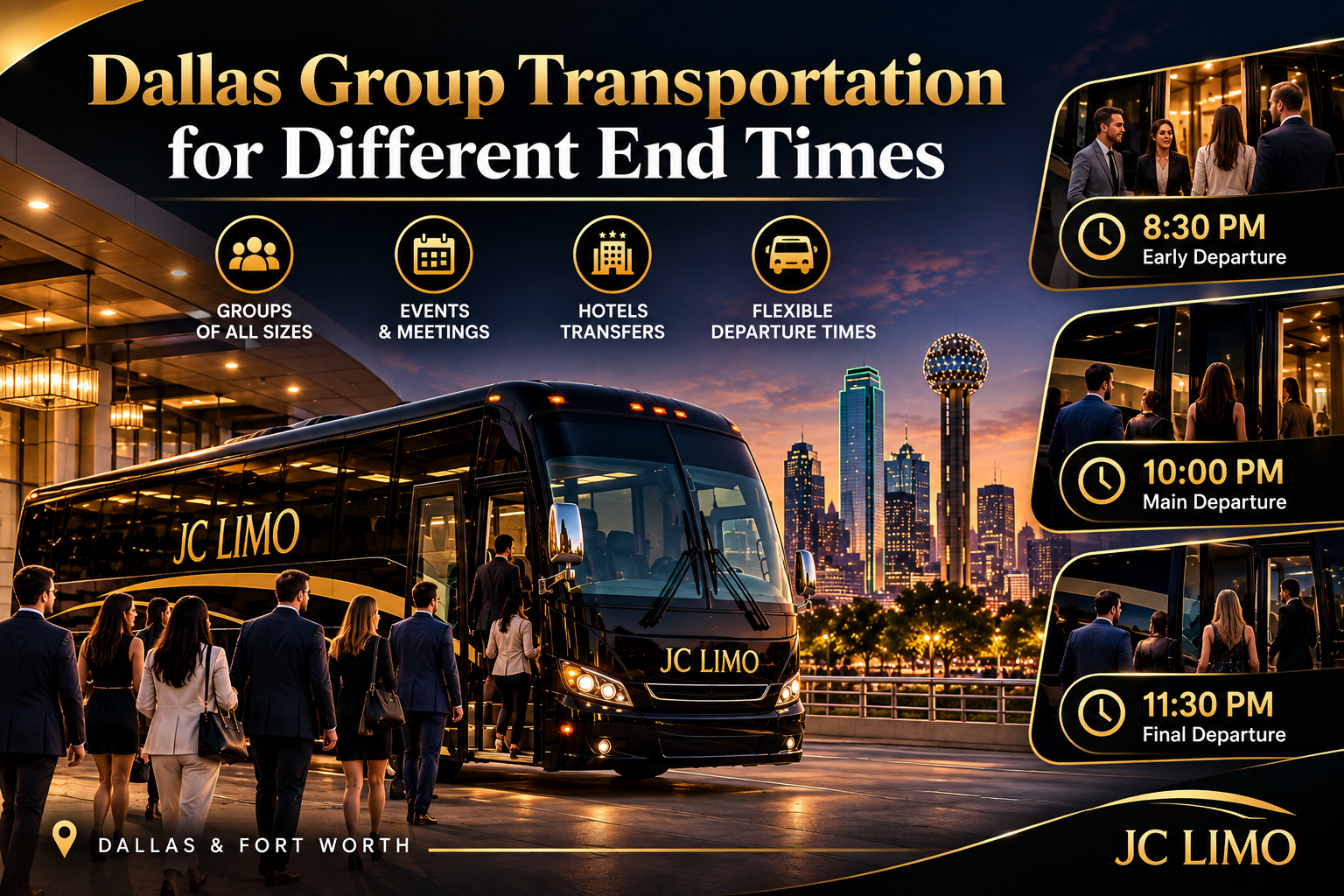
One practical solution is offering scheduled return departures.
Instead of telling everyone, “The bus leaves at 11:00 p.m.,” passengers might have several clearly defined options.
For example:
First departure: 8:30 p.m.
Second departure: 10:00 p.m.
Final departure: 11:30 p.m.
The exact schedule depends on the event, group, and transportation arrangement, but the concept is simple.
Passengers can choose the departure that fits their evening.
Organizers maintain structure.
And people do not have to arrange separate transportation simply because they are ready to leave earlier than the rest of the group.
This is where JC LIMO shuttle transportation can be particularly useful for events with flexible ending times.
Corporate Events Rarely End for Everyone at Once
Corporate groups often have different responsibilities.
Employees may finish their scheduled activities while managers remain for discussions.
Executives could attend a private dinner after the main meeting.
Some attendees may have early flights the next morning and prefer to return to the hotel sooner.
Others may want to continue networking.
One fixed return time can force very different passengers into the same schedule.
Providing transportation windows can make the experience more convenient.
Employees who are finished can return to the hotel.
Those who need to stay can continue their evening knowing another scheduled transportation option is available.
For the organizer, this is easier than responding to individual transportation requests throughout the night.
Conferences Naturally Divide Groups
Large conferences are another common example.
During the day, attendees may follow roughly the same schedule.
At night, everything changes.
One group attends an industry dinner.
Another goes to a networking reception.
Some return directly to the hotel.
Others attend an off-site event.
A company bringing employees to a Dallas conference may therefore need transportation that becomes more flexible as the day progresses.
Rather than treating every evening movement as a separate problem, planners can establish a shuttle structure around the most common routes.
For example, transportation might connect the main conference area with the company’s hotel at scheduled intervals.
Employees receive the schedule in advance and choose the departure that works for them.
Weddings Need More Than One Return Option
Wedding transportation is often planned around one simple route:
Hotel to venue.
Venue to hotel.
But wedding guests rarely leave at the same time.
Some guests stay until the final song.
Others leave shortly after dinner.
Families with young children may want to return earlier.
Older guests might prefer not to stay late.
Members of the wedding party could remain after most guests have left.
If there is only one return bus, guests face a choice between leaving earlier on their own or waiting until the final scheduled departure.
Multiple shuttle times can create a better guest experience.
For example, an early shuttle could leave after dinner, another during the reception, and a final bus at the end of the night.
The exact schedule should reflect the event rather than following a generic formula.
Concerts and Entertainment Events Can Be Unpredictable
Concerts, performances, and large entertainment events introduce another challenge: exact finishing times may vary.
An event may run longer than expected.
Passengers may also take different amounts of time to exit the venue.
One person leaves immediately.
Another waits for the crowd to thin.
Someone stops to purchase merchandise.
A larger group might take several minutes just to gather at the designated meeting point.
Transportation planning should allow for this reality.
Instead of assuming everyone will be standing beside the bus the moment the event ends, give the group clear instructions about where to meet and how the departure will work.
For Dallas group transportation, the meeting point can be just as important as the departure time.
Sporting Events Require a Clear Post-Event Plan
Sports groups and fans can face similar challenges.
Large venues generate significant movement when an event ends.
Thousands of people may leave at approximately the same time.
Traffic increases.
Pickup areas become busy.
Group members can easily become separated.
The transportation plan should therefore be communicated before passengers enter the venue.
Everyone should know where they are expected to meet afterward.
If there are multiple departure options, passengers should know which one they are using.
Waiting until the event finishes to decide where everyone should go can create unnecessary confusion.
Hotel Returns Should Be Simple
After a long event, most passengers want one thing from transportation:
simplicity.
They do not want to search for directions.
They do not want to compare ride options.
They do not want to wonder where the rest of the group went.
They want to know where the bus is and when it leaves.
A clear JC LIMO bus or shuttle schedule can make the return journey one of the easiest parts of the evening.
This matters particularly for visitors unfamiliar with Dallas or Fort Worth.
At the end of a long conference, wedding, corporate program, or event, removing another decision from the traveler’s evening can make a noticeable difference.
Multiple Hotels Make End Times Even More Important
Now add another layer.
The group is not staying at one hotel.
Some passengers need to return to downtown Dallas.
Others are staying elsewhere.
Another group may be staying closer to DFW Airport.
If passengers are also leaving at different times, transportation becomes significantly more complicated.
The solution begins with identifying the major travel patterns.
How many people are staying at each hotel?
Which passengers are likely to leave early?
Can hotels be grouped logically into the same route?
Would separate shuttle movements make more sense?
Planning these questions in advance is much easier than trying to solve them outside the venue late at night.
Don’t Create Too Many Departure Times
Flexibility is useful.
Too much flexibility can create another problem.
If passengers have a bus every 15 minutes, the transportation plan may become unnecessarily complex.
Organizers should focus on the departure windows that are likely to serve meaningful portions of the group.
For many events, a small number of well-timed departures can provide enough flexibility.
An early departure serves guests who are finished.
A middle departure serves the main group.
A final departure serves those staying until the end.
Simple schedules are easier to communicate and easier for passengers to remember.
Tell Everyone the Schedule Before the Event
Transportation instructions should not arrive when passengers are already ready to leave.
Ideally, the return schedule should be communicated before the event starts.
Passengers should know:
Where the return transportation will depart.
What times are available.
Which hotel or destination each shuttle serves.
When they should arrive at the meeting point.
Who they should contact if necessary.
This gives people the ability to plan their evening.
Someone who wants the early shuttle knows when to wrap up a conversation.
Another passenger knows they can stay longer because there is a later departure.
Transportation becomes predictable rather than reactive.
Choose an Easy Meeting Point
Large venues can have many entrances.
Hotels can have multiple driveways.
Convention centers may have several loading zones.
A vague instruction such as “meet outside” is rarely enough for a large group.
The pickup location should be specific and easy to identify.
If passengers were dropped off at a particular location, using the same point for return transportation can sometimes simplify things, depending on venue requirements.
The meeting point should also be communicated in a format passengers can easily check from their phones.
The easier the location is to understand, the less time the group spends searching for one another.
Assigning Group Leaders Can Help
For particularly large groups, assigning a coordinator to each departure can make the process smoother.
This person does not need to manage the transportation itself.
They can simply help gather passengers and confirm that the people expected on that departure are present.
Corporate groups can assign team leaders.
Tour groups may already have guides.
Wedding planners can coordinate with family representatives or event staff.
This creates a communication bridge between the passengers and the overall transportation plan.
Consider the Next Morning
The right departure time may depend on what happens the following day.
If the group has an early morning meeting, some passengers may appreciate an earlier return option.
If departure flights begin early, travelers may need time to pack and rest.
A multi-day corporate program could have breakfast scheduled early the next morning.
Transportation planning should therefore consider more than the current event.
A late evening followed by an early start can affect the entire group’s experience.
Offering a reasonable return option can help passengers manage their own schedules.
Don’t Forget Staff and Organizers
Attendees are not always the last people to leave.
Event organizers, company staff, speakers, wedding planners, coordinators, or other team members may need to remain after guests depart.
If these people are part of the transportation plan, their schedules should be considered separately.
A final shuttle may need to operate later than the main guest transportation.
This is another reason passenger groups should be identified before transportation is finalized.
The last attendee and the last staff member may have very different departure times.
Late-Night Transportation Should Be Planned Early
Waiting until late at night to determine how people will return to their hotel is rarely ideal.
Passengers are tired.
Phones may have low batteries.
People may be unfamiliar with the area.
The group may also be leaving a crowded venue at the same time as hundreds or thousands of other visitors.
Having transportation arranged in advance gives the evening a defined ending.
Everyone knows the plan before they need it.
Think Beyond One-Way Bus Transportation
Group transportation does not always mean one bus carrying every passenger together from beginning to end.
Some itineraries are better served by a combination of bus and shuttle movements.
The group might travel together to the event on one larger vehicle.
Return transportation could then operate according to several departure windows.
Another itinerary might use different shuttles for separate hotels.
The right transportation structure depends on the group’s actual behavior.
The goal is not to force passengers into a transportation model.
The transportation should support the way the event works.
Keep the Final Departure Clear
If multiple return options are available, one detail should be unmistakable:
the final departure.
Passengers need to know when the last scheduled group transportation leaves.
This helps prevent misunderstandings and gives people a clear deadline.
The final departure time should be communicated alongside the other transportation details rather than treated as something passengers will figure out later.
Clarity protects both the passengers and the organizer.
Give Your Group Flexibility Without Losing Organization
A group can arrive together without leaving together.
That does not have to create a transportation problem.
The key is recognizing different departure needs before the event begins.
Think about when passengers are realistically likely to leave.
Consider whether early and late return options would help.
Create simple departure windows.
Choose clear pickup points.
Communicate the schedule in advance.
Account for different hotels and passenger groups.
And make the final departure easy to understand.
For corporate events, conferences, weddings, entertainment, sports, private gatherings, and other group trips throughout Dallas, Fort Worth, and North Texas, JC LIMO provides bus and shuttle transportation that can be coordinated around the actual itinerary.
Some passengers may be ready to leave early.
Others may want to stay until the end.
With the right transportation plan, both can fit into the same organized trip.

Related posts
 13Oct, 26
Dallas Group Transportation With Luggage and Equipment
 13Oct, 26
Dallas Group Transportation With Multiple Drop-Offs
 13Oct, 26
- October 13, 2026
- 0
- 10
