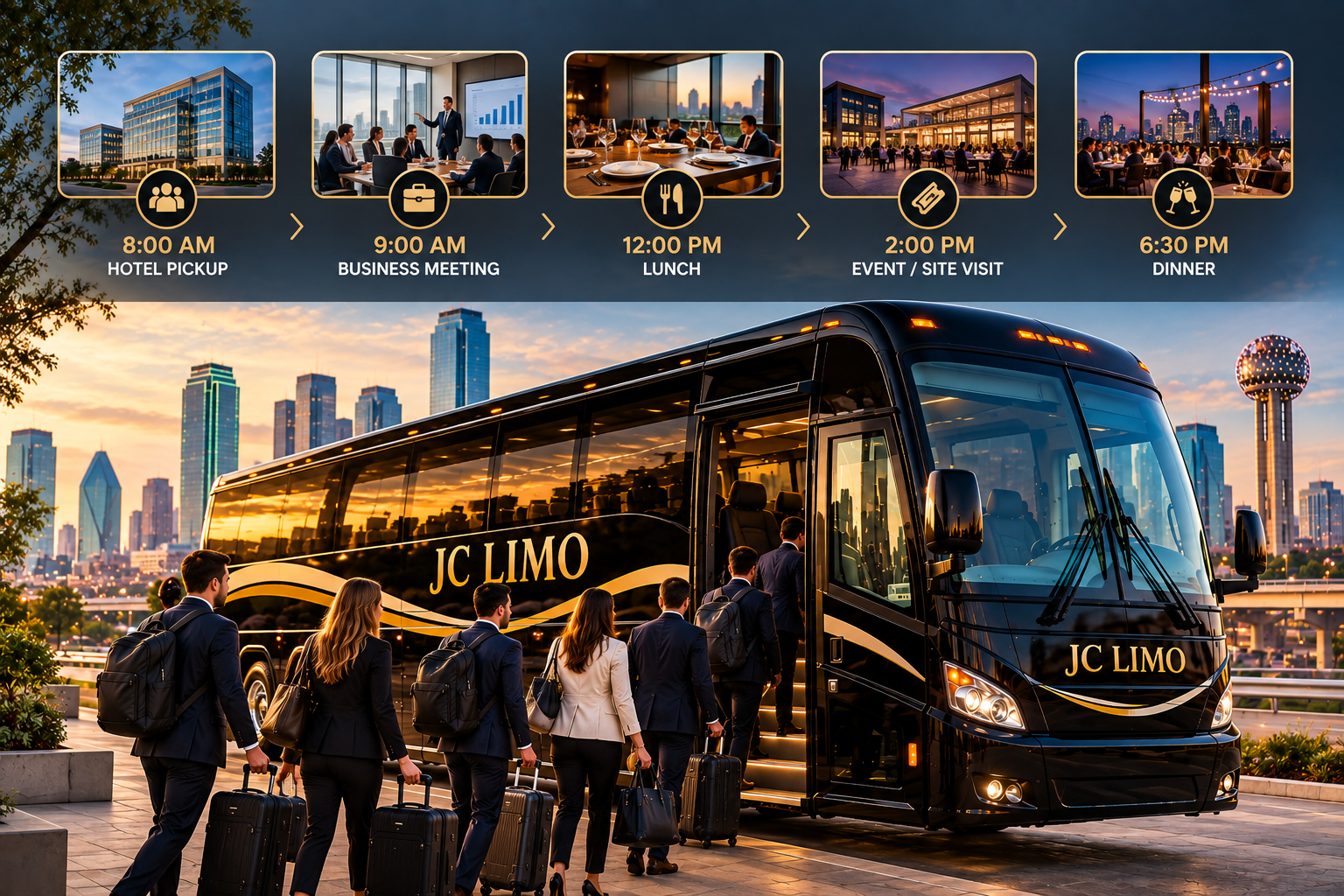
Some group itineraries have plenty of breathing room.
Others barely stop.
A corporate team finishes a morning meeting and immediately needs to travel to lunch. After lunch, there is a site visit. The site visit is followed by an evening event, and dinner begins shortly afterward.
A sports group may move from practice to lunch, from lunch to a tournament venue, and from the venue to a team dinner.
Visitors exploring Dallas and Fort Worth may have several attractions, restaurants, tours, and events planned in a single day.
When activities are scheduled back-to-back, transportation becomes one of the most important parts of the itinerary.
Every transfer connects two commitments.
If one transfer runs poorly, the delay can continue through the rest of the day.
For groups of 20, 30, 40, or more passengers, repeatedly arranging separate vehicles between activities can make an already busy schedule even more complicated.
A coordinated bus or shuttle transportation plan provides a different approach.
Instead of solving transportation after every activity, the entire day’s route can be organized in advance.
JC LIMO provides group transportation throughout Dallas, Fort Worth, and surrounding Texas areas for corporate teams, event attendees, sports groups, families, private groups, organizations, and other travelers with full schedules.
Why Back-to-Back Schedules Are Difficult for Groups
A schedule can look perfectly reasonable on paper.
Meeting: 9:00 a.m.–11:00 a.m.
Lunch: 11:30 a.m.–1:00 p.m.
Site visit: 1:30 p.m.–3:30 p.m.
Event: 4:00 p.m.–6:00 p.m.
Dinner: 6:30 p.m.
Every activity appears to have 30 minutes between it and the next.
But those 30 minutes are not necessarily free.
A group needs time to leave the first location.
Passengers need to board.
The vehicle needs to travel.
Everyone needs to unload.
The group may need to walk to the next entrance.
Suddenly, a 30-minute gap can be very tight.
The larger the group becomes, the more important these transition periods are.
That is why transportation needs to be included when the itinerary itself is being created.
Don’t Schedule Activities First and Transportation Second
A common approach to group planning is to choose all the activities first.
Once the itinerary is complete, transportation is added afterward.
That can create problems.
Two activities may look like they fit perfectly into the same afternoon until someone checks the distance between them.
A meeting in Dallas followed shortly by an event in Fort Worth requires real travel time.
Likewise, two destinations may be geographically close but have very different arrival and parking requirements.
A better approach is to build the activities and transportation together.
Every time an activity is added, ask:
Where is the group coming from?
How long does everyone have to move?
Where will the bus pick passengers up?
Where will it drop them off?
How much time does the group need after arrival?
This creates an itinerary based on the real journey rather than just reservation times.
Transition Time Is Part of the Schedule
People often think of transportation time as the number of minutes a vehicle is moving.
For groups, it is more than that.
A realistic transition includes:
Finishing the current activity.
Gathering passengers.
Walking to the pickup point.
Boarding.
Traveling.
Unloading.
Walking into the next location.
If luggage or equipment is involved, loading and unloading may add more time.
A 15-minute drive might therefore require a much larger window in the actual itinerary.
This is especially important for large Dallas group transportation schedules.
The bus cannot leave simply because the previous activity technically ended.
Passengers need enough time to reach it.
Corporate Groups Often Have Packed Itineraries
Business travel is one of the clearest examples of back-to-back scheduling.
Companies may want to make the most of a short visit to Dallas.
A team arrives for two days and needs to fit in meetings, office visits, presentations, lunches, client dinners, and networking events.
That can create a very busy transportation schedule.
If employees arrange rides separately after each activity, the group may lose valuable time repeatedly regrouping.
A coordinated corporate shuttle can remain part of the day’s itinerary.
Passengers leave one meeting and know where transportation is waiting.
They travel together to the next location.
After that activity, the process repeats.
This can make a packed schedule easier to follow.
It also gives organizers a clearer picture of where the group is throughout the day.
Keep the Next Departure Clear
During a busy itinerary, passengers should always know one thing:
When do we leave next?
They do not necessarily need the entire transportation plan memorized.
But before entering an activity, it helps to communicate the next departure.
For example:
“We’ll meet back at the bus at 1:15 p.m.”
That simple instruction gives passengers a clear deadline.
It also reduces the need for organizers to search for people after the activity ends.
For multi-stop days, communication should be repeated throughout the itinerary.
The next pickup location and departure time should never be a mystery.
Choose Locations That Work Together
If you have control over the itinerary, geography can make a major difference.
Suppose your group has three activities in Dallas.
Choosing locations that are reasonably connected can reduce transportation time and make the day feel much easier.
If every activity is in a different direction, passengers may spend a large part of the day on the road.
This becomes even more important when combining Dallas and Fort Worth in one itinerary.
Visiting both can make sense.
Repeatedly traveling back and forth between them usually requires much more time.
Try to group activities geographically when possible.
A Dallas portion of the day can include several nearby stops before the group continues toward another area.
Transportation should create a logical path through the itinerary.
Lunch Can Become a Scheduling Bottleneck
Lunch often looks like a natural break.
For groups, it can become one of the most unpredictable parts of the day.
A meal scheduled for one hour may take longer when dozens of people are dining together.
Passengers need time to enter.
The group orders.
Food is served.
Everyone finishes at different times.
Then payment or other arrangements need to be completed before the group leaves.
If another activity begins immediately afterward, a small lunch delay can affect the rest of the day.
When planning back-to-back transportation, allow realistic time for meals.
Also consider restaurant location.
Choosing a restaurant close to the next activity may make the schedule more practical than selecting one that requires a long detour.
Sports Groups Move Differently
Back-to-back transportation for sports groups requires additional planning.
Players may have equipment.
They may need time to change.
Coaches may hold brief meetings after activities.
The team may need meals between games or practices.
A schedule that simply says “game ends at 2:00, bus leaves at 2:05” may not reflect reality.
The group needs enough time to gather equipment and board.
Using a dedicated group bus can still make the overall day easier because players, coaches, staff, and gear remain connected under one transportation plan.
The vehicle can move the team from the hotel to practice, from practice to lunch, from lunch to competition, and back to the hotel or another activity.
The transportation follows the team rather than being arranged from scratch at every stop.
Conventions Can Create Several Trips in One Day
Conference attendees may also have packed schedules.
The morning begins at a hotel.
The group travels to the convention venue.
There is a private lunch somewhere else.
Attendees return for afternoon sessions.
Then the company has an evening dinner.
That can mean several transfers in one day.
If everyone is expected to organize their own transportation each time, attendees spend a surprising amount of energy thinking about logistics.
A planned JC LIMO shuttle can connect those activities.
Passengers receive clear pickup instructions.
The organizer knows how the group will move between locations.
The day becomes a sequence rather than a collection of unrelated transportation decisions.
Avoid Creating Impossible Connections
One of the most important parts of back-to-back scheduling is recognizing when the itinerary simply does not work.
If an activity in Dallas ends at 3:00 p.m. and another activity in a distant part of the Metroplex begins shortly afterward, no amount of transportation planning can create extra time.
Sometimes the itinerary itself needs to change.
This is an important distinction.
Professional group transportation can help organize movement efficiently, but organizers should still allow realistic travel windows.
When reviewing the schedule, identify the tightest transitions.
Those are the parts of the day most likely to cause problems.
If necessary, move an activity, shorten another stop, or increase the gap.
A realistic itinerary is better than an impressive-looking schedule that the group cannot actually follow.
Build Small Buffers Into the Day
A packed schedule does not mean every minute needs to be assigned.
Small buffers can protect the itinerary.
If an activity finishes ten minutes late, the entire day should not immediately collapse.
Adding reasonable transition time gives the schedule flexibility.
The goal is not to create long periods of waiting.
It is to avoid depending on perfect timing at every stop.
Groups naturally move more slowly than individuals.
One person may need the restroom.
Someone leaves something behind.
A conversation runs over.
A passenger needs extra time to reach the bus.
These are normal situations.
A little flexibility helps absorb them.
Loading and Unloading Can Add Up
Consider a group with six activities during the day.
If boarding and unloading take an extra ten minutes at every stop, that becomes a meaningful amount of time across the full itinerary.
This is why passengers should understand the importance of being ready.
If the bus or shuttle is scheduled to depart at 2:00 p.m., the group should not begin gathering at 2:00.
They should already be at the pickup point.
For corporate groups, assigning one organizer or group leader to help confirm that passengers are ready can make departures smoother.
For sports teams, coaches and staff often naturally fill this role.
For private groups, one clear point of contact can help keep everyone aligned.
The Vehicle Should Match the Entire Day
When a group has one simple transfer, choosing transportation can be straightforward.
Back-to-back activities require a broader view.
Consider how the vehicle will be used throughout the day.
Will passengers have luggage?
Are they carrying presentation materials?
Does a sports team have equipment?
Will shopping bags or other belongings accumulate?
How many people will travel during each segment?
Does the group size remain the same?
A vehicle should be selected around the full itinerary rather than only the first trip.
This can be particularly important on days that begin with hotel checkout or end at the airport.
Don’t Forget Passenger Comfort
Efficiency matters, but a packed itinerary can become exhausting.
If passengers spend the entire day moving from one activity to another without any breathing room, even a well-organized schedule may feel overwhelming.
Think about the experience.
Are there opportunities for passengers to rest?
Is there enough time to eat?
Do they have access to their belongings when needed?
Are there unnecessarily long routes between activities?
Transportation planning can improve the experience by reducing avoidable stress.
A clear bus schedule means passengers do not need to constantly arrange rides, navigate, or look for parking.
That gives them more mental space during an already busy day.
Plan Dallas and Fort Worth as Distinct Areas
When an itinerary includes both Dallas and Fort Worth, consider organizing activities into geographic blocks.
For example, the group might spend the morning and early afternoon in Dallas before continuing to Fort Worth for the evening.
That is often more practical than:
Dallas → Fort Worth → Dallas → Fort Worth.
Repeated cross-Metroplex travel can consume valuable time.
A forward-moving route usually makes better use of the schedule.
This does not mean every itinerary needs to follow the same structure.
It means geography should be part of the decision.
Look at where activities are located before deciding their order.
Sometimes changing the sequence of two stops can make the entire transportation plan more efficient.
What Happens if an Activity Runs Late?
Back-to-back schedules need a plan for delays.
Suppose a corporate presentation is scheduled to finish at 11:00 a.m. but continues until 11:20.
The next activity does not disappear.
The organizer needs to decide whether to shorten the transition, adjust the next stop, or modify something later in the day.
This is easier when transportation is already centralized.
The group is not waiting for 15 separate vehicles.
Everyone is moving under the same basic itinerary.
Clear communication is still essential.
If the schedule changes, passengers should receive one consistent update rather than several conflicting messages.
Different Group Members May Have Different Schedules
Sometimes most of the group follows the main itinerary while a few passengers have separate commitments.
An executive may leave early for the airport.
Several conference attendees may skip an evening activity.
A sports staff member may need to travel elsewhere.
Trying to redesign the entire group route around every individual variation can make the schedule unnecessarily complicated.
Instead, identify which passengers are part of the main transportation plan.
Then determine whether separate arrangements are needed for exceptions.
The main group transportation route should remain as clear as possible.
Plan the Final Stop Before the Day Begins
After a full day of back-to-back activities, the last thing passengers want is uncertainty about how they are getting back.
The final destination should be established from the beginning.
Is everyone returning to the hotel?
Is the group ending at the airport?
Are passengers staying in a different part of Texas?
Does the evening event end somewhere different from where it started?
Knowing the final destination can also influence the order of earlier activities.
A route that gradually moves toward the final drop-off may be more efficient than one that requires significant backtracking at the end of the night.
Make Transportation Information Easy to Find
Busy itineraries create a lot of information.
Passengers may receive meeting agendas, event tickets, restaurant details, hotel information, and other instructions.
Transportation details can easily become lost.
Keep them simple.
For each major transfer, passengers mainly need:
Pickup location
Meeting time
Departure time
Next destination
If the pickup point is unusual, include a clear description.
If the schedule changes, update the group through one agreed communication channel.
The easier the transportation information is to understand, the less time organizers spend answering repeated questions.
A Busy Day Should Still Feel Organized
A packed itinerary does not automatically need to feel rushed.
The difference often comes down to transitions.
If passengers finish one activity and immediately begin asking:
“Where do we go?”
“Who’s driving?”
“Where is the bus?”
“What time is the next event?”
then the schedule will feel more stressful than it needs to.
When the next transportation step is already clear, the group can simply move forward.
That is the value of treating transportation as part of the itinerary rather than something arranged between activities.
Every transfer becomes an intentional connection between two parts of the day.
Keep Back-to-Back DFW Activities Moving With JC LIMO
A full schedule can be a great way to make the most of a group trip to Dallas and Fort Worth—but only when passengers can move efficiently between activities.
JC LIMO provides professional bus and shuttle transportation throughout Dallas, Fort Worth, and surrounding Texas areas for corporate teams, sports groups, conferences, private events, tours, organizations, families, and other group itineraries.
Build transportation into the schedule from the beginning.
Group nearby activities when possible.
Allow realistic transition time.
Keep the next departure clear.
Plan for meals, luggage, and equipment.
Include small buffers.
And make sure everyone knows where the day will end.
When meetings, events, dining, tours, and activities are scheduled one after another, a coordinated Dallas–Fort Worth group transportation plan helps connect every part of the itinerary.

Related posts
 13Oct, 26
Dallas Group Transportation With Luggage and Equipment
 13Oct, 26
Dallas Group Transportation With Multiple Drop-Offs
 13Oct, 26
- October 13, 2026
- 0
- 10
