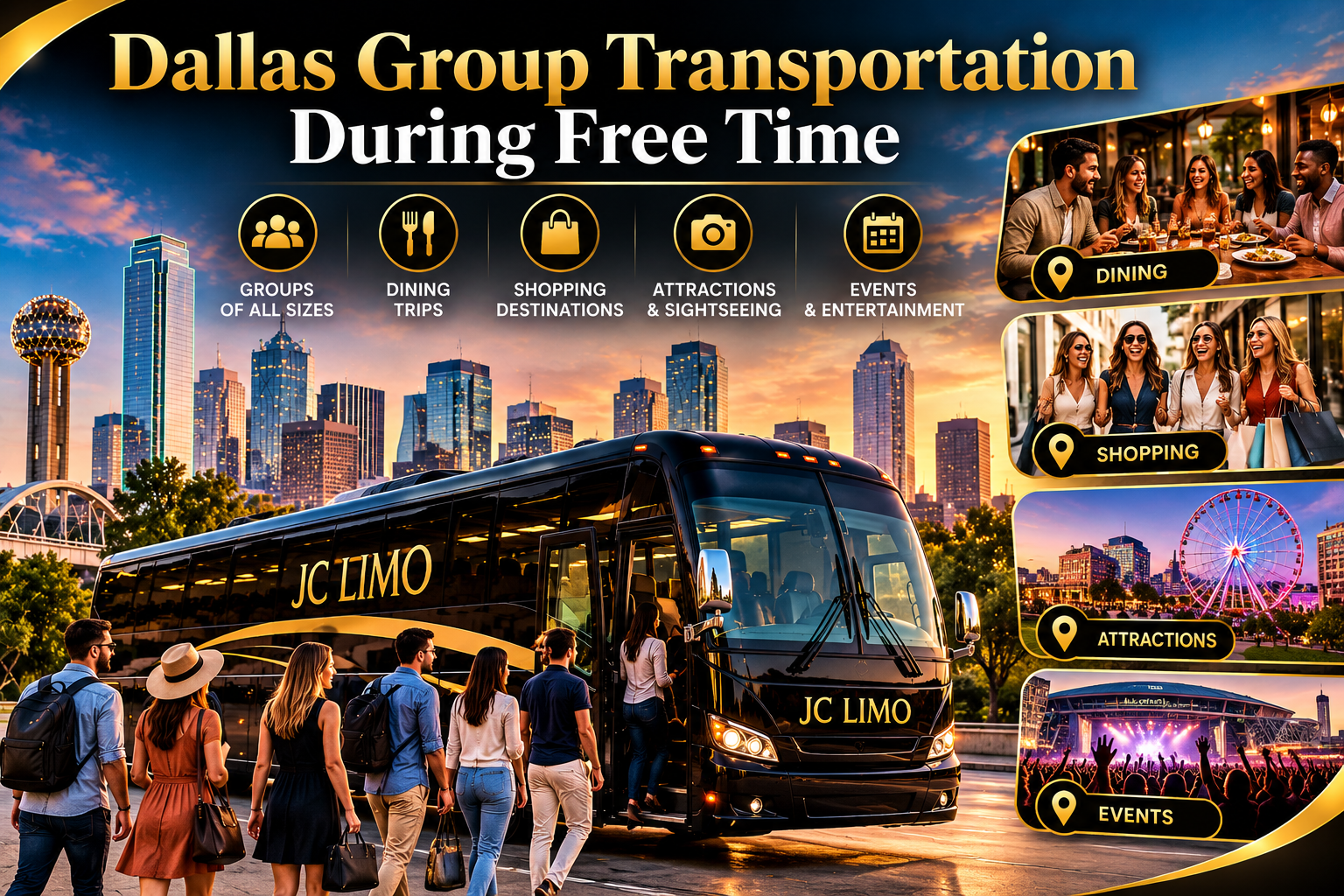
Not every hour of a group trip needs to be scheduled.
In fact, some of the best parts of visiting Dallas–Fort Worth happen during the time between meetings, conferences, tournaments, weddings, tours, and organized events.
A corporate team may have three hours before dinner. Conference attendees might have a free afternoon. A tour group could have an open evening before the next day’s activities. Wedding guests may want to explore Dallas while the wedding party is busy preparing for the ceremony.
Free time sounds easy.
From a transportation perspective, however, it can become surprisingly complicated.
Where should everyone go? Does the entire group need to stay together? How will people return to the hotel? What happens if different passengers want to visit different places? And how can organizers offer flexibility without spending the entire afternoon coordinating individual rides?
For groups traveling throughout Dallas, Fort Worth, and North Texas, a planned bus or shuttle transportation strategy can make free time genuinely feel free.
With JC LIMO transportation, organizers can connect hotels, dining areas, attractions, entertainment districts, shopping destinations, and event venues while still keeping the larger itinerary organized.
Free Time Still Needs a Transportation Plan
When a schedule says “free time from 2:00 to 6:00 p.m.,” it can look like there is nothing to organize.
For individual travelers, that may be true.
For a group, it is different.
Imagine 40 conference attendees staying at a Dallas hotel.
Their morning sessions finish at 1:00 p.m., and dinner begins at 7:00 p.m.
Some want to explore the city.
Others want lunch.
A few want to shop.
Another group wants to return to the hotel.
If everyone arranges transportation independently, the group quickly spreads across the area.
That is not necessarily a problem until everyone needs to be at dinner at the same time.
Now the organizer is trying to determine where people are, whether they have transportation, and whether they will arrive on schedule.
Planning transportation around free periods gives passengers flexibility without disconnecting them from the main itinerary.
Dallas–Fort Worth Gives Groups Plenty of Options
One reason free-time transportation matters in North Texas is simply the size of the area.
Dallas–Fort Worth offers many different areas for dining, shopping, entertainment, sightseeing, and group activities.
But those destinations are not necessarily within walking distance of a group’s hotel or event venue.
A visitor might see several interesting destinations online and assume they are relatively close because they are all described as being in the Dallas area.
In practice, travel between destinations can take time.
The Metroplex includes Dallas, Fort Worth, Arlington, Irving, Grapevine, Plano, Frisco, and many other communities, each with its own hotels, restaurants, attractions, business districts, and entertainment options.
Organized Dallas group transportation gives planners the ability to turn free time into a manageable part of the itinerary rather than leaving passengers to navigate a large unfamiliar region independently.
Create Optional Group Activities
Free time does not have to mean everyone goes completely separate ways.
One useful approach is offering optional transportation to a particular destination.
For example, a corporate group could finish its morning meeting and offer a shuttle from the hotel to a popular dining or shopping area.
Passengers who want to participate can use the transportation.
Those who prefer to relax at the hotel can stay behind.
The shuttle then returns at a scheduled time.
This creates flexibility without creating dozens of individual transportation plans.
The same approach can work for conferences, conventions, organized tours, school groups, family gatherings, and multi-day private events.
The important part is making the schedule clear.
Passengers should know where the bus is going, when it leaves, and when it returns.
Give People Enough Time to Enjoy the Stop
A common planning mistake is trying to fit too much into a short free period.
If a group has three hours available, that does not necessarily mean it has three hours at the destination.
Transportation time has to be included.
So does boarding.
If the destination is 30 minutes away, the actual available time is already reduced by an hour for the round trip.
Add the time needed to gather and board the group, and the free period becomes even shorter.
A good transportation plan starts by determining how much usable time passengers will actually have.
If the group would spend almost as much time traveling as enjoying the destination, another option may make more sense.
Free time should feel relaxed rather than rushed.
Dining Creates Its Own Transportation Challenges
Food is often the first thing groups want during an open period.
But moving a large group to lunch or dinner can be more complicated than it appears.
A restaurant may have limited space for bus loading.
Passengers may finish eating at different times.
The group may want to visit several nearby restaurants rather than one location.
A planned bus or shuttle service can help by establishing one central drop-off and pickup point when appropriate.
Passengers can explore dining options within the designated area and return to the meeting point at a specific time.
This gives travelers more choice while keeping transportation manageable.
For corporate groups, this can also create a more relaxed experience than requiring everyone to attend another organized meal.
Shopping Trips Work Well With Scheduled Shuttles
Shopping is another popular free-time activity for groups visiting Texas.
Instead of arranging individual rides, organizers can schedule a bus or shuttle to a shopping destination and provide a defined return time.
The concept is simple:
Hotel departure.
Shopping destination.
Free time.
Scheduled pickup.
Return to the hotel or continue to the next activity.
Passengers know exactly how much time they have.
Organizers know when the group will be back.
Transportation becomes part of the experience without controlling what people do once they arrive.
That balance between organization and independence is what makes scheduled free-time transportation useful.
Corporate Trips Need Time Away From the Meeting Room
Business travel can involve long days.
Employees may spend hours in conferences, workshops, presentations, training sessions, and client meetings.
When there is a free afternoon or evening, giving people an opportunity to leave the hotel or meeting venue can make the trip feel less repetitive.
A company could arrange transportation to a dining district, entertainment area, team activity, or other destination.
Participation can remain optional.
The company is simply removing one of the biggest barriers: figuring out transportation in an unfamiliar city.
With a scheduled JC LIMO shuttle, employees know when and where they can join the trip and how they will return.
That creates structure without turning free time into another mandatory corporate activity.
Conference Attendees May Not Know Dallas
Large conferences often bring visitors from across the United States and beyond.
Many attendees may be visiting Dallas for the first time.
Give them four free hours and they may spend the first 30 minutes searching online for what to do, another 20 minutes comparing transportation options, and additional time figuring out how far destinations are from the hotel.
Organizers can simplify the experience by providing optional transportation recommendations or scheduled group shuttles.
Instead of asking visitors to understand Dallas geography immediately, the event can create a simple transportation opportunity.
For example, attendees could receive instructions such as:
The shuttle departs the conference hotel at 2:30 p.m.
Passengers have free time at the destination.
The return shuttle departs at 5:30 p.m.
Now the traveler can focus on enjoying the city rather than coordinating the logistics.
Wedding Weekends Have Plenty of Unscheduled Time
Wedding transportation usually focuses on the ceremony and reception.
But out-of-town guests often arrive well before those events.
They may have an entire morning, afternoon, or even day available.
This is especially common with destination-style wedding weekends where guests arrive in Dallas or Fort Worth from different states.
The couple does not need to organize every minute of their guests’ stay.
However, optional transportation can make the weekend easier.
A shuttle could connect the main hotel with a selected entertainment or dining area.
Family members could have transportation for a group lunch.
Guests could visit a local attraction before returning to prepare for the ceremony.
These small transportation arrangements can make the overall wedding experience feel more organized without creating an overly strict schedule.
Don’t Turn Free Time Into Another Tour
There is an important distinction between supporting free time and controlling it.
If every minute has a required stop, it is no longer free time.
Groups usually appreciate having options.
Transportation can provide the framework.
Passengers provide the individual experience.
A bus might drop everyone in an area with several restaurants, shops, or attractions instead of requiring the entire group to follow one activity.
Then the only fixed part is the return time.
This gives people freedom while maintaining enough structure to keep the rest of the itinerary on schedule.
Set One Clear Pickup Location
The return trip is often where free-time transportation becomes difficult.
Passengers spread out.
Some lose track of time.
Others are unsure where the bus is waiting.
A clear meeting point solves many of these problems.
The location should be easy to identify and communicate.
Passengers should receive the pickup time before leaving the bus.
For larger groups, reminding everyone to arrive several minutes before departure can also help.
The simpler the instructions, the easier the group is to manage.
Avoid changing the pickup location unless necessary.
Travelers should not have to search through multiple messages to determine where their transportation will be.
Allow Time Between Free Time and Important Events
Free time should not end five minutes before an important activity begins.
If a group has dinner reservations, a meeting, a game, a performance, or another scheduled event later in the day, transportation should include a reasonable buffer.
Passengers may need to return to the hotel and change clothes.
Traffic conditions could increase travel time.
Someone may be slightly late returning to the bus.
Building extra time between the optional activity and the next important commitment protects the main itinerary.
For example, if an evening event starts at 7:00 p.m., bringing everyone back from a free-time activity at 6:45 creates unnecessary pressure.
A more comfortable schedule gives passengers time to transition.
Consider Separate Transportation for Smaller Groups
Sometimes the entire group will not want the same activity.
A large corporate group could have one set of employees interested in shopping while another group wants to visit a different destination.
Depending on passenger numbers and the overall itinerary, separate shuttle transportation may be more practical than forcing everyone into one activity.
The same can apply to tour groups and private events.
The key is avoiding unnecessary complexity.
If dividing the group creates too many routes and pickup times, one central destination may still be easier.
Transportation planning is about finding the right balance between passenger choice and operational simplicity.
Use Free Time to Connect Two Scheduled Activities
Free-time transportation can become even more efficient when the optional destination fits naturally between two required activities.
Imagine a group finishing a morning event in Fort Worth but needing to be in another part of the Metroplex later that evening.
Instead of returning to the hotel immediately, the itinerary could include a convenient free-time destination along the broader route.
The group enjoys a break.
Transportation avoids unnecessary backtracking.
And everyone continues to the next activity afterward.
This type of planning requires looking at the entire day rather than treating each trip separately.
Keep Luggage and Personal Belongings in Mind
Free-time activities sometimes happen on arrival or departure days.
That means passengers may have luggage with them.
A group that checks out of its hotel at 11:00 a.m. but does not leave Dallas until the evening may want to use those hours rather than sitting at the hotel.
Transportation planning should account for what happens to the group’s belongings during that period.
Organizers should discuss luggage requirements when arranging the transportation so the day’s plan reflects the actual needs of the passengers.
The same applies to corporate equipment, sports gear, shopping bags, and other items the group may carry.
Free Time Should Make the Trip Better, Not Harder
An open afternoon can be one of the most enjoyable parts of a group trip.
It gives people time to explore.
Eat somewhere new.
Shop.
See Dallas or Fort Worth.
Spend time with colleagues, friends, or family without another formal activity.
But the experience becomes less enjoyable when everyone is constantly checking ride availability, navigating unfamiliar roads, or worrying about getting back in time.
That is where organized transportation adds value.
With JC LIMO bus and shuttle transportation, groups can build flexible periods into their Dallas–Fort Worth itinerary while maintaining a clear connection to the next scheduled activity.
The transportation plan provides structure.
The passengers decide how to enjoy the time.
Make More of Your Group’s Time in Dallas–Fort Worth
A successful group itinerary is not measured by how many activities can be packed into one day.
Sometimes the unscheduled hours matter just as much.
The goal is to give passengers enough freedom to enjoy them without creating transportation problems later.
Identify where the group might want to go.
Calculate realistic travel time.
Set clear departure and return schedules.
Choose simple pickup locations.
Leave enough buffer before the next event.
And make sure everyone understands the plan.
For corporate teams, conference attendees, wedding guests, tour groups, families, and other groups traveling throughout Dallas, Fort Worth, and North Texas, JC LIMO can provide bus and shuttle transportation that connects both the scheduled and unscheduled parts of the trip.

Related posts
 13Oct, 26
Dallas Group Transportation With Luggage and Equipment
 13Oct, 26
Dallas Group Transportation With Multiple Drop-Offs
 13Oct, 26
- October 13, 2026
- 0
- 10
