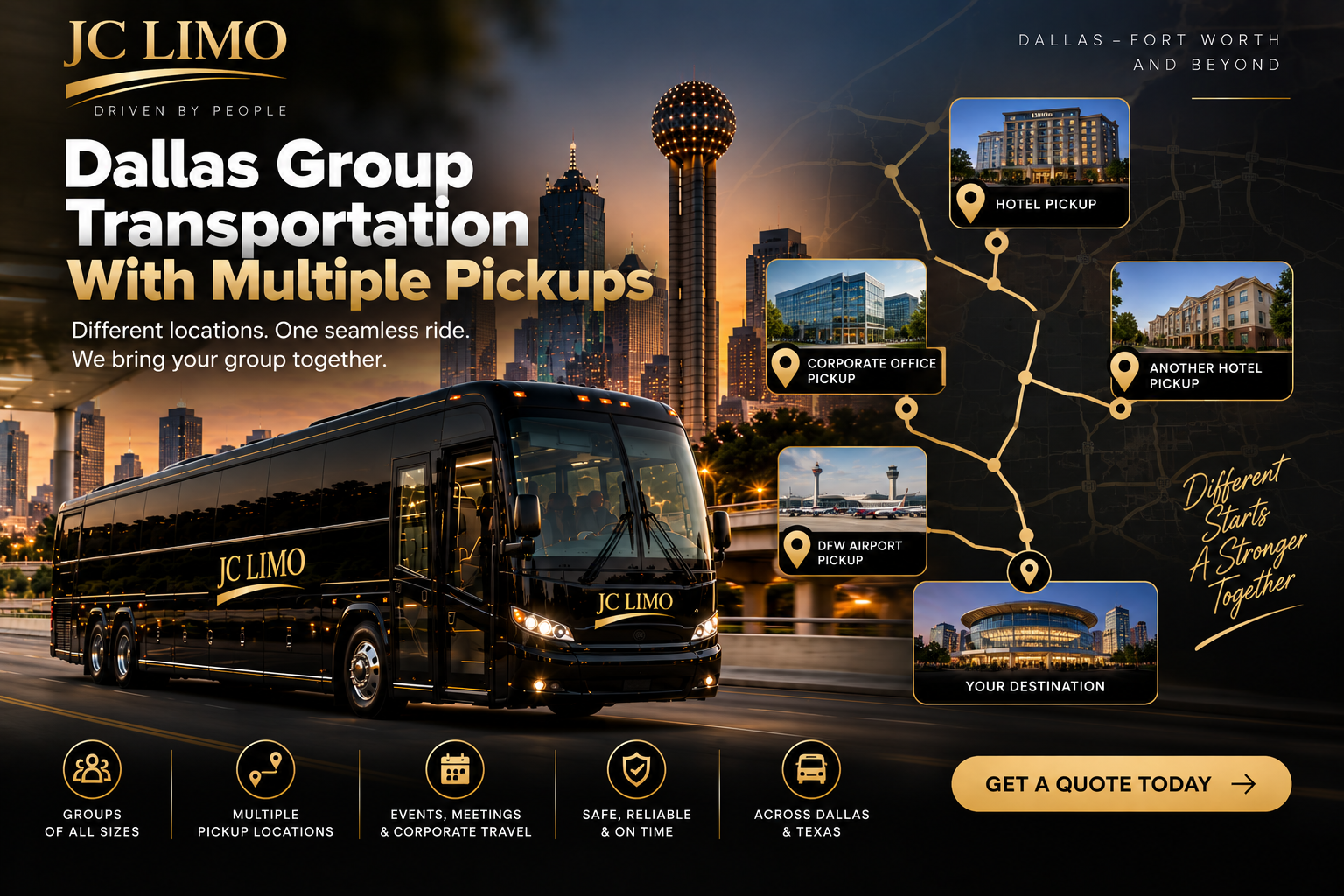
Getting one group from one location to one destination is usually straightforward.
Getting the same group together when everyone starts in a different place is where transportation planning becomes more interesting.
Some passengers may be staying at a hotel in Dallas. Others could be meeting at an office in Plano. A few may be coming from another hotel. Employees could be gathering at designated pickup points before a company event. Wedding guests may be spread across several properties. Conference attendees might need transportation from different locations to the same venue.
The destination is shared.
The starting point is not.
For these trips, simply booking a bus is not enough. The route, pickup order, passenger count at each location, boarding time, and final arrival all need to work together.
With a carefully planned JC LIMO bus or shuttle, groups can connect multiple pickup locations across Dallas–Fort Worth without turning the beginning of the trip into a logistical headache.
Why Multiple Pickup Locations Change the Plan
Consider a corporate event for 50 employees.
If all 50 people are waiting at the same Dallas office, transportation is relatively simple.
One pickup.
One boarding period.
One departure.
One destination.
Now imagine those 50 employees are divided between three locations.
Twenty are at an office.
Fifteen are at a hotel.
Fifteen are meeting at another designated location.
The total group size has not changed.
The transportation plan has.
Every additional pickup affects timing.
The bus has to reach the location, passengers need to board, and the vehicle then continues to the next stop.
That means organizers should plan multiple pickups as part of one complete route rather than treating each stop independently.
Start With a Passenger List by Location
Before deciding the route, understand where people actually are.
Create a simple list.
For example:
Hotel A — 18 passengers
Hotel B — 12 passengers
Dallas office — 20 passengers
Total — 50 passengers
This gives the transportation plan a foundation.
Without passenger counts by location, organizers may know the total group size but still have difficulty determining how the shuttle should operate.
Passenger distribution can also affect vehicle planning.
One pickup location may have most of the group while another has only a few people.
That matters when deciding whether one bus should visit every location or whether a different arrangement would make more sense.
Not Every Pickup Point Needs Its Own Stop
When people are spread across Dallas–Fort Worth, it can be tempting to make transportation as personalized as possible.
Pick up five passengers here.
Three there.
Seven somewhere else.
That may sound convenient for individuals, but it can create an inefficient route for the entire group.
Every stop adds time.
If several passengers are staying near each other, it may be better to establish one central meeting point.
Instead of four hotel pickups in the same general area, passengers might gather at one designated hotel.
Instead of several employee stops, the group may use one central pickup location.
The right solution depends on the itinerary, but fewer well-planned stops can often create a smoother group transportation experience.
Choose Pickup Locations That Work for a Bus
A convenient passenger location is not automatically a practical bus pickup point.
The location should be easy for passengers to find, but it should also be appropriate for the transportation plan.
Hotels may have designated entrances.
Corporate campuses may have specific loading areas.
Event venues may use dedicated transportation zones.
When establishing pickup locations, avoid vague instructions such as:
“Meet somewhere outside the hotel.”
Instead, give passengers a specific point.
For example:
Pickup: Main hotel entrance
or
Pickup: Designated group transportation area
Clear locations help passengers and organizers stay on the same page.
Decide the Pickup Order Carefully
The order of stops can have a significant effect on the journey.
Imagine a group with passengers in Dallas, Irving, and Arlington heading to an event.
The bus should not necessarily visit the locations in the order the organizer wrote them on a spreadsheet.
The route should consider geography, timing, passenger needs, and the final destination.
An inefficient sequence can create unnecessary backtracking.
For longer multi-stop routes, transportation planning should consider how the locations connect as a complete journey.
The goal is not simply to reach every pickup.
It is to reach every pickup while keeping the group on schedule.
Work Backward From the Final Arrival
Just as with a single pickup, multiple-stop transportation should be built around the required arrival time.
Suppose the group must arrive at an event by 6:30 PM.
The last pickup cannot happen at 6:25 PM simply because the venue is nearby.
You need to account for:
Travel between stops.
Boarding at each location.
Possible delays.
Traffic.
Final travel to the destination.
Unloading.
A sample schedule could look like:
4:45 PM — Pickup 1
5:15 PM — Pickup 2
5:45 PM — Pickup 3
6:20 PM — Target venue arrival
The actual times depend on the route, but the principle is important.
Start with the final requirement and build backward.
Give Each Pickup Its Own Meeting Time
If a bus is scheduled to reach a hotel at 5:00 PM, passengers should not begin walking downstairs at 5:00.
They should already be gathered.
A clear schedule might say:
Meet in lobby: 4:45 PM
Bus pickup: 5:00 PM
This creates a boarding window and reduces the chance that the entire route is delayed because passengers at one stop were not ready.
With multiple pickups, a delay at the first location can affect everyone waiting at the second and third.
That is why punctual boarding becomes even more important.
One Late Stop Can Affect the Entire Route
Multiple pickup schedules operate like connected pieces.
If Pickup 1 runs 15 minutes late, Pickup 2 may also be 15 minutes late.
That delay then reaches Pickup 3.
By the time the group reaches the destination, a small issue at the beginning may have become a significant schedule problem.
Organizers can reduce this risk by giving passengers clear instructions.
Meet before the bus arrives.
Have bags ready.
Complete hotel checkout in advance when possible.
Know the pickup point.
Keep the transportation coordinator informed.
Simple preparation at every stop protects the larger itinerary.
Hotels Are Natural Pickup Hubs
Hotels are often useful meeting points for visiting groups.
Wedding guests, corporate travelers, conference attendees, and tour groups may already be concentrated at several hotels.
Instead of asking visitors to find transportation individually, a hotel shuttle can collect passengers according to a planned route.
For example:
Hotel A.
Hotel B.
Event venue.
Or, if the hotels are far apart, separate transportation may make more sense.
The best approach depends on the number of passengers and geography.
What matters is that guests receive clear instructions before the transportation day.
Corporate Groups May Begin From Several Offices
Businesses can face a similar challenge.
A company may have employees working from several locations around Dallas–Fort Worth.
For a company event, conference, training session, or corporate celebration, employees may need to converge at one destination.
A corporate shuttle can connect designated pickup points.
This can be easier than asking every employee to drive independently, particularly when the destination has limited parking or the company wants everyone to arrive within the same window.
It also creates a shared travel experience before the event begins.
Employee Transportation Can Use Centralized Pickup Points
Recurring employee transportation often benefits from simplicity.
If a company is transporting workers to a facility, project, or work site, trying to pick up every employee individually may not be practical.
Instead, the company can establish centralized meeting locations.
Employees travel to the designated pickup.
The shuttle follows a predictable route.
This can make recurring transportation easier to understand and manage.
The exact setup depends on the workplace, shift, passenger count, and route, but consistency is valuable.
When employees know where and when the bus arrives, transportation becomes part of the routine.
Wedding Guests May Be Spread Across Several Hotels
Large weddings often have guests staying at more than one hotel.
That creates a question for the couple or event planner:
Should the shuttle visit every hotel?
Sometimes yes.
Sometimes a central hotel is easier.
The answer depends on hotel locations, guest counts, ceremony timing, and vehicle requirements.
Whatever arrangement is chosen, communicate it clearly.
Guests should know:
Which hotel has transportation.
When they need to meet.
When the bus leaves.
Whether return transportation is available.
Which return shuttle they should use.
The easier the instructions are, the easier the experience will be for guests.
Airport Arrivals Can Create Temporary Pickup Groups
Multiple pickups are not always physical locations.
Sometimes they are different arrival windows.
A company may have employees landing at DFW Airport throughout the afternoon.
Instead of arranging transportation independently for every traveler, passengers arriving within similar windows may be grouped when appropriate.
This requires flight information.
Arrival time.
Airline.
Airport.
Luggage expectations.
Passengers should also understand the meeting instructions.
Airport transportation can become much easier when the organizer knows who is arriving and when.
Luggage Changes Multiple-Pickup Transportation
If several pickup locations involve travelers with luggage, boarding may take longer.
Imagine a bus visiting three hotels to collect out-of-town guests.
At each stop, passengers bring suitcases.
That means each pickup requires more than simply opening the door.
Passengers need to gather.
Belongings need to be ready.
The group needs to board.
When arranging JC LIMO transportation, tell the transportation team when passengers will have luggage or equipment.
This helps ensure the plan considers the complete trip rather than only the number of people.
Dallas–Fort Worth Distances Matter
The Metroplex is large.
Dallas, Fort Worth, Arlington, Irving, Plano, Frisco, Grapevine, and other North Texas communities can all appear in the same group itinerary.
But adding a pickup in another part of the Metroplex can significantly change the route.
Organizers should avoid assuming that every additional stop is “just a few minutes away.”
Look at the complete geography.
If one pickup is far from the others, it may be worth considering whether that passenger group should use a separate transportation arrangement.
The most efficient solution is not always the one with the fewest buses.
Sometimes separating routes creates a better overall experience.
When One Bus Makes Sense
One bus can work well when pickup locations form a logical route.
For example:
Hotel A.
Nearby Hotel B.
Venue.
Passengers board progressively, and the vehicle continues toward the final destination.
This can be simple and efficient.
It also gives the group one shared transportation plan.
JC LIMO offers options including 31-passenger minibuses and 56-passenger motor coaches, allowing organizers to consider transportation according to passenger count, route, luggage, and itinerary requirements.
When Multiple Shuttles May Make More Sense
One vehicle is not always the best solution.
Imagine half the group is staying in Fort Worth and the other half is in Dallas, while everyone needs to attend an event in Arlington.
Sending one bus across the Metroplex simply to collect everyone could create unnecessary travel.
Separate transportation routes may sometimes provide a more practical option.
Both groups can leave from their respective locations and meet at the destination.
The decision should be based on the route and schedule rather than assuming every passenger must board the same vehicle from the beginning.
Multi-Day Trips Can Use Different Pickup Strategies
A group does not have to use the same transportation structure every day.
Day one may involve airport pickups.
Day two may begin from one hotel.
Day three could include several business locations.
Day four might be a single long-distance Texas trip.
The transportation plan should adapt to the itinerary.
For a multi-day corporate program or tour, create a daily transportation schedule rather than trying to force every day into the same format.
This keeps the plan practical.
Return Transportation Needs Just as Much Planning
The group may start from three locations but return to two.
Or everyone may return to one hotel.
Some passengers may leave an event early.
Others stay until the end.
Return transportation should be planned at the same time as the initial pickups.
For example:
Return Shuttle 1 — Hotel A
Return Shuttle 2 — Hotel B + Hotel C
Or:
One return bus with multiple hotel drop-offs
The right arrangement depends on the group.
Passengers should know their return plan before the event begins.
Drop-Off Order Matters Too
At the end of a long day, passengers generally want to reach their destination without unnecessary delays.
If the bus has several hotel drop-offs, consider the route.
A poor drop-off order can send passengers across Dallas–Fort Worth and then back again.
Just as with pickup planning, the sequence should reflect geography and practicality.
For late-night transportation, keeping the return route straightforward becomes especially valuable.
Appoint One Transportation Coordinator
Multiple pickup locations create more communication points.
A single transportation coordinator can help keep everything organized.
That person can confirm:
Passenger counts.
Pickup locations.
Schedule.
Missing passengers.
Changes.
Hotel contacts.
Return transportation.
Instead of passengers contacting different people, information flows through one central point.
For a large corporate group, wedding, conference, or private event, this can dramatically simplify communication.
Create a Passenger List for Every Stop
A basic passenger list can be extremely useful.
For example:
Hotel A
18 passengers.
Coordinator: Sarah.
Hotel B
12 passengers.
Coordinator: Michael.
Office
20 passengers.
Coordinator: David.
Now the main organizer knows who should be at each location.
If Hotel B has only 10 people waiting, it is easier to determine whether two passengers are missing.
This is far more efficient than trying to count the entire group only after everyone has boarded.
Send the Schedule the Day Before
Passengers should not discover their pickup details at the last minute.
Send a simple transportation schedule before the trip.
Include:
Pickup location.
Meeting time.
Departure time.
Destination.
Coordinator contact.
Return transportation details.
For multi-stop trips, passengers only need the information relevant to their pickup plus any general group instructions.
Avoid overwhelming them with unnecessary route details.
Send a Reminder Before Departure
A short reminder can prevent delays.
For example:
JC LIMO pickup tomorrow: Meet at the hotel main entrance by 7:15 AM. Bus departs at 7:30 AM. Please have all luggage ready.
That message answers the most important questions.
Where?
When?
What should I bring?
Simple communication works.
Allow for Traffic Without Overcomplicating the Day
Dallas–Fort Worth traffic conditions can vary according to time, location, events, construction, and other factors.
With multiple pickups, the route already has more variables than a direct trip.
Reasonable buffers can help protect the schedule.
This is particularly important when the final destination has a fixed arrival time, such as:
Airport.
Wedding ceremony.
Conference.
Corporate presentation.
Concert.
Sporting event.
The goal is not to arrive excessively early.
It is to avoid building a plan that only works if every part of the journey goes perfectly.
24/7 Dispatch Can Support Complex Schedules
Multiple pickup transportation may happen early in the morning or late at night.
Airport groups may need pre-dawn departures.
Events may end after normal business hours.
Employees may travel around shift schedules.
JC LIMO provides 24/7 dispatch, supporting transportation needs across different times and itineraries.
For groups with more complicated schedules, communication becomes an important part of keeping the transportation plan organized.
Make Several Starting Points Feel Like One Group
Multiple pickup locations do not have to create a fragmented travel experience.
With the right plan, passengers can begin in different places and still arrive as one organized group.
Know where everyone is.
Choose practical meeting points.
Plan the pickup order.
Build the schedule backward.
Give passengers time to board.
Keep communication simple.
Plan the return journey.
And make sure the route reflects the actual geography of Dallas–Fort Worth.
Connect Your Dallas Group With JC LIMO
Whether passengers are gathering from multiple hotels, corporate offices, designated employee locations, airports, or other points across North Texas, JC LIMO can provide professional bus and shuttle transportation built around the group’s itinerary.

Related posts
 13Oct, 26
Dallas Group Transportation With Luggage and Equipment
 13Oct, 26
Dallas Group Transportation With Multiple Drop-Offs
 13Oct, 26
- October 13, 2026
- 0
- 10
