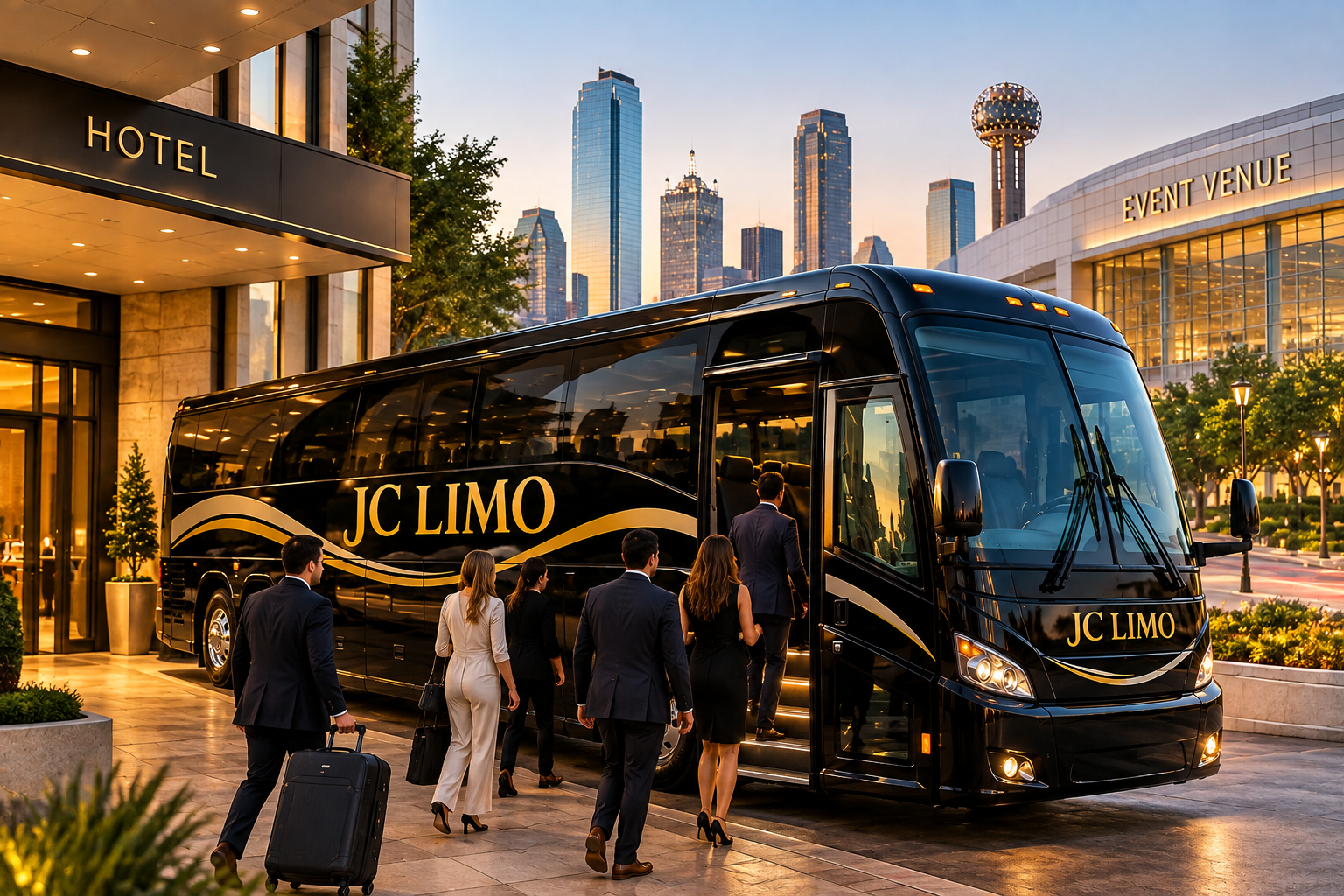
When a large group travels to an event, getting everyone to the destination is only part of the challenge.
The real question is whether everyone will arrive together and on time.
A group may be staying at a hotel in Dallas while attending a conference, wedding, corporate event, sporting event, convention, dinner, or private gathering somewhere else in the Dallas–Fort Worth area.
On paper, the plan seems simple.
Leave the hotel. Travel to the venue. Attend the event. Return afterward.
But once 20, 30, 40, or more passengers are involved, that simple transfer can become one of the most complicated parts of the schedule.
Some people leave early. Others wait until the last minute. Several passengers use rideshare services. A few rent cars. Someone gets stuck looking for parking. Another person goes to the wrong entrance.
Before the event begins, the group is already scattered.
A dedicated bus or shuttle transportation plan can make the experience much easier.
With JC LIMO, groups traveling throughout Dallas, Fort Worth, and surrounding Texas communities can coordinate transportation between hotels and venues around one shared schedule.
Instead of asking every passenger to solve transportation individually, the group can travel together.
Why Hotel-to-Venue Transportation Needs Planning
When people travel individually, transportation is usually a personal responsibility.
Group travel is different.
If you are organizing a corporate meeting for 50 employees, you probably want those employees at the venue before the meeting begins.
If you are coordinating wedding guests, you do not want half of them searching for parking while the ceremony starts.
If a sports team has a scheduled game, players and coaches need to arrive with enough time to prepare.
That makes transportation part of the event itself.
The organizer needs to think about several things:
Where will passengers meet?
When should boarding begin?
How long will the journey realistically take?
Where can the bus load and unload passengers?
What happens after the event?
Will everyone return to the same hotel?
Answering those questions early creates a more organized transportation experience.
Turn the Hotel Into a Central Meeting Point
Hotels are naturally useful pickup locations for visiting groups.
Most passengers already know how to get back to their hotel. They have their belongings there. The lobby also provides a convenient place for people to gather before departure.
For this reason, a hotel can become the transportation hub for the entire trip.
Instead of telling 40 people to meet directly at an unfamiliar venue somewhere in Dallas or Fort Worth, organizers can give them a much simpler instruction:
Meet in the hotel lobby at 7:30 a.m.
The shuttle or bus can then depart according to the planned schedule.
This approach removes many individual decisions.
Passengers do not need to choose routes.
They do not need to find parking.
They do not need to arrange separate rides.
They simply meet at the agreed location and travel with the group.
For visitors unfamiliar with North Texas, this can be particularly helpful.
Boarding Time Is Not Departure Time
One small scheduling mistake causes a surprising number of transportation delays.
If the bus needs to leave at 8:00 a.m., telling everyone to meet at 8:00 a.m. probably means the bus will not actually depart at 8:00.
Passengers need time to leave their rooms, come downstairs, check that they have everything, find the pickup point, load belongings, and board.
The larger the group, the more time this can take.
A better plan separates the meeting time, boarding time, and departure time.
For example, passengers might be asked to meet downstairs at 7:30 a.m., begin boarding shortly afterward, and be ready for an 8:00 a.m. departure.
That creates a buffer for minor delays without immediately affecting the event schedule.
Professional group transportation is not only about the time spent driving.
It includes everything required to move the group from one place to another efficiently.
Corporate Meetings and Conferences
Dallas–Fort Worth hosts business travelers throughout the year.
Companies may bring employees, executives, partners, customers, or guests into Texas for conferences, meetings, training programs, exhibitions, company retreats, and other professional events.
Often, attendees stay at one or several hotels away from the main venue.
That creates a daily transportation requirement.
If everyone is expected to arrange individual rides each morning, arrival times can vary significantly.
Some attendees may arrive early.
Others may encounter traffic.
Someone may have difficulty finding the correct building entrance.
Another employee may arrive late because a ride was unavailable when needed.
A dedicated corporate shuttle creates a more predictable process.
Attendees meet at the hotel.
They board together.
The bus travels to the meeting or event location.
At the end of the program, passengers know where to meet for the return trip.
This can be repeated throughout a multi-day conference.
Instead of transportation becoming a new question every morning, it becomes a familiar part of the schedule.
Wedding Transportation From Hotels to Venues
Weddings create a different type of transportation challenge.
Guests may be arriving from different cities or states. Some know Dallas well, while others may never have visited Texas before.
The ceremony and reception might also be held at locations away from the hotel.
Without group transportation, guests need to determine how to reach each destination themselves.
For a small wedding, that may be manageable.
For a larger wedding, it can create unnecessary complications.
A hotel shuttle arrangement gives guests a central place to meet before traveling to the ceremony or reception.
Afterward, transportation can bring them back to the hotel according to the event schedule.
This can be especially convenient for out-of-town guests who do not have vehicles in Dallas.
It also makes the experience easier for the hosts.
Instead of answering transportation questions throughout the day, organizers can communicate a clear shuttle schedule in advance.
Transportation for Sports Groups
Teams frequently stay at hotels during tournaments, competitions, training programs, and other sporting events.
Their transportation requirements are often more complicated than those of ordinary travelers.
Players may have equipment bags.
Coaches may carry additional supplies.
The group may need to travel to several venues during the same day.
There may also be strict arrival requirements before games or competitions begin.
Using separate vehicles introduces additional variables.
Players could arrive at different times. Equipment might be separated from the people who need it. Drivers may take different routes.
A dedicated bus keeps the transportation plan centralized.
Players, coaches, staff, and equipment can travel under the same schedule.
For teams visiting Dallas and Fort Worth, this can make moving between hotels, practice facilities, stadiums, fields, arenas, and other locations easier to coordinate.
Conventions and Trade Shows
Large conventions and trade shows can create particularly busy transportation periods.
A group may need to travel from its hotel to a convention center early in the morning and return late in the afternoon.
There may also be evening dinners, networking events, or private functions.
If attendees are traveling independently, the company or organization may have little control over when people arrive.
A planned shuttle schedule creates structure.
For example, one bus might leave the hotel at a specific time in the morning.
Depending on the group and itinerary, additional transportation can be arranged around different schedules.
At the end of the event, passengers can meet at a designated pickup point for the return journey.
The important thing is clarity.
People should know exactly where transportation will be and when they need to be there.
What if Your Group Is Staying at Multiple Hotels?
Not every event group fits neatly into one hotel.
Large weddings, conferences, conventions, and corporate programs may use several properties.
That makes transportation more complex, but it can still be organized effectively.
One option is to establish separate pickup times for each hotel.
The route might begin at Hotel A, continue to Hotel B, collect the remaining passengers at Hotel C, and then proceed to the venue.
The order should make geographic sense.
Otherwise, the bus could spend unnecessary time traveling back and forth across Dallas.
Another option for larger groups is to use more than one vehicle when appropriate.
The best approach depends on the number of passengers, hotel locations, destination, schedule, and overall itinerary.
The important point is to design transportation around the real group rather than trying to force every itinerary into the same structure.
Consider the Venue Before the Trip
Transportation planning should include more than the hotel.
The destination matters just as much.
Where can a large vehicle safely unload passengers?
Is there a designated bus entrance?
Will the group need to walk from the drop-off point?
Is the pickup location after the event different from the drop-off location?
These questions may sound minor, but they become important when dozens of people are moving at once.
Imagine arriving at a large venue with 50 passengers and only then trying to determine which entrance the group should use.
That confusion can easily delay the schedule.
Planning the arrival point beforehand creates a smoother transition between transportation and the event.
The same principle applies to the return trip.
Passengers should know exactly where to meet the JC LIMO shuttle or bus after the event.
Choosing the Right Vehicle
The number of passengers is obviously important when choosing transportation, but it is not the only consideration.
A group of 30 business travelers carrying small personal bags may have different requirements from 30 athletes carrying equipment.
A wedding group may have different transportation needs from conference attendees.
Consider:
Total number of passengers
Luggage requirements
Equipment or event materials
Number of hotel pickups
Distance to the venue
Duration of the trip
Number of scheduled transfers
Return transportation requirements
JC LIMO provides different bus and shuttle options for groups traveling around Dallas and Fort Worth.
Choosing transportation according to the actual itinerary helps make the trip more practical for passengers and organizers.
Don’t Forget the Return Journey
Getting everyone to an event is usually the first concern.
Getting everyone back is sometimes treated as an afterthought.
That can be a mistake.
After a long conference, wedding, tournament, concert, or corporate event, passengers may be tired and ready to return to their hotel.
They should not have to begin organizing transportation at that point.
The return trip should already be part of the plan.
Tell passengers where the bus will meet them.
Give them a departure time.
If there are multiple return times, communicate them clearly.
For events where different passengers may leave at different times, transportation can be planned around those requirements in advance.
A complete transportation plan covers both directions.
Give Passengers Clear Instructions
Even the best transportation plan can become confusing if nobody knows what it is.
Communication should be simple and specific.
Before the event, passengers should receive the hotel pickup location, meeting time, departure time, destination, and expected return information.
Avoid vague instructions such as:
“The bus will be outside in the morning.”
Instead, provide a specific location and time.
For example:
“Please meet in the main hotel lobby by 7:30 a.m. for the 8:00 a.m. departure.”
That gives passengers something concrete to follow.
If the hotel has several entrances, specify which entrance will be used.
If the pickup location changes after the event, make sure everyone knows before they leave the bus.
A few clear instructions can prevent dozens of questions later.
Reduce the Need for Individual Parking
Parking is another reason hotel-to-venue transportation can be useful.
When 30 passengers drive separately, the group may require many parking spaces.
Those vehicles may not even end up in the same parking area.
Passengers then need to walk from different locations and find the correct entrance.
When the event finishes, the process happens again in reverse.
A group bus or shuttle reduces the number of individual vehicles involved.
Passengers can be dropped at an appropriate location and collected again after the event.
This can simplify the experience, particularly when the destination is busy or unfamiliar.
Instead of thinking about parking, passengers can focus on the event they came to attend.
Make Multi-Day Transportation Consistent
For groups staying in Dallas or Fort Worth for several days, consistency can make transportation much easier.
If passengers use the same hotel meeting point each morning, they quickly learn the routine.
They know where to wait.
They understand when boarding begins.
They know what time the bus leaves.
This becomes especially valuable during conferences, corporate programs, tournaments, and multi-day events.
Rather than sending entirely new transportation instructions every day, organizers can build a predictable schedule.
Changes can still be communicated when necessary, but the overall process remains familiar.
That reduces confusion for passengers and administrative work for organizers.
Group Transportation Is Part of the Guest Experience
Transportation is sometimes treated as a background service.
For passengers, however, it can be a significant part of the trip.
If transportation is confusing, late, or poorly coordinated, that frustration can affect how people feel about the entire event.
When transportation is organized, passengers can focus on the experience itself.
Corporate guests can think about the meeting.
Wedding guests can enjoy the celebration.
Athletes can focus on competition.
Conference attendees can focus on sessions and networking.
Transportation should support the schedule rather than become another problem the group needs to solve.
That is why hotel-to-venue planning deserves attention before passengers arrive in Texas.
Plan Dallas Fort Worth Transportation With JC LIMO
Whether you are organizing a corporate conference, wedding, tournament, convention, private event, business meeting, or group gathering, moving passengers between their hotel and venue should be simple.
JC LIMO provides professional group transportation throughout Dallas, Fort Worth, and surrounding Texas areas, with bus and shuttle options designed for different group sizes and itineraries.
Coordinate your pickup times, keep passengers together, plan the return journey, and make transportation part of the event schedule from the beginning.
Instead of asking dozens of people to find their own way across DFW, give the entire group one organized transportation plan.

Related posts
 13Oct, 26
Dallas Group Transportation With Luggage and Equipment
 13Oct, 26
Dallas Group Transportation With Multiple Drop-Offs
 13Oct, 26
- October 13, 2026
- 0
- 10
