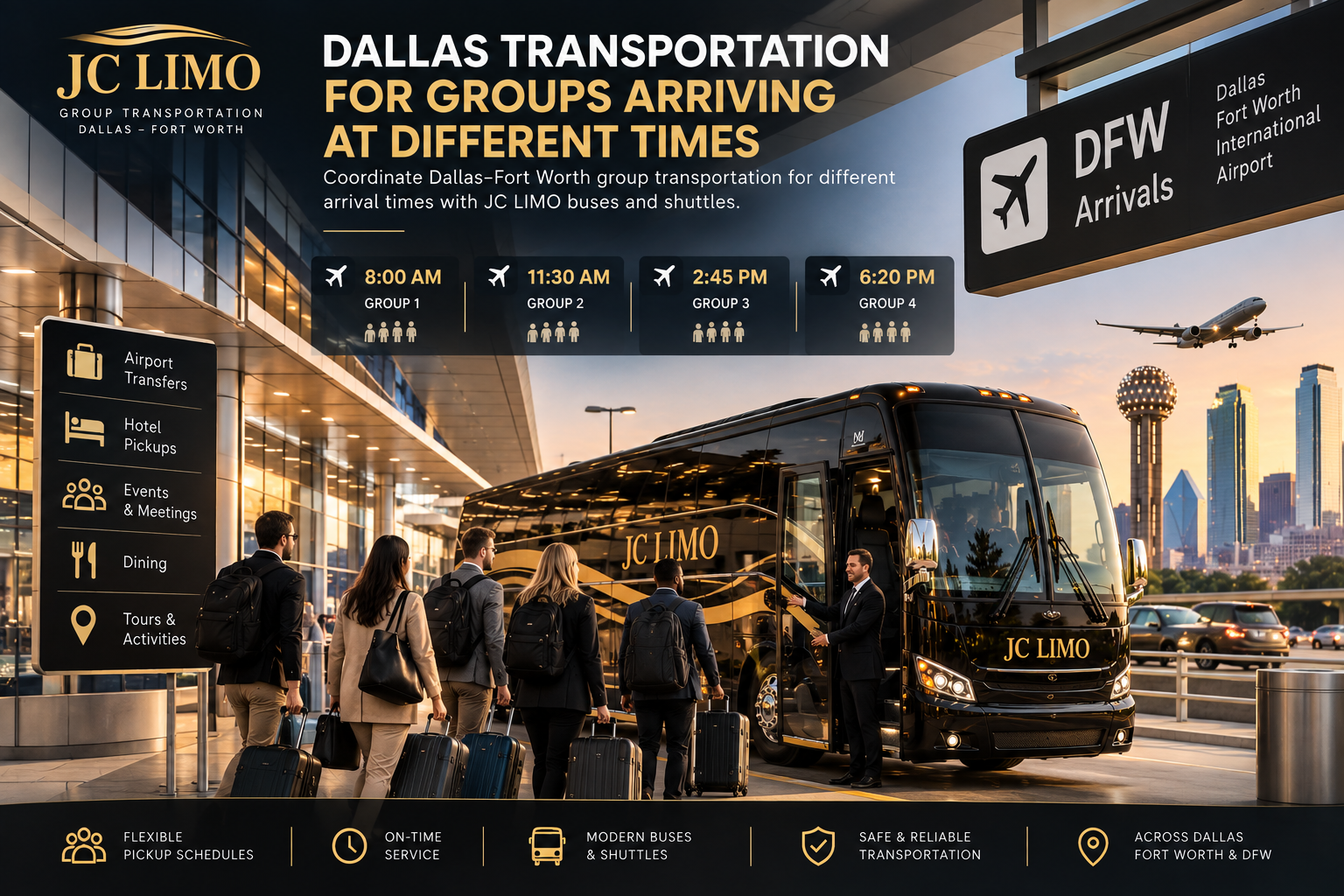
Getting a group around Dallas–Fort Worth is one challenge. Getting everyone together when they arrive at completely different times is another.
One passenger lands in Dallas in the morning. Another group arrives around lunchtime. Several people are driving into Texas from another city. The final travelers may not reach their hotel until evening.
Yet everyone is expected to be together for a meeting, conference, wedding, dinner, tour, or event.
This situation is common for large groups.
Corporate travelers may fly from offices around the country. Wedding guests often arrive throughout the weekend. Conference attendees book different flights. Family members travel from different states. International visitors may have connections that put them into Dallas hours apart.
Trying to make everyone follow one airport pickup time rarely works.
Instead, the transportation plan needs to be built around how people are actually arriving.
With professional Dallas group transportation, organizers can coordinate airport transfers, hotel movements, event transportation, and scheduled bus and shuttle service without expecting every passenger to follow the same arrival schedule.
For groups traveling throughout Dallas, Fort Worth, and North Texas, JC LIMO can help turn scattered arrivals into one organized itinerary.
Why Group Arrivals Rarely Happen at the Same Time
It would be convenient if 40 passengers could all arrive on the same flight.
Most group travel does not work that way.
Passengers may be traveling from:
- Different cities
- Different states
- International destinations
- Separate corporate offices
- Different airports
- Different airline schedules
Even passengers departing from the same city may choose different flights because of price, availability, personal schedules, or airline preferences.
That means a group listed as “arriving Friday” could actually arrive over a 10-hour period.
Transportation planning should reflect that reality.
Rather than thinking about one arrival, organizers should think about arrival windows.
Build an Arrival List Before Planning Transportation
The first step is understanding when everyone is expected.
Create a simple passenger arrival list.
For each traveler or group, record the expected arrival time and relevant transportation needs.
For example:
Group A — 9:30 AM — 12 passengers
Group B — 11:15 AM — 8 passengers
Group C — 2:45 PM — 18 passengers
Group D — 6:30 PM — 10 passengers
Immediately, the transportation challenge becomes easier to see.
Instead of arranging individual transportation for 48 people, the organizer may be able to group passengers into several practical pickup windows.
That can create a much more manageable Dallas airport transportation plan.
Group Passengers Into Arrival Windows
If two groups are arriving within a reasonable period, it may make sense to coordinate them into the same transportation window.
For example, passengers arriving at 10:00 AM and 10:30 AM may be able to travel together.
Passengers arriving at 10:00 AM and 3:00 PM probably should not.
The goal is to balance efficiency with passenger experience.
Saving one bus trip is not particularly useful if the first group has to wait at the airport for several hours.
Organizers should consider:
flight arrival times, baggage collection, group size, luggage, hotel check-in, scheduled activities, and how long passengers would realistically need to wait.
A good transportation plan is not simply about minimizing the number of trips.
It is about moving people efficiently without creating unnecessary inconvenience.
Allow Time for Baggage Collection
A flight arrival time is not the same as a passenger pickup time.
If a flight is scheduled to land at 2:00 PM, passengers will not necessarily be ready to board transportation at 2:05 PM.
They may need time to:
exit the aircraft,
walk through the terminal,
collect checked luggage,
meet the rest of their group,
and reach the designated transportation area.
International travelers may require additional time.
This should be considered when building a bus or shuttle pickup schedule in Dallas.
Scheduling transportation too tightly can create unnecessary pressure before the trip has even begun.
Flight Delays Are Part of Airport Transportation
Flights do not always arrive according to schedule.
Weather, aircraft issues, airport congestion, connections, and operational changes can all affect arrival times.
For a group organizer, one delayed flight can create a difficult question:
Does everyone else wait?
The answer depends on the size of the delayed group and the rest of the itinerary.
If three passengers are delayed while 35 others have already arrived, keeping the entire group waiting may not make sense.
If half of the group is on the delayed flight, the transportation plan may need to be reconsidered.
This is why airport transportation works better when there is some flexibility built into the schedule.
A good plan should anticipate that not every flight will operate exactly as expected.
Use the Hotel as the Main Group Hub
For many trips, the easiest way to manage staggered arrivals is to make the hotel the central meeting point.
Passengers can arrive in different transportation groups throughout the day.
Once they reach the hotel, they become part of the main group.
This creates a simple structure:
Airport → Hotel → Group Activity
Instead of trying to assemble everyone at the airport, travelers can gradually gather at the hotel.
When it is time for the first major group activity, a JC LIMO bus can collect everyone from one location.
This works especially well when the first scheduled event is later in the day or the following morning.
What If Hotel Rooms Aren’t Ready?
Early arrivals introduce another challenge.
Hotel check-in may not be available yet.
If passengers arrive in Dallas at 9:00 AM but rooms are not ready until the afternoon, the group needs a plan.
Depending on the hotel and itinerary, luggage may be stored while travelers have lunch, attend an activity, or spend time nearby.
For larger groups, transportation can also be incorporated into the plan.
Rather than leaving passengers without direction for several hours, organizers can create an early-arrival itinerary.
This might include:
a group lunch,
a sightseeing activity,
an informal meeting,
or another planned stop.
The shuttle or bus can then return passengers to the hotel later.
Corporate Groups Often Arrive From Several Offices
Corporate travel is one of the clearest examples of staggered group arrivals.
A company may be bringing employees to Dallas from New York, Chicago, Los Angeles, Atlanta, Boston, or other cities.
Everyone is attending the same conference or meeting, but they are not necessarily traveling together.
Without centralized planning, every employee may independently arrange transportation from the airport.
That can create dozens of separate expenses and arrival experiences.
Coordinated corporate transportation in Dallas provides an alternative.
Passengers arriving during similar windows can be grouped together for scheduled transfers.
Once everyone reaches the hotel, the company can transition to a standard group transportation schedule for meetings, dinners, conferences, and other activities.
Wedding Weekends Have Similar Challenges
Wedding guests rarely arrive at the same time.
Some come the day before.
Others arrive on the morning of the wedding.
Family members may arrive earlier in the week.
The wedding party may have a completely different schedule.
Transportation should therefore be organized around the actual wedding weekend rather than one universal arrival.
For example:
Thursday could involve transportation for the wedding party.
Friday could include selected airport transfers and transportation to a welcome dinner.
Saturday could focus on hotel-to-ceremony and reception shuttle service.
Sunday might include return transportation or a group brunch.
This creates a complete transportation program rather than treating each movement as an unrelated trip.
Conferences Can Create Arrival Waves
Large conferences naturally create waves of travelers.
Some attendees arrive the evening before.
Others arrive early on the opening day.
Exhibitors may arrive even earlier for setup.
Executives might fly in only for specific meetings.
When a company sends a large team to a Dallas conference, understanding these arrival patterns can help simplify transportation.
Instead of arranging rides one passenger at a time, planners can identify the largest arrival windows and build transfers around them.
The result is a more structured experience from the beginning.
Don’t Forget Dallas Love Field
Not every traveler arriving in Dallas uses the same airport.
Depending on flights and travel plans, group members may arrive through different airports.
That creates another layer of planning.
An organizer should know not only when passengers arrive, but where.
If some passengers are arriving at one airport while others are arriving elsewhere, they should not automatically be placed on the same pickup schedule.
Transportation routes need to reflect the actual arrival locations.
For large groups, this may require separate vehicles or different pickup windows.
Account for Luggage When Choosing the Bus
Airport transportation is different from moving a group between a hotel and a restaurant.
Every passenger may have luggage.
A group of 40 people could easily have 40 large suitcases plus carry-on bags.
That space requirement needs to be considered when choosing a vehicle.
Passenger capacity alone does not tell the full story.
Organizers should communicate expected luggage requirements when planning bus transportation in Dallas.
This becomes even more important for sports groups, production crews, corporate teams with equipment, and travelers staying in Texas for extended periods.
Plan Transportation for Early Arrivals
Passengers arriving early should know what they are expected to do.
Are they traveling directly to the hotel?
Will they meet another group at the airport?
Is there an activity before check-in?
Are they responsible for lunch?
When will the main group gather?
Giving early arrivals clear instructions reduces uncertainty.
It also prevents organizers from receiving the same questions repeatedly throughout the day.
A simple schedule can make a big difference.
Give Late Arrivals a Clear Plan Too
Late travelers need just as much information.
If the group has already left for dinner when several passengers reach Dallas, what happens next?
Do they travel directly to the restaurant?
Do they go to the hotel and join the group later?
Will another shuttle collect them?
These questions should ideally be answered before the trip.
Late-arrival transportation can be built into the broader schedule so passengers are not trying to make last-minute arrangements after landing.
Some Groups Arrive by Road Instead of Air
Not everyone traveling to Dallas–Fort Worth arrives by plane.
Texas is large, and groups may drive from cities throughout the state or neighboring regions.
Others may arrive by train or another form of transportation.
For large events, the overall group might include a combination of:
air travelers,
local Dallas participants,
people driving from elsewhere in Texas,
and passengers arriving from Fort Worth or surrounding communities.
The organizer’s goal is not necessarily to control every person’s journey into Dallas.
The goal is to establish the point where everyone joins the official group transportation plan.
For many trips, that point is the hotel.
For others, it may be the event venue.
Different Arrivals Can Still Lead to One Group Experience
Staggered arrivals do not have to make the trip feel disorganized.
The key is establishing when individual travel ends and the shared itinerary begins.
Once passengers are together, the group can use one bus or shuttle for the rest of the schedule.
That may include transportation to:
business meetings,
restaurants,
conferences,
sporting events,
weddings,
private events,
Fort Worth attractions,
shopping destinations,
and other locations throughout North Texas.
From that point forward, passengers travel together.
Fort Worth May Be the Final Destination
Some passengers arriving in Dallas are not actually staying in Dallas.
Their final destination may be Fort Worth, Texas.
For a large group, arranging a coordinated transfer can be easier than asking every passenger to find separate transportation west.
This is particularly relevant for conferences, weddings, tours, business events, and group trips taking place primarily in Fort Worth.
Passengers can be collected according to the planned arrival structure and transported to the group’s Fort Worth accommodation or destination.
From there, the same vehicle or transportation program can support the rest of the itinerary.
Departure Day Needs the Same Level of Planning
Arrival transportation gets plenty of attention.
Departure transportation should receive just as much.
If passengers arrived on different flights, they will probably leave at different times too.
A single airport departure may not work.
Instead, organizers can create departure groups based on flight times.
For example:
Departure Group A — Early morning flights
Departure Group B — Midday flights
Departure Group C — Afternoon flights
The pickup schedule can then be planned backward from the required airport arrival times.
Passengers should know exactly when their JC LIMO transportation leaves the hotel.
Don’t Cut Airport Departure Times Too Close
Group airport transportation should include reasonable time for unexpected delays.
Traffic happens.
Loading dozens of suitcases takes time.
Someone may come down from their hotel room late.
Large groups can take longer to move through an airport than individual travelers.
A transportation plan that leaves no margin for error can create unnecessary stress.
It is generally better to build a realistic buffer into the schedule than to depend on every stage going perfectly.
Communication Is the Most Important Part
Even a well-designed transportation plan can fail if passengers do not understand it.
Every traveler should receive clear instructions before arriving in Texas.
The information might include:
- Assigned arrival group
- Airport meeting instructions
- Approximate pickup window
- Hotel destination
- Main group meeting time
- Emergency or organizer contact
- Departure-day transportation schedule
Keep the instructions simple.
Passengers do not need every logistical detail behind the plan.
They need to know what they personally need to do.
One Transportation Plan Can Simplify a Complicated Arrival Day
Forty passengers arriving on ten different flights sounds complicated.
It does not have to mean 40 separate transportation arrangements.
By grouping similar arrival times, identifying clear meeting points, accounting for luggage, using hotels as central hubs, and planning for delays, organizers can create a much simpler structure.
Once passengers arrive and settle in, the entire group can transition into one coordinated transportation schedule.
That is when the trip begins to feel organized.
Bring Everyone Together With JC LIMO
Group travel does not always begin with everyone standing in the same place.
Sometimes the group comes together gradually.
Passengers arrive on different flights.
Some land early.
Others arrive late.
A few may be driving into Dallas.
Several may be staying in different locations.
Professional transportation helps connect those separate journeys.
JC LIMO provides bus and shuttle transportation for groups throughout Dallas, Fort Worth, Texas, and the wider DFW area, helping organizations coordinate airports, hotels, meetings, conferences, weddings, events, tours, and other group travel needs.
The key is planning around the real arrival pattern rather than expecting every traveler to follow the same schedule.
Group similar arrival times.
Allow enough time for luggage.
Prepare for flight delays.
Create clear hotel meeting points.
Plan separately for early and late arrivals.
And organize departure transportation with the same care.

Related posts
 13Oct, 26
Dallas Group Transportation With Luggage and Equipment
 13Oct, 26
Dallas Group Transportation With Multiple Drop-Offs
 13Oct, 26
- October 13, 2026
- 0
- 10
