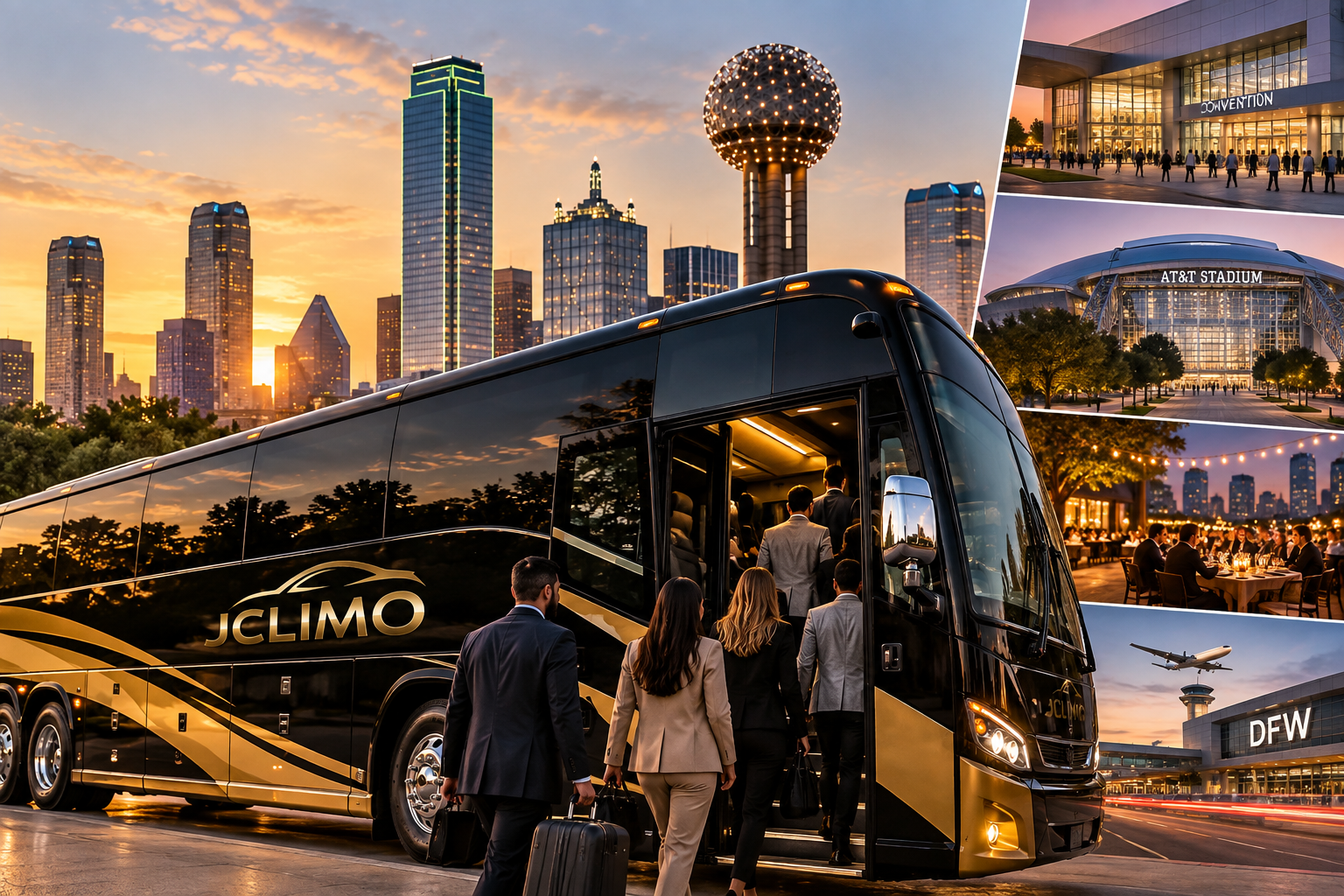
A group trip to Dallas rarely revolves around just one destination.
A corporate team might attend a morning conference, visit a client in the afternoon, and finish the day with dinner. A family could travel to a graduation ceremony before heading to a restaurant and then a celebration. A sports group may have practices, games, meals, and hotel transfers scheduled across several days.
Every additional activity adds another transportation requirement.
For individuals, moving between destinations may be relatively simple. For groups, however, transportation needs to work as one connected part of the trip.
People need to know where to meet, when to leave, which destination comes next, and how they are getting there. When everyone starts arranging separate rides, even a carefully planned schedule can become difficult to manage.
JC LIMO provides group transportation throughout Dallas, Fort Worth, and surrounding Texas communities using buses and shuttles that can be planned around multi-event trips.
Instead of treating every journey as a separate transportation problem, groups can create a travel plan that connects the entire experience.
When One Trip Includes Several Events
Consider a company bringing employees to Dallas for a three-day program.
Day one includes airport arrivals and a welcome dinner.
Day two includes a conference, lunch, an office visit, and an evening event.
Day three includes a final meeting before everyone returns to the airport.
Transportation affects nearly every part of that schedule.
The group needs to travel between hotels, business locations, restaurants, event venues, and airports—sometimes several times within the same day.
Without a transportation plan, the organizer may spend much of the trip coordinating individual rides.
Who has already left?
Which car is going to the restaurant?
Has everyone arrived at the venue?
Who is still waiting at the hotel?
Where should everyone meet afterward?
Those questions can quickly distract from the actual purpose of the trip.
Organized bus or shuttle transportation creates a clearer structure.
The group knows where transportation begins, where it is going, and when everyone needs to be ready.
Keep the Group Connected Throughout the Day
Group transportation is about more than moving people from Point A to Point B.
It can also help keep the group connected.
When people travel in separate vehicles, the group begins to split apart. Some passengers arrive early. Others get delayed. Someone enters the wrong destination. Another person decides to make an additional stop.
This might not matter for a casual afternoon.
It matters much more when the next activity begins at a specific time.
With a bus or shuttle, passengers can leave together and arrive as a group.
That can be particularly helpful for corporate programs, weddings, conferences, school trips, family events, sports groups, church organizations, and other trips where several people need to follow the same schedule.
Dallas and Fort Worth Offer Plenty to Fit Into One Trip
Dallas–Fort Worth is a large metropolitan area with business districts, entertainment destinations, stadiums, restaurants, hotels, convention venues, universities, and attractions spread throughout the region.
A group staying in Dallas may have activities in Arlington or Fort Worth.
Visitors staying near DFW Airport might need to travel to Irving, Plano, Frisco, downtown Dallas, or another North Texas destination.
That means a trip that appears geographically simple can involve significant time on the road.
For multi-event groups, transportation should therefore be planned at the same time as the activities.
It is not enough to know that dinner begins at 7:00 p.m.
The organizer also needs to know when the previous event finishes, how long boarding may take, how far the restaurant is from the venue, and how much time should be allowed for travel.
A well-planned transportation schedule connects those details.
Corporate Trips With Multiple Activities
Corporate travel often includes some of the busiest group itineraries.
Companies may bring teams to Dallas for conferences, training programs, client meetings, product launches, company offsites, exhibitions, or internal events.
A typical business itinerary could include:
Hotel pickup
Conference transportation
Lunch
Office visit
Client meeting
Team-building activity
Dinner
Hotel return
The next day could begin again with another early departure.
When employees arrange individual transportation for every movement, travel can become fragmented.
Some people may drive rental cars. Others use rideshare services. Some travel with colleagues.
The company then has multiple arrival times to manage.
Using a JC LIMO bus or shuttle gives the group a shared transportation arrangement.
Employees can meet at an established pickup point and travel together to the next activity.
For visitors who do not know Dallas or Fort Worth well, this also removes the need to repeatedly navigate unfamiliar roads and destinations.
Conference Transportation Beyond the Convention Center
A conference trip rarely begins and ends at the convention center.
Attendees may also participate in networking dinners, private meetings, company receptions, exhibitions, entertainment, or team activities.
That creates additional transportation needs.
A company could schedule a morning shuttle from its hotel to the conference.
After the final session, employees might board again for dinner.
Later that evening, transportation can return the group to the hotel.
The next morning, the schedule begins again.
Thinking about conference transportation as a complete program rather than one transfer can make the experience easier for attendees and organizers.
The same approach works for trade shows, industry exhibitions, training events, and other professional gatherings across Dallas–Fort Worth.
Transportation for Wedding Weekends
Weddings are another example of events that often include several destinations.
The wedding itself may be only one part of the weekend.
Guests could attend a welcome gathering, rehearsal dinner, ceremony, reception, after-party, and farewell brunch.
Hotels may also be located away from the wedding venue.
For out-of-town guests, arranging transportation for each activity can be challenging.
A shuttle schedule can create clear connections between major locations.
Guests know where to meet.
They know when transportation leaves.
They do not need to individually navigate unfamiliar parts of Dallas or Fort Worth.
For the couple and wedding planners, organized group transportation can also reduce the number of individual transportation questions that need to be answered throughout the weekend.
Sports Groups Moving Between Activities
Sports trips often involve highly structured schedules.
A team may travel from a hotel to practice, return for a break, travel to a game, go to dinner, and then head back to the hotel.
Tournament weekends can involve even more movement.
Transportation needs to account for athletes, coaches, staff, and sometimes equipment or luggage.
When several activities are scheduled close together, keeping everyone on the same transportation plan can help the group move more efficiently.
Bus transportation can also make longer Texas trips easier when teams need to travel beyond Dallas–Fort Worth for competitions or events.
Instead of organizing several vehicles, the team can travel together according to one schedule.
Family Celebrations With More Than One Destination
Not every multi-event trip is a business or organizational event.
Family gatherings can create equally complex transportation schedules.
A graduation weekend might include a ceremony, family photos, dinner, and a private celebration.
A reunion could include hotel pickups, sightseeing, lunch, an afternoon activity, and an evening event.
Birthday celebrations and milestone events may involve several venues throughout Dallas.
When a large family travels together, separate cars can create unnecessary complications.
Some relatives may not know the area.
Others may have different vehicles or parking arrangements.
Using a bus or shuttle allows the group to spend more of the experience together while reducing the need to coordinate individual transportation between every activity.
Airport Transportation Can Be Part of the Program
For groups arriving from outside Texas, the trip often starts at the airport.
DFW International Airport may be the first transportation point in a much larger itinerary.
Passengers could travel from the airport to a hotel before attending a welcome event later that day.
At the end of the trip, transportation may need to return everyone to the airport.
When flights and event schedules are part of the same plan, airport transportation should be considered alongside the rest of the itinerary.
Organizers should think about arrival times, luggage, passenger numbers, hotel check-in, and the timing of the first activity.
The return trip deserves the same attention.
If a group has a final meeting before heading to the airport, enough time should be included for the transfer and airport procedures.
Different Days Can Require Different Transportation Plans
A multi-day trip does not necessarily need the same transportation schedule every day.
One day might require a simple hotel-to-event transfer.
Another could involve five different locations.
The next day may consist mainly of airport departures.
That is why transportation planning should reflect the actual itinerary.
For example:
Day One: Airport → Hotel → Welcome Dinner → Hotel
Day Two: Hotel → Conference → Restaurant → Corporate Event → Hotel
Day Three: Hotel → Meeting → Lunch → Entertainment Venue → Hotel
Day Four: Hotel → DFW Airport
Looking at the trip this way helps organizers understand when buses or shuttles are needed and how transportation fits between activities.
Build Realistic Travel Time Into Every Event
One of the easiest mistakes in a busy itinerary is scheduling activities too close together.
If an event ends at 4:00 p.m., that does not mean the group will be on the road at exactly 4:00.
People need time to leave the venue, walk to the pickup location, board the vehicle, and get settled.
Then the group still needs to travel to the next destination.
Dallas traffic can also affect timing.
Rush hour, construction, sporting events, concerts, conventions, and other major activities can influence travel conditions.
That is why organizers should avoid building schedules around ideal travel times.
Allowing realistic transportation windows creates breathing room between events and reduces the pressure caused by small delays.
Establish Clear Pickup Points
Multi-event transportation becomes easier when everyone knows exactly where to meet.
“Outside the venue” can mean several different places at a large hotel, convention center, stadium, or event complex.
A specific pickup point is much clearer.
Before the trip, organizers should communicate:
Where passengers should meet
What time boarding begins
What time the bus leaves
Where the group is going next
Who passengers should contact if needed
Clear instructions become especially important when the itinerary includes several events.
Passengers should not have to guess where their transportation will be after every activity.
Think About What the Group Is Carrying
Passenger count is important, but it is not the only factor when planning transportation.
Groups may also travel with:
Suitcases
Conference materials
Sports equipment
Event supplies
Presentation equipment
Personal bags
The amount of luggage or equipment can affect transportation needs.
A group arriving from DFW Airport may have significantly more belongings than the same group traveling from a hotel to dinner.
These details should be considered when arranging the bus or shuttle.
Transportation should fit the practical needs of the trip, not simply the number of people traveling.
What If an Event Runs Late?
Multi-event trips rarely operate with perfect timing.
A conference session could run longer than planned.
A game could go into overtime.
Dinner service might take longer.
A meeting could end early.
An event schedule could change.
Building some flexibility into the transportation plan helps groups respond to these situations.
Communication is particularly important.
When the organizer has a central transportation arrangement, changes can be managed more clearly than when passengers are traveling through numerous independent rides.
The more complicated the itinerary becomes, the more valuable that central coordination can be.
Make the Ride Part of the Group Experience
Transportation does not have to feel like dead time between activities.
For many groups, traveling together is part of the experience.
Employees can discuss the day.
Family members can spend time together.
Event attendees can relax before the next activity.
Visitors can see more of Dallas and North Texas while traveling between destinations.
Instead of separating everyone into different vehicles after every event, a bus or shuttle keeps the group connected between experiences.
For a trip with several activities, those moments can become part of what makes the entire program feel organized and cohesive.
Plan Your Multi-Event Transportation With JC LIMO
A busy Dallas trip can include conferences, dinners, meetings, celebrations, attractions, sporting events, airport transfers, and several other activities.
Every event has its own schedule.
Transportation is what connects them.
JC LIMO provides buses and shuttles for groups traveling throughout Dallas, Fort Worth, and surrounding Texas areas.
Whether your group is attending multiple events in one day or following a multi-day itinerary across North Texas, planning transportation in advance can help keep passengers together and the schedule organized.

Related posts
 13Oct, 26
Dallas Group Transportation With Luggage and Equipment
 13Oct, 26
Dallas Group Transportation With Multiple Drop-Offs
 13Oct, 26
- October 13, 2026
- 0
- 10
