A group shuttle can make transportation look effortless.
Passengers walk outside, the bus arrives, everyone boards, and the group moves to the next destination.
Behind that simple experience, however, is a schedule that needs to work.
A shuttle arriving ten minutes too late can affect a meeting. A departure scheduled too early may leave passengers behind. A route with too many stops can make a short journey unnecessarily long. And when dozens—or hundreds—of passengers are involved, small scheduling problems can quickly become bigger ones.
That is why successful group transportation in Dallas–Fort Worth begins before the first passenger boards.
Whether you are planning transportation for a corporate event, hotel, conference, employee team, wedding, airport group, private event, or multi-day program, the shuttle schedule should reflect how people will actually move.
With a clear itinerary and professional transportation support from JC LIMO, organizers can create a shuttle plan that is easier for passengers to understand and easier to manage throughout the day.
Start With the People, Not the Bus
One of the easiest planning mistakes is beginning with the vehicle.
“How many buses do we need?”
That question matters, but it should not necessarily be the first one.
Start with the passengers.
How many people need transportation?
Where are they coming from?
Do they all need to arrive at the same time?
Will everyone leave together?
Are passengers staying at one hotel or several?
Does the number of passengers change throughout the day?
Once those details are clear, it becomes much easier to determine how the bus or shuttle transportation should operate.
A 50-person group traveling from one hotel to one venue has a different transportation need from 50 people spread across three hotels.
The total passenger count may be identical.
The schedule is not.
Build the Schedule Backward From Arrival Time
A reliable shuttle schedule usually starts with one important question:
When does the group need to arrive?
Suppose a corporate conference begins at 9:00 AM.
The transportation schedule should not automatically say:
“Bus leaves hotel at 8:30 AM.”
Instead, work backward.
Perhaps passengers should be at the venue by 8:30 AM to register, find the meeting room, grab coffee, and settle in.
Then consider travel time.
After that, account for unloading.
Then boarding.
Then the passenger meeting time.
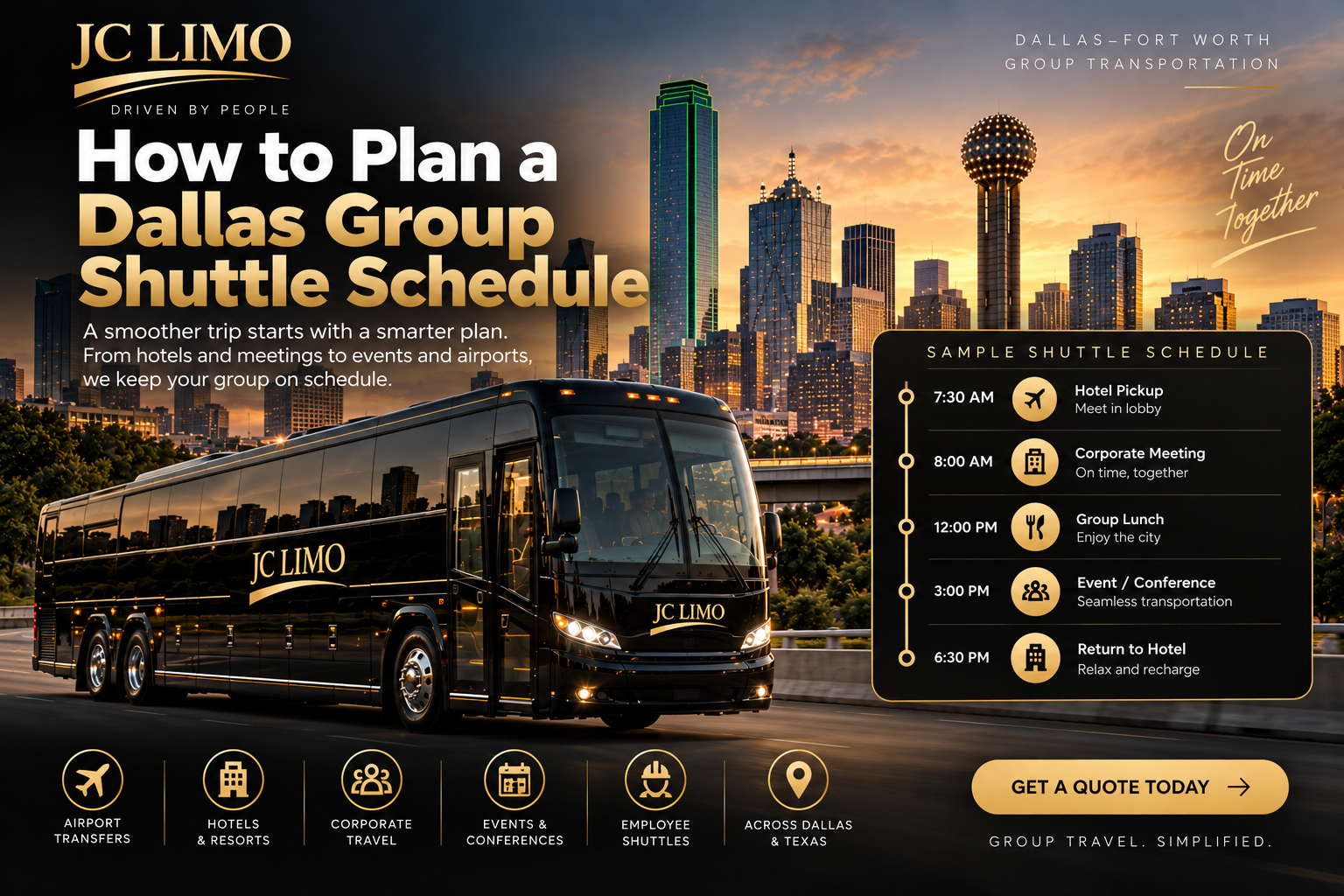
The final schedule may look more like:
7:40 AM — Passengers meet in hotel lobby
7:50 AM — Boarding begins
8:00 AM — Shuttle departs
8:30 AM — Target venue arrival
This gives the itinerary structure.
The goal is not simply to leave the hotel on time.
The goal is to have the group where it needs to be at the right time.
Boarding Time Is Part of Transportation Time
A common mistake in group transportation planning is treating departure time as the only time that matters.
If a bus is scheduled to leave at 8:00 AM, 40 passengers cannot all appear at 8:00 AM and expect the vehicle to instantly move.
People need time to walk from the hotel.
Find the bus.
Finish conversations.
Load bags.
Confirm that colleagues are present.
Board.
Get seated.
A practical Dallas shuttle schedule should include a boarding window.
The larger the group, the more important that becomes.
Instead of telling passengers only “Bus at 8:00,” tell them:
Meet at 7:45. Bus departs at 8:00.
That small difference can make the entire morning run more smoothly.
Choose Pickup Locations Carefully
The best pickup location is not always the location closest to the passengers.
It is the location where the group can realistically gather and board.
For a hotel group, the main entrance may work well.
For an office, a designated employee entrance may be better.
For an event, the venue may have a specific transportation area.
For recurring employee transportation, a centralized meeting location may be easier than several individual stops.
Pickup locations should be:
Easy to explain.
Easy for passengers to find.
Suitable for the vehicle.
Consistent whenever possible.
If passengers need a paragraph of instructions just to locate the bus, the pickup point may be too complicated.
Fewer Stops Can Create a Better Shuttle
Adding more stops can seem convenient.
Why not pick everyone up as close as possible?
Because every additional stop affects the route.
The bus has to reach the location.
Passengers need to board.
The vehicle needs to return to the route.
A five-minute stop can become longer once the entire process is considered.
Multiply that by four or five locations and the shuttle may spend a significant amount of time collecting passengers rather than moving toward the destination.
For some groups, several stops are necessary.
For others, asking passengers to meet at one or two central pickup locations creates a more efficient shuttle transportation plan.
One-Way Transportation and Shuttle Loops Are Different
Not every shuttle should operate the same way.
Sometimes the group simply needs one movement:
Hotel to event.
Office to venue.
Airport to hotel.
Hotel to dinner.
In other situations, passengers need transportation continuously over several hours.
That is where a shuttle loop may make more sense.
Imagine a conference with several hotels and a nearby venue.
Instead of one departure, transportation may operate according to scheduled windows.
Passengers have more than one opportunity to travel.
This can work particularly well when not everyone needs to arrive or leave at exactly the same time.
Create Shuttle Windows Passengers Can Remember
Complicated schedules create complicated questions.
If the bus leaves at 7:12, 7:47, 8:23, and 8:56, passengers are more likely to keep checking the schedule.
A consistent pattern can be easier to communicate when the itinerary allows it.
For example:
Departures every 30 minutes from 7:00 AM to 9:00 AM.
Or:
Hotel departures: 6:30 PM, 7:00 PM, 7:30 PM.
The exact schedule should always reflect the real transportation requirements, but simplicity has value.
Passengers should be able to understand when they can travel without studying a complicated timetable.
Multiple Hotels Need a Clear Strategy
Conferences, weddings, corporate programs, and large private events often involve guests staying at several hotels.
There are two common approaches.
The first is to have a bus stop at several hotels on the same route.
The second is to operate separate transportation from different locations.
Which approach makes sense depends on passenger numbers, hotel locations, timing, vehicle capacity, and the event schedule.
If the hotels are close and passenger numbers are manageable, one route may work.
If they are spread across Dallas–Fort Worth, combining every hotel into one shuttle could create a long journey.
The transportation plan should prioritize a practical passenger experience rather than simply reducing the number of routes.
Dallas–Fort Worth Geography Matters
Dallas and Fort Worth are part of the same Metroplex, but that does not mean every destination is close.
Groups may also need transportation to Arlington, Irving, Plano, Frisco, Grapevine, and other North Texas areas.
A shuttle schedule should be based on the actual route.
If a corporate group stays in one city and attends meetings in another, travel time becomes an important part of the itinerary.
Do not create the schedule based only on how close two locations appear when looking at a large map.
The Metroplex is extensive.
Your transportation plan should reflect that.
Traffic Buffers Should Be Intentional
A good schedule includes breathing room.
That does not mean adding an unnecessary hour to every trip.
It means understanding which arrival times cannot be missed and planning accordingly.
Airport departures require appropriate timing.
Corporate presentations may have fixed starts.
Wedding ceremonies will not wait for a shuttle full of guests.
Conference sessions begin according to the program.
Sporting events and concerts have scheduled start times.
For these journeys, the transportation schedule should account for realistic conditions rather than assuming everything will go perfectly.
Dallas–Fort Worth traffic, road work, weather, major events, and other conditions can affect travel.
A reasonable buffer protects the itinerary.
Plan the Return Trip at the Same Time
Organizers sometimes put most of their attention into getting passengers to the destination.
Then someone asks:
“How are we getting back?”
The return journey should be part of the original transportation plan.
For a corporate dinner, decide when the bus will depart.
For a wedding, determine whether there will be one return or several.
For a concert, identify the post-event pickup point.
For a conference, establish afternoon shuttle windows.
For an employee route, make sure the return aligns with shift completion.
Planning both directions creates a complete group transportation experience.
Events May Need More Than One Return Time
Not everyone leaves an event at the same moment.
At a wedding, some guests may want to return to the hotel earlier.
At a conference, attendees may finish at different times.
At a corporate function, one group may leave after dinner while another stays for networking.
In these cases, several return departures may be more practical than one.
For example:
First return: 9:30 PM
Second return: 10:30 PM
Final return: 11:30 PM
The right schedule depends on the event.
The important part is that passengers know their options before they need them.
Airport Shuttles Need Flight Information
Airport transportation should not be scheduled using only the number of passengers.
Flight times matter.
If 50 guests are leaving Dallas on the same day but their flights are spread from morning until evening, one airport transfer may not work.
Organizers should collect:
Airport.
Airline.
Flight departure time.
Passenger name or group.
Luggage requirements.
Passengers with similar departure windows can then be considered together when building the transportation plan.
The same principle applies to arrivals.
A well-organized airport shuttle schedule can help avoid sending a vehicle for every individual traveler while also avoiding excessive waiting.
Employee Shuttles Depend on Consistency
Employee transportation often works differently from event transportation because the schedule repeats.
If a shuttle moves workers from a hotel or designated pickup location to a work site, employees need predictable timing.
For example:
Morning pickup: 5:30 AM
Work site arrival: Before shift begins
Evening departure: After shift
The exact schedule may vary according to the operation, but consistency is important.
Employees should not have to ask every day when transportation is coming.
A recurring JC LIMO shuttle can become part of the normal routine.
Match Vehicle Capacity to Passenger Flow
JC LIMO offers transportation options including 31-passenger minibuses and 56-passenger motor coaches.
Vehicle capacity is important, but the largest available vehicle is not automatically the right answer.
Consider passenger flow.
Maybe 100 people need transportation, but they do not all need to travel simultaneously.
A scheduled shuttle system could move passengers in groups.
Another event may require everyone to arrive together, creating a different vehicle requirement.
Luggage also matters.
Airport travelers have different space needs from employees traveling between a parking area and workplace.
Vehicle planning and schedule planning should happen together.
Make the Schedule Easy to Read
Passengers should not receive a transportation document that looks like an airline operations manual.
Keep it clear.
For example:
Morning Transportation
7:30 AM — Meet in hotel lobby
7:45 AM — Bus departure
8:15 AM — Arrive at conference
Evening Transportation
6:00 PM — Meet at hotel entrance
6:15 PM — Depart for dinner
9:30 PM — Return shuttle #1
10:30 PM — Final return shuttle
This format tells passengers what they actually need to know.
Use One Transportation Contact
For large groups, designate one person as the main transportation coordinator.
This person can communicate with passengers and help keep the schedule organized.
If the meeting runs late, there is one person handling the update.
If several passengers are missing, there is one person checking.
If the event changes its pickup instructions, information can flow through one central contact.
Without a coordinator, transportation questions can become scattered among event planners, hotel staff, passengers, managers, and drivers.
Centralizing communication reduces confusion.
Send Reminders Before Important Departures
Even a perfect shuttle schedule only works if passengers remember it.
For important departures, send a reminder.
A morning message might say:
JC LIMO shuttle departs the hotel at 7:45 AM. Please meet in the lobby by 7:30 AM.
An event return message might say:
Final hotel shuttle leaves the designated pickup area at 11:00 PM. Please arrive by 10:50 PM.
Simple reminders can prevent unnecessary delays.
Have a Plan for Schedule Changes
Real itineraries change.
Meetings run longer.
Flights are delayed.
Events finish later.
A dinner reservation changes.
Weather affects the day.
A professional transportation plan should have enough flexibility to respond when circumstances change.
That does not mean every schedule can be changed instantly.
It means organizers should communicate updates as early as possible and maintain a clear line of communication.
JC LIMO’s 24/7 dispatch can be particularly valuable for groups whose transportation requirements extend into early mornings, evenings, or changing travel schedules.
Do Not Forget Passenger Experience
Efficiency is important, but the shuttle schedule should also make sense for the people using it.
A route that looks perfect on paper may not feel perfect if passengers spend excessive time waiting.
A schedule with too little boarding time may create stress.
A pickup point far from the hotel entrance may be inconvenient for guests with luggage.
Transportation is part of the overall experience.
For a conference attendee, it may be the first interaction of the morning.
For a wedding guest, it is part of the celebration.
For an employee, it may happen every day.
For an out-of-town visitor, it shapes how easy Dallas feels to navigate.
Good scheduling balances operational efficiency with passenger convenience.
A Better Schedule Creates a Better Group Trip
The best shuttle transportation often goes unnoticed.
Passengers know where to go.
The bus arrives.
Everyone boards.
The group reaches the destination.
Then transportation is ready when it is time to move again.
That simplicity comes from planning.
Start with passenger needs.
Work backward from arrival times.
Include boarding windows.
Choose practical pickup locations.
Keep routes efficient.
Add reasonable buffers.
Plan the return.
Communicate the schedule clearly.
And make sure transportation fits the real itinerary.
Build Your Dallas Shuttle Plan With JC LIMO
Whether you are coordinating a corporate program, conference, airport transfer, employee route, wedding, private event, hotel shuttle, or multi-stop itinerary, transportation works better when every movement has a clear purpose and schedule.
JC LIMO provides professional buses and shuttles for groups throughout Dallas, Fort Worth, the DFW Metroplex, North Texas, and destinations across Texas, with options for both one-time transportation and more complex group itineraries.

Related posts
 13Oct, 26
Dallas Group Transportation With Luggage and Equipment
 13Oct, 26
Dallas Group Transportation With Multiple Drop-Offs
 13Oct, 26
- October 13, 2026
- 0
- 10
