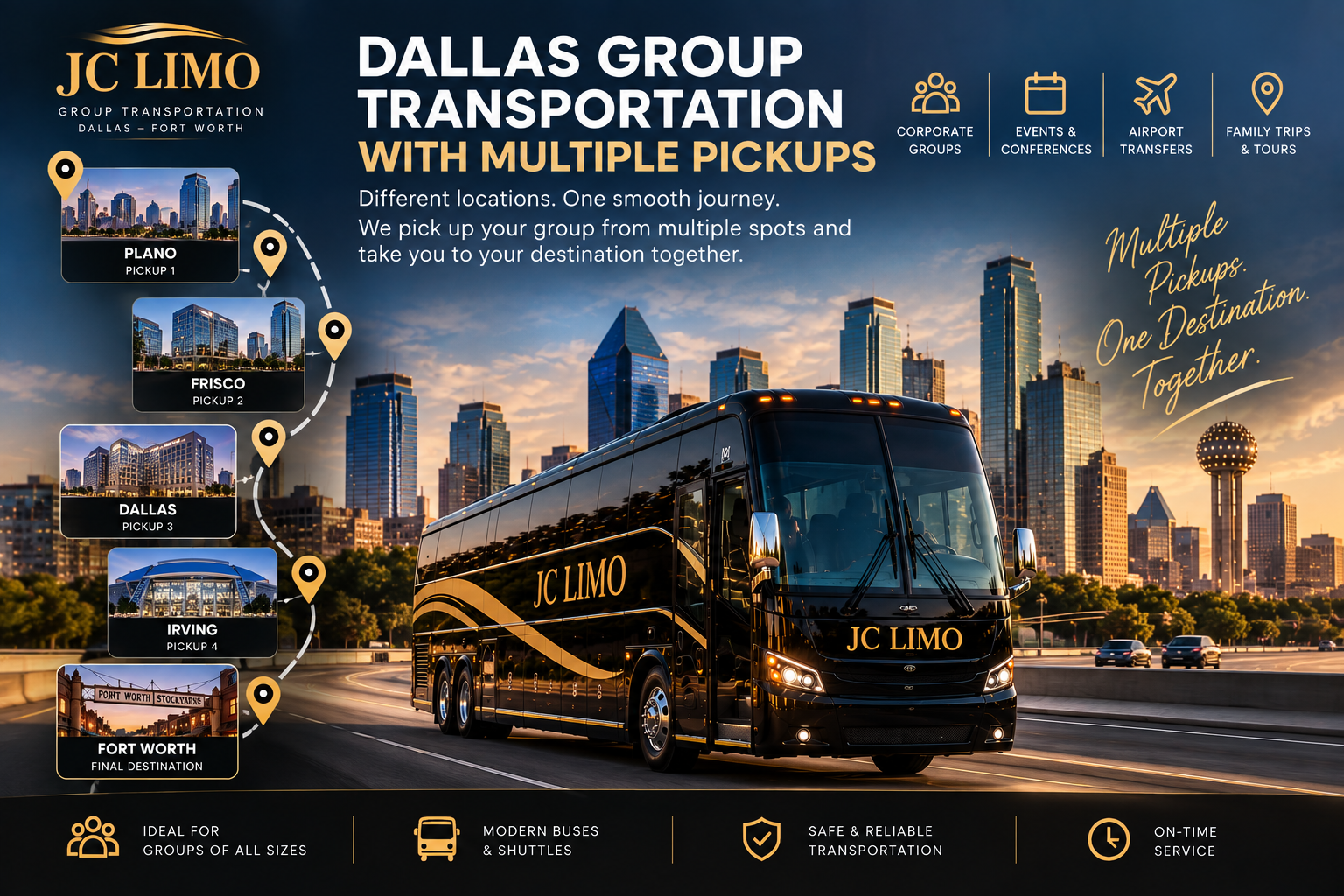
Not every group begins its journey in the same place.
A corporate team may have employees coming from several offices. Wedding guests could be staying across different areas of Dallas. A family reunion might bring relatives together from multiple neighborhoods. An event group may need to collect passengers in Dallas, Irving, and Arlington before continuing to Fort Worth.
When everyone has the same destination but different starting points, transportation becomes more than simply booking a bus.
The pickup route needs to make sense.
Times need to be realistic.
Passengers need clear instructions.
And every additional stop has the potential to affect the entire schedule.
For groups traveling across Dallas, Fort Worth, Texas, and the surrounding DFW Metroplex, professional transportation can bring those separate starting points together.
With a coordinated JC LIMO bus or shuttle, organizers can create one transportation plan that collects passengers from multiple locations and keeps the entire group moving toward the same destination.
Why Multiple Pickup Locations Are So Common
Group transportation does not always begin at a hotel.
Many real-world trips involve passengers spread across a large area.
A company may have employees working from different offices.
Conference attendees might stay at several accommodations.
Families may be staying with relatives throughout Dallas–Fort Worth.
Wedding guests could be divided between hotels and private residences.
A tour group may have participants joining from different meeting points.
The important thing is not forcing everyone to travel independently to one distant pickup location if a more practical route can be created.
Multiple pickups can make group transportation more convenient—but only when they are planned carefully.
Start by Mapping Every Pickup Point
Before choosing the order of pickups, list every location.
Do not begin by guessing which stop should come first.
Start with the complete picture.
For example:
Pickup A — Downtown Dallas
Pickup B — Irving
Pickup C — Arlington
Final Destination — Fort Worth
Once the locations are clear, the route becomes easier to evaluate.
The goal is to avoid unnecessary backtracking.
A Dallas group transportation route should generally move toward the final destination rather than repeatedly crossing the same part of the Metroplex.
Geography Matters in Dallas–Fort Worth
The DFW Metroplex covers a large area.
Two passengers can both say they are “in Dallas” while actually being a significant distance apart.
Add Fort Worth, Arlington, Irving, Plano, Frisco, Grapevine, and surrounding Texas communities, and a poorly planned pickup route can become extremely long.
This is why transportation planning should consider geography before exact pickup times are assigned.
If the first stop sends the bus away from every other passenger, the route may need to be reconsidered.
An efficient route connects pickup points logically while moving the group toward its final destination.
Don’t Add Too Many Pickup Locations
Multiple pickups can be convenient, but there is a limit.
If a 40-passenger group requests 20 individual pickup addresses, the bus could spend more time collecting people than actually traveling to the event.
In these situations, centralized meeting points may work better.
Instead of picking up every employee from home, a company might establish three convenient pickup locations.
Instead of visiting six nearby hotels, passengers may be able to meet at two central properties.
The goal is to balance convenience with efficiency.
A group transportation service works best when passengers can be consolidated into practical pickup points.
Create Pickup Hubs
One effective strategy is to create transportation hubs.
Suppose employees live throughout North Texas.
Rather than sending the bus to each person’s neighborhood, the company could establish several meeting locations based on where employees are concentrated.
For example:
North Dallas Pickup
Downtown Dallas Pickup
Arlington Pickup
The bus follows the route and collects each group.
This approach can work for corporate events, conventions, concerts, sporting events, private outings, and other large-group travel.
It gives passengers more convenient options without creating an overly complicated route.
Give Every Location a Different Ready Time
If the bus has four pickup stops, passengers should not all receive the same departure time.
Each location needs its own schedule.
For example:
7:00 AM — Pickup 1
7:25 AM — Pickup 2
7:50 AM — Pickup 3
8:15 AM — Pickup 4
9:00 AM — Final destination
This seems simple, but it prevents a common problem.
Passengers at the final pickup do not need to arrive an hour early because they were given the first location’s departure time.
Clear location-specific schedules make the entire JC LIMO shuttle route easier to understand.
Ready Time and Departure Time Are Different
If the bus is expected to leave a location at 7:30 AM, passengers should be ready before 7:30.
A better instruction might be:
Ready time: 7:15 AM
Bus departure: 7:30 AM
That creates a boarding window.
It gives passengers time to arrive, check belongings, and board without immediately putting the schedule behind.
For large groups, those extra minutes matter.
A five-minute delay at four different stops can turn into a 20-minute delay before the group reaches its destination.
One Late Passenger Can Affect Everyone
This is one of the biggest challenges with multiple pickups.
At the first stop, one person is five minutes late.
At the second stop, another passenger is ten minutes late.
The third location takes longer to board than expected.
By the time the bus reaches the final pickup, the route is already behind schedule.
Organizers should establish clear expectations before travel day.
Passengers need to understand that the bus schedule affects everyone, not only them.
For time-sensitive events, departure policies should be communicated clearly in advance.
Corporate Employee Pickups Can Simplify Event Travel
Companies frequently organize transportation for employees attending conferences, training sessions, holiday parties, corporate retreats, and other events.
Employees may be spread across different offices or parts of Dallas–Fort Worth.
Asking everyone to drive individually creates several challenges.
Employees need parking.
Arrival times vary.
Some people may be unfamiliar with the venue.
Others may prefer not to drive after a long event.
A scheduled corporate shuttle in Dallas can bring employees together before the event begins.
Multiple pickup hubs allow companies to serve different parts of the team while maintaining one coordinated transportation program.
Multiple Offices Can Share One Transportation Plan
Some businesses operate from several offices across North Texas.
If employees from those offices are attending the same event, the locations themselves can become natural pickup points.
For example, the JC LIMO bus could begin at one office, continue to a second location, and then travel to the final venue.
This eliminates the need to create unfamiliar meeting points.
Employees already know where the offices are and where to wait.
The same concept can work for school campuses, community centers, hotels, churches, and other established locations.
Wedding Guests May Need Several Pickup Areas
Wedding transportation can also involve multiple starting points.
Some guests may be staying at the main wedding hotel.
Others may be at another property.
Family members might be staying elsewhere.
The wedding party may have its own schedule.
Rather than asking every guest to find the ceremony independently, scheduled wedding shuttles can connect selected pickup locations with the venue.
The key is avoiding an excessive number of stops.
If several hotels are close together, one central pickup may be more practical.
If they are far apart, separate shuttle routes might work better.
Large Events May Need More Than One Bus
One bus does not always need to collect everyone.
For very large groups, several buses can operate from different areas.
Imagine 120 passengers attending an event in Fort Worth.
One shuttle could serve Dallas.
Another could collect passengers from Plano and North Dallas.
A third might serve Arlington and Irving.
All three buses then travel toward the same event.
This can be much more efficient than sending one vehicle across the entire Metroplex before the event even begins.
Consider Passenger Numbers at Every Stop
Not all pickup points require the same amount of time.
A stop collecting five passengers may be quick.
A location where 35 passengers are boarding will take longer.
The schedule should reflect that difference.
Organizers should know approximately how many people are expected at each location.
This information also helps with passenger counts.
If Pickup A should have 12 passengers but only 11 board, the group leader knows immediately that someone is missing.
Use Group Leaders at Major Pickup Locations
For larger trips, assigning one person to each pickup point can make the process much smoother.
The group leader can:
confirm passengers have arrived,
keep everyone near the loading area,
assist with headcounts,
communicate delays,
and make sure passengers are ready when the bus arrives.
This prevents the driver or main organizer from needing to locate individuals at every stop.
It is a simple strategy that can save time.
Choose Pickup Locations a Bus Can Actually Access
A convenient meeting point for a car is not necessarily convenient for a large bus.
Narrow streets, small parking areas, restricted entrances, low clearances, and heavy traffic can make some locations impractical.
When choosing pickup points, think about the vehicle.
Hotels, offices, event venues, and established commercial loading areas can often be easier than random street corners.
The pickup location should allow passengers to board safely without creating unnecessary complications for the route.
Airport Pickups Require a Different Approach
Airports create their own transportation considerations.
Passengers may arrive at different times or terminals.
In this case, “multiple pickups” may actually mean several airport arrival groups rather than several addresses around Dallas.
The schedule should account for:
flight arrival times,
baggage collection,
terminal locations,
passenger numbers,
and possible delays.
Airport transportation should not be planned as though passengers are waiting at a hotel entrance ready to board.
They may need additional time before reaching the designated transportation area.
Luggage Adds Time at Every Pickup
If passengers are traveling with luggage, each stop may take longer.
A corporate group boarding with only personal bags can load quickly.
An airport group with 25 suitcases cannot.
Luggage needs to be placed appropriately before the bus continues.
The same applies to sports equipment, event supplies, musical instruments, or other belongings.
When planning Dallas bus transportation, organizers should consider what passengers are bringing as well as how many people are boarding.
Fort Worth Destinations Need Smart Route Planning
If the final destination is Fort Worth, Texas, the pickup route should ideally progress westward when geography allows.
For example, collecting passengers in Dallas, then Arlington, then continuing toward Fort Worth may make sense.
Collecting passengers in Arlington, traveling back to far North Dallas, and then heading toward Fort Worth would likely create unnecessary mileage.
The same principle works in reverse for groups traveling from Fort Worth toward Dallas.
The route should generally move toward the destination rather than away from it.
Sporting Events Can Benefit From Central Pickups
Sporting events can generate heavy traffic and parking demand.
Instead of dozens of passengers driving separately, a group can meet at several established locations and travel together.
This works well for:
company outings,
fan groups,
families,
schools,
community organizations,
and private groups.
Passengers do not need to coordinate multiple vehicles at the venue afterward.
They return to the same JC LIMO bus or shuttle and travel back according to the scheduled route.
Concerts and Entertainment Trips Work the Same Way
A group attending a concert or entertainment event may live throughout Dallas–Fort Worth.
Multiple pickup hubs can bring everyone together before reaching the venue.
The return trip can then follow a planned drop-off route.
This creates a clear beginning and end to the group experience.
It also reduces the need for every passenger to independently navigate event traffic and parking.
Don’t Forget the Return Route
Organizers sometimes carefully plan every pickup before an event but assume the return trip will simply work itself out.
It should be planned too.
Will passengers be dropped at the same locations?
Should the order be reversed?
Has anyone arranged a different return?
Does the final drop-off create unnecessary backtracking?
The most efficient return route may not always be an exact reversal of the morning route.
Review it separately.
Communicate Any Route Changes to Everyone
If a pickup time changes, do not tell only the passengers at that stop.
A delay at the first location may affect the entire route.
Everyone should receive updated timing when necessary.
Keep the message simple:
Transportation Update
Pickup 1: 7:15 AM
Pickup 2: 7:45 AM
Pickup 3: 8:10 AM
Event arrival: approximately 9:00 AM
One clear update is better than several conflicting messages.
Multi-Day Trips May Need Different Pickup Routes
Groups staying in Dallas–Fort Worth for several days may not need the same transportation pattern every morning.
Day one might involve multiple hotel pickups.
Day two could begin from one conference venue.
Day three may require airport transportation.
Each day’s route should be built around that day’s actual needs.
There is no reason to maintain a complicated multi-stop route when passengers are already together.
Keep the Route Simple Whenever Possible
A successful multiple-pickup transportation plan is not necessarily the one with the most stops.
Usually, the opposite is true.
The best route gives passengers convenient access while keeping the overall journey efficient.
That may mean asking some passengers to travel a short distance to a central meeting point.
A 10-minute trip to a pickup hub could save the entire group 30 minutes of bus travel.
Think about the experience of all passengers, not only the convenience of one stop.
One Bus Can Turn Separate Groups Into One Group
Before the first pickup, passengers may be scattered across Dallas–Fort Worth.
Some are at hotels.
Others are at offices.
Several are waiting in Arlington.
Another group may be closer to Fort Worth.
As the bus follows the route, those separate groups gradually become one.
By the time everyone reaches the final destination, the group is traveling together.
That is one of the practical benefits of organized transportation.
Coordinate Multiple Pickups With JC LIMO
A group does not need to start in one place to travel together.
With the right planning, several pickup locations can become one coordinated transportation route.
JC LIMO provides professional bus and shuttle transportation for groups throughout Dallas, Fort Worth, Texas, and the surrounding DFW Metroplex, helping connect offices, hotels, airports, events, meetings, entertainment destinations, and other locations.
Start by mapping every pickup.
Consolidate passengers when possible.
Choose locations suitable for a bus.
Give each stop its own ready and departure time.
Allow extra time for large groups and luggage.
Use group leaders at major locations.
Plan the return route separately.
And avoid adding unnecessary stops that make everyone spend more time traveling.

Related posts
 13Oct, 26
Dallas Group Transportation With Luggage and Equipment
 13Oct, 26
Dallas Group Transportation With Multiple Drop-Offs
 13Oct, 26
- October 13, 2026
- 0
- 10
