Getting employees to the right place at the right time sounds simple—until a business starts managing dozens or hundreds of people across multiple locations.
One employee drives from Dallas. Another comes from Fort Worth. Some are traveling from Plano or Frisco. Others may need to reach a remote worksite, training facility, conference venue, warehouse, corporate office, or temporary project location.
Then come the familiar challenges: traffic, limited parking, different arrival times, last-minute schedule changes, and employees trying to coordinate individual transportation.
For businesses across Dallas, Fort Worth, and North Texas, employee transportation can quickly become an operational issue rather than just a commuting question.
That’s where organized employee shuttles can help.
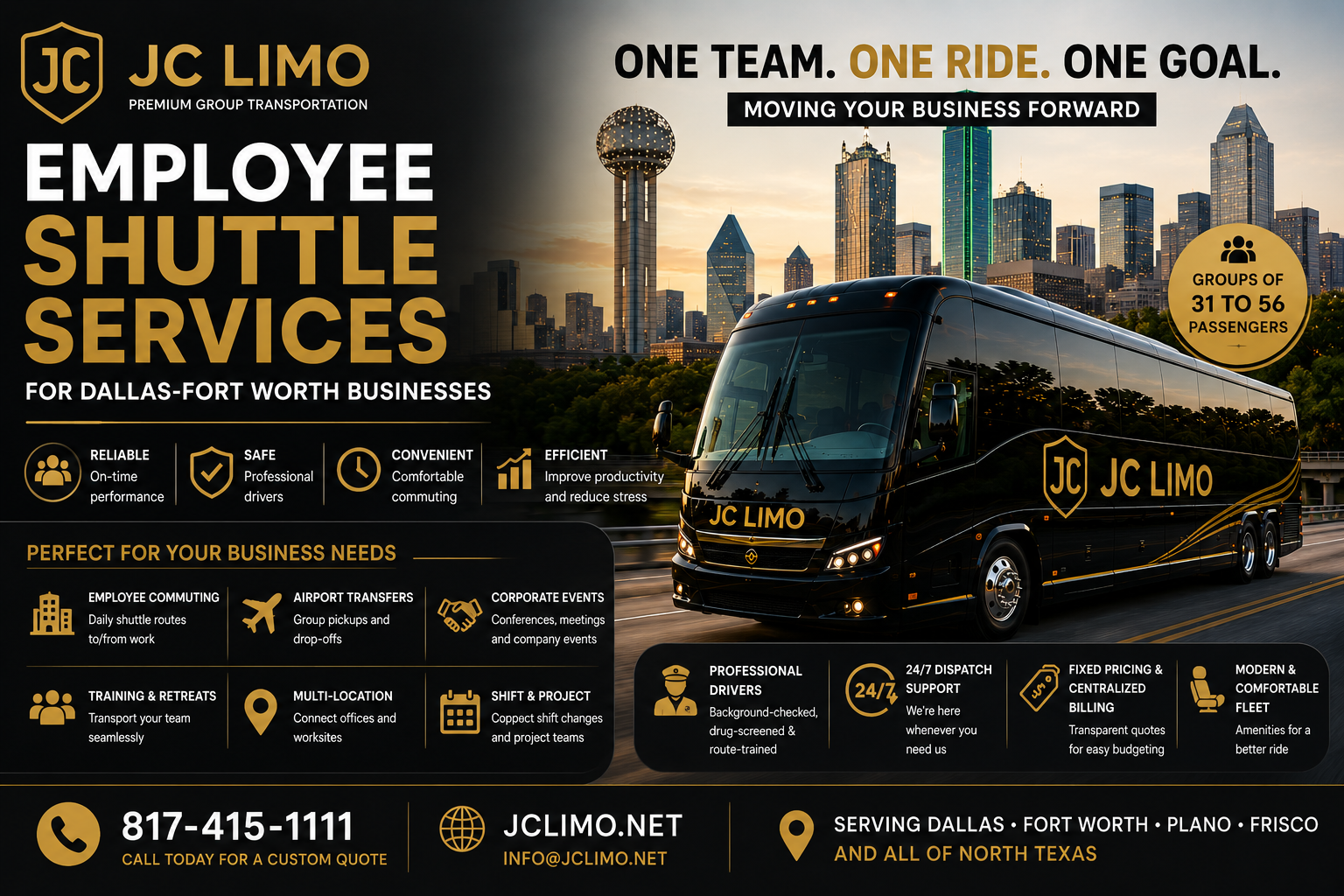
JC LIMO provides private bus transportation for companies and workforce groups throughout the DFW area. From recurring employee shuttle routes to one-time corporate transportation, businesses can build a more organized way to move their teams while reducing many of the complications associated with individual travel.
Why Employee Transportation Deserves More Attention
Transportation affects more than how someone gets to work.
It can influence punctuality, employee experience, event schedules, parking demand, and the amount of coordination required from managers.
Consider a company with 50 employees attending an off-site training program.
If everyone drives separately, the company is relying on 50 individual journeys going according to plan.
Some employees may leave early.
Others may encounter traffic.
Someone might have difficulty finding the building.
Several people could spend extra time searching for parking.
The training starts at 9:00 AM, but the full group isn’t ready until 9:20.
A private bus changes the structure.
Instead of managing 50 journeys, the business creates one transportation plan.
Employee Shuttles Can Support Different Business Needs
When people hear “employee shuttle,” they sometimes imagine only a daily commuter bus.
That’s one use, but corporate transportation can serve many different purposes.
Companies may need transportation for:
- Daily or scheduled employee routes
- Remote parking connections
- Corporate events
- Training sessions
- Conferences
- Trade shows
- Airport transfers
- Temporary worksites
- Multi-location operations
- Company celebrations
- Employee outings
The best transportation model depends on how often employees need to travel, where they’re going, and how many people are involved.
Connect Employees With the Workplace
A workforce may be spread across a large geographic area.
This is especially relevant in Dallas-Fort Worth, where employees can live in different cities throughout the Metroplex.
For some organizations, designated pickup locations can provide a centralized option for part of the workforce.
Rather than trying to create a stop for every individual employee, companies can identify practical meeting points based on their operational needs.
Employees travel to the pickup location, then complete the main journey together.
Why Central Pickup Points Can Work
Centralized pickup locations can:
- Reduce the number of required stops
- Make schedules easier to understand
- Create more predictable departure times
- Simplify route planning
- Keep groups together
The goal isn’t necessarily to replace every employee’s complete commute.
It’s to simplify the portion of the journey where centralized transportation provides the most value.
Remote Parking Shuttles Can Reduce Parking Pressure
Parking can become a serious challenge for growing companies.
An office may have been designed for 100 employees but now supports significantly more.
A temporary project might not have enough nearby parking.
A large company event may attract more vehicles than the venue can accommodate comfortably.
Remote parking combined with shuttle transportation can provide another option.
Employees park at a designated location and use a shuttle for the final part of the journey.
This can be particularly useful during:
- Major company events
- Office construction
- Temporary parking restrictions
- Large meetings
- Seasonal demand
- Special projects
Instead of trying to squeeze more cars into a limited area, the business manages the movement of people.
Transportation for Warehouses and Industrial Locations
Not every workplace is located in a central business district.
Warehouses, manufacturing facilities, distribution centers, construction sites, and other operational locations may be situated away from convenient transportation options.
For these businesses, workforce transportation can become part of daily operational planning.
A private bus can connect a designated pickup location with the worksite based on scheduled shift times.
Shift Timing Makes Reliability Important
Operational teams often work according to defined shifts.
If one shift starts at 7:00 AM, employees need to be ready before operations begin.
Individual transportation creates different arrival times.
A coordinated shuttle route can create a more structured schedule for employees using the service.
The same principle can apply when transporting workers back to the designated drop-off point after the shift.
Construction Workforce Transportation
Large construction projects can involve significant numbers of workers traveling to the same location.
Parking near the project may be limited.
Site access may also require careful coordination.
Workforce shuttle transportation can help move employees from an approved meeting or parking location to the jobsite.
For project managers, this can reduce the number of individual vehicles that need to reach the work area.
It also creates clearer arrival and departure schedules for the groups using the shuttle.
Corporate Campus Transportation
Larger organizations may operate across several buildings or facilities.
Employees might need to move between:
- Office buildings
- Training centers
- Parking areas
- Meeting facilities
- Event spaces
- Partner locations
If these movements happen frequently, asking employees to drive their own vehicles every time can be inefficient.
A corporate shuttle can connect important locations according to a planned schedule.
This allows the company to treat transportation as part of the campus infrastructure rather than a separate problem for every employee.
Hotel-to-Office Transportation for Visiting Teams
Dallas-Fort Worth attracts business travelers from across the country and around the world.
Companies may bring teams to Texas for:
- Training
- Corporate meetings
- Conferences
- Project launches
- Temporary assignments
- Client engagements
If a visiting group is staying at the same hotel, arranging transportation between the hotel and workplace can simplify the trip considerably.
Instead of asking every visitor to book a ride each morning, the company can establish one departure.
For example:
7:30 AM – Hotel meeting time
7:45 AM – Shuttle departure
8:15 AM – Office arrival
5:30 PM – Office pickup
6:00 PM – Hotel return
Visitors receive one clear plan.
Airport Transportation for Employees and Executives
Business transportation often begins before anyone reaches the office.
A company may need to collect employees, executives, clients, or partners from DFW International Airport or Dallas Love Field.
For larger groups, arranging multiple individual rides can create unnecessary complexity.
A private shuttle or bus can connect the airport with:
- Corporate offices
- Hotels
- Conference centers
- Training locations
- Event venues
When luggage and multiple passengers are involved, planning this transportation in advance can make the arrival process more organized.
Employee Transportation for Conferences
Companies frequently send teams to conferences and conventions across DFW.
If 30 employees are staying at the same hotel and attending the same event, arranging 10 or 15 separate rides every morning may not make much sense.
A private shuttle creates a central schedule.
The team leaves together and arrives together.
This can also be helpful after the conference when employees need transportation to a company dinner or networking event.
Think About the Entire Conference Day
A transportation schedule might include:
Hotel → Convention Center
Convention Center → Client Dinner
Restaurant → Networking Event
Networking Event → Hotel
By planning the full itinerary, companies avoid rebuilding their transportation solution several times during the same day.
Trade Show Teams Have Unique Requirements
Trade show transportation often involves early mornings and long days.
Employees may need to reach the venue before regular attendees for booth setup.
At the end of the day, teams may remain behind to organize materials.
There could also be client dinners and evening meetings.
This means standard event transportation isn’t always enough.
The shuttle schedule needs to reflect the team’s actual working hours.
When requesting transportation, companies should provide detailed timing rather than simply giving the official event schedule.
Company Events Should Start at the Office, Not the Venue
Company celebrations and employee events are supposed to bring teams together.
Why wait until everyone reaches the venue?
For many businesses, transportation can begin from the office.
Employees meet at a designated time, board the bus, and travel to the event together.
This can work well for:
- Holiday parties
- Annual celebrations
- Team-building activities
- Award ceremonies
- Employee appreciation events
- Corporate retreats
The journey becomes part of the shared experience.
Training Programs Need Organized Arrivals
Training sessions often depend on everyone beginning at the same time.
When attendees arrive gradually, trainers may have to delay the program or repeat information for late participants.
For large employee groups, scheduled transportation can support a more organized start.
This becomes even more useful when training takes place somewhere unfamiliar to employees.
Instead of sending directions to dozens of people, the company can provide one pickup location and one departure schedule.
Multi-Location Businesses Can Connect Their Teams
Some companies operate several offices or facilities throughout Dallas-Fort Worth.
Employees may occasionally need to move between them for:
- Meetings
- Training
- Project work
- Company events
- Operational support
A planned shuttle can connect these locations when enough employees are traveling together.
For example:
Fort Worth Office → Arlington Facility → Dallas Headquarters
Instead of employees driving separately, the company can coordinate one group movement.
Employee Shuttles Can Reduce Administrative Friction
Individual business travel creates administrative work.
Employees may submit:
- Mileage claims
- Parking receipts
- Rideshare expenses
- Taxi receipts
- Tolls
For occasional travel, this may be manageable.
For a large group moving repeatedly, it can create significant administrative clutter.
Centralized transportation provides a clearer structure.
JC LIMO offers fixed pricing and centralized billing, allowing companies to treat group transportation as one planned expense rather than dozens of individual transactions.
Better Transportation Can Support Punctuality
No transportation solution can eliminate traffic.
Dallas-Fort Worth roads are still Dallas-Fort Worth roads.
But centralized transportation can remove some variables from the process.
If 40 employees drive separately, there are 40 different departure decisions and routes.
With one bus, there is one primary group journey.
Companies can establish:
Meeting time → Boarding time → Departure time → Target arrival
This makes transportation easier to communicate and manage.
Communication Is Essential for Employee Shuttle Programs
Even the best transportation plan can fail if employees don’t understand it.
Businesses should clearly communicate:
- Pickup location
- Meeting time
- Departure time
- Expected destination
- Return schedule
- Important route instructions
- Contact procedure when appropriate
Avoid telling employees only that the “bus comes at 7:30.”
Does that mean they should arrive at 7:30?
Or does the vehicle depart at 7:30?
Make the difference clear.
For example:
Meet by 7:15 AM. Bus departs at 7:30 AM.
Small details can prevent unnecessary delays.
Match the Vehicle to Your Workforce
Employee transportation should be built around actual passenger numbers.
Sending a vehicle that’s too small creates an obvious problem.
Using significantly more capacity than required may also be inefficient.
JC LIMO provides options ranging from approximately 31-passenger minibuses to 56-passenger motor coaches, giving businesses flexibility for groups of different sizes.
Minibuses
A minibus may be suitable for:
- Department outings
- Smaller employee groups
- Airport transfers
- Executive teams
- Training groups
- Smaller shuttle movements
Larger Motor Coaches
Larger buses can support:
- Company-wide events
- Large workforce groups
- Conferences
- Major training sessions
- Corporate outings
Passenger count should always be one of the first details discussed when planning transportation.
Think About More Than Passenger Count
A group of 40 employees traveling to a company dinner has different needs from 40 employees arriving at DFW Airport with luggage.
When requesting transportation, communicate the complete requirements.
Include:
- Number of passengers
- Pickup location
- Destination
- Date
- Required arrival time
- Return schedule
- Number of stops
- Luggage or equipment
- Frequency of service
- Any special operational considerations
These details help create a transportation plan based on the real trip.
Professional Drivers Keep Employees Focused on Work
When businesses rely on employee vehicles for group travel, someone still has to drive.
That employee’s responsibility shifts from participating in the group to navigating traffic and parking.
Professional transportation removes that responsibility.
JC LIMO drivers are background-checked, drug-screened, and route-trained.
Employees can use the journey to talk with colleagues, review information, prepare for meetings, or simply travel without needing to focus on the road.
24/7 Dispatch Support Matters for Business Transportation
Business schedules change.
Flights are delayed.
Meetings run long.
Events finish early.
A shift schedule changes.
A conference extends beyond its expected finish.
Transportation needs to exist in the real world, where plans don’t always stay exactly as originally written.
JC LIMO provides 24/7 dispatch support, giving companies a transportation contact when schedules require attention.
For multi-stop trips and large employee movements, this operational support can be especially valuable.
Recurring Shuttle Service Requires Careful Planning
A one-time employee event and a recurring shuttle route are different transportation challenges.
For recurring service, companies should evaluate how employees actually use the route.
Consider:
- Most practical pickup locations
- Shift times
- Passenger demand
- Number of required movements
- Workplace access
- Traffic patterns
- Return schedules
The goal should be to create a service that fits real workforce behavior rather than designing a route based only on what looks convenient on a map.
Review the Transportation Plan as the Business Changes
A shuttle program shouldn’t necessarily remain identical forever.
Businesses change.
Teams grow.
Office locations move.
Work schedules shift.
Passenger demand changes.
Companies should periodically review transportation requirements and ask whether the current setup still makes sense.
A route designed for 25 employees may need adjustment when 50 people begin using it.
Transportation should evolve with the organization.
Employee Transportation Is Part of the Workplace Experience
Businesses invest heavily in the employee experience inside the workplace.
They improve offices.
Introduce better technology.
Plan company events.
Develop training programs.
Create employee benefits.
Transportation can be part of that experience too.
When a company provides organized transportation for the situations where employees need it most, it removes another point of friction from the day.
For visiting employees, it can make an unfamiliar city easier to navigate.
For event attendees, it can make the day more organized.
For large teams, it can create a clearer schedule.
Move Your DFW Workforce With One Clear Plan
Dallas-Fort Worth businesses operate across a large and constantly moving metropolitan area.
Employees may need to reach offices, hotels, airports, construction sites, warehouses, training facilities, conferences, corporate events, and other locations throughout North Texas.
When everyone travels independently, transportation becomes fragmented.
Private employee shuttles and group buses provide a more centralized option.
With more than 15 years serving Dallas, Fort Worth, Plano, Frisco, and surrounding DFW communities, JC LIMO provides professional group transportation for businesses with different workforce needs.
From one-time company events to recurring employee transportation, airport transfers, training programs, conferences, and multi-location travel, the goal is simple:
Get the group where it needs to be with a transportation plan that’s easier to manage.

Related posts
 24Aug, 26
 Why Groups Choose JC LIMO in Dallas Fort Worth Texas – Copy – Copy – Copy
 24Aug, 26
 Top Group Transportation Services in Dallas Fort Worth Area – Copy – Copy – Copy
 24Aug, 26